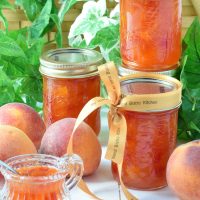
Peach Marmalade
Ingredients
- 7 large peaches, washed
- Zest of one orange
- 1 medium-sized orange, seeded and chopped into small pieces
- Zest of ½ lemon
- ½ medium-sized lemon, seeded and chopped into small pieces
- 1/3 cup maraschino cherries, chopped
- 1½ tbsp Peach Schnapps (optional) or ½ tsp almond flavoring (optional)
- Granulated sugar equal to weight of fruit pulp
Instructions
-
Wash canning jars and lids in hot soapy water. Rinse. Drain jars.
-
Fill a large-sized stockpot about two-thirds full of hot tap water. Fit stockpot with wire rack. Place the jars, on the rack, upright and in single layer, into the water. Use more than one stockpot if necessary to accommodate all jars needed for the recipe. Do not stack jars on top of each other in stockpot. Ensure the jars are fully submerged, each jar filled with water, and that the water is at least an inch over the tops of the jars, adding more if necessary. Cover, bring to a boil over medium-high heat, then reduce heat slightly and boil gently for 10 minutes. Turn off heat and leave the jars in the hot water to have ready to fill once the marmalade is ready.
-
Heat 2-3 cups of water in saucepan over medium-high heat. When boiling, reduce heat to low and, one at a time, plunge peaches in boiling water for about 1 minute to loosen skin. Peel each peach as soon as it comes out of the hot water. Halve the peaches and remove and discard stones. Dice the peaches into small pieces, about ½“ in size.
-
Place cut-up peaches in large measuring cup or bowl. Add the chopped orange and lemon along with the orange and lemon zest. Weigh the amount of fruit and use the same weight of granulated sugar. For example, if the total amount of the pulp equals 1 pound, then 1 pound of sugar will be required.
-
Place pulp and sugar into a medium-sized stockpot. Stir. Bring mixture to a boil over medium-high heat, stirring frequently to prevent scorching. Immediately reduce heat and cook, uncovered, at a slow gentle boil until mixture thickens and reaches a temperature of 217°F on a candy thermometer (see Note below for alternative method for testing marmalade doneness). Stir mixture frequently to prevent scorching. Be patient, this can be expected to take an hour or so. The marmalade may be cooked to a temperature of 220°F but it will be a thicker marmalade and less pliable to spread than if it is cooked to 217°F.
-
When the marmalade has been cooking for about 20-30 minutes, fill the hot water canner about half full of hot tap water. Cover and bring to a boil over medium-high heat to have it ready for processing of the filled jars. Reduce heat to keep canner water hot.
-
When marmalade has reached 217°F (or 220°F, if you wish) , remove the stockpot from heat and skim off any foam that may still remain on the marmalade. Stir in cherries and Peach Schnapps (or almond flavoring), if using.
-
Boil a kettle of water to have ready, if needed, to top up water levels in the canner once the filled jars are added.
-
Use jar lifter tongs to carefully remove the hot sterilized jars from the water, one at a time, emptying the water from the jars back into the pot. Drain jars well and place on heat-proof board. Do be very careful as this is scalding hot water.
-
Using a ladle, or a heat-proof glass measuring cup, and a wide-mouthed canning funnel, fill the hot sterilized jars with the marmalade, leaving about ¼” headroom in each jar to allow for expansion during the hot water processing. Remove any trapped air bubbles in the jars with a chopstick or small heatproof spatula. Add more marmalade to jars, if necessary, to bring marmalade up to ¼“ from jar rims. Wipe the jar rims with a clean damp cloth to remove any stickiness that could prevent the lids from sealing properly to the jars.
-
Center the lids on jars so the sealing compound on the lid edges aligns with the jar rims. Fingertip tighten the ring/screw bands until resistance is encountered. Do not over-tighten.
-
Using jar lifter tongs, carefully place filled jars upright in wire basket positioned in the canner, ensuring jars do not touch each other or fall over. If a canner is not completely full of filled jars, add enough hot empty jars to fill it to capacity to prevent filled jars from toppling over during processing. Make sure the empty jars are already hot as cold jars immersed in boiling hot water are likely to crack. Let the empty jars fill with water from the canner as they are submerged.
-
Ensure the water level is at least 1” above the tops of jars, adding more boiling water as necessary. Cover with canner lid. Increase the heat to return the water to a full rolling boil then decrease the heat to just keep the water at a moderately rolling boil but not boiling over. Process jars in the hot water bath for 10 minutes, adjusting time as and if necessary for altitude. Start timing the processing from the point at which a full rolling boil is reached after jars have been added to the canner. At the end of the processing time, turn off heat and remove canner lid.
-
Let jars sit in the hot water for 5 minutes then, using jar lifter tongs, carefully remove the jars filled with marmalade, one at a time, upright and without tipping them over, and transfer them to a heat-proof cutting board, that has been covered with a towel, to cool completely. Listen for the “pop” or “ping” sound as the bottles seal over the next few minutes or hours. The lids of properly sealed jars will curve downward.
-
Cover jars with a towel to keep light out and let jars rest, undisturbed, on counter for 24 hours. Then, test each jar for proper sealing by very lightly pressing down on the center of each jar lid. If the lid is already pressed downward, and does not pop back up, it is properly sealed. Any jars that do not pass this test should be refrigerated and the marmalade used within a week or so.
-
Store properly sealed marmalade bottles in cool, dark place and allow to rest for at least 1-2 weeks to allow flavor to fully develop before opening. Use marmalade within 1 year of bottling. Refrigerate marmalade once jar has been opened.
Recipe Notes
Yield: Apx. 5 half-pints
*Note that it is difficult to give a precise cooking time for the marmalade since various factors, including the pectin level of the fruit and heat level of stove, can vary significantly and may affect cooking and marmalade-setting times. If you don’t have a candy thermometer or instant read thermometer to check doneness of marmalade at 217°F-220°F, place 2-3 freezer-proof saucers in the freezer before beginning to cook the marmalade. To test for doneness, place a small amount of marmalade on chilled saucer and swirl saucer around. Let marmalade sit, untouched, for about a minute, then gently push your finger through the marmalade. If the marmalade holds its shape (i.e., does not run back together after the finger has been removed from the marmalade), it is set and ready to bottle. If not, continue to cook mixture, repeating the “chill” test about every 3 minutes or so (always removing the pot from the heat while conducting the chill test) until the marmalade passes the “chill” test. Do not overcook as it will result in a very thick marmalade, dark in color.
It is recommended that the first “chill” test be conducted somewhere around the 45-50 minute point in the cooking process. It does not necessarily mean that the marmalade will be done in that timeframe and more than one “chill” test may need to be performed.
[Copyright My Island Bistro Kitchen]