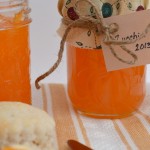
Zucchini Jam
Ingredients
- 6 cups grated fresh zucchini (peel and inner membrane matter removed before grating)
- 6 cups granulated sugar
- 1 cup canned crushed pineapple, with juice
- 3 tbsp bottled lemon juice
- 1 tbsp bottled lime juice
- 1 (85g) pkg orange jello powder
- 1 (85g) pkg lemon jello powder
Instructions
-
Wash canning jars and lids in hot soapy water. Rinse. Drain jars.
-
Fill a large-sized stockpot about two-thirds full of hot tap water. Fit stockpot with wire rack. Place the jars, on the rack and upright and in single layer, into the water. Use more than one stockpot if necessary to accommodate all jars needed for the recipe. Do not stack jars on top of each other in stockpot. Ensure the jars are fully submerged, each jar filled with water, and that the water is at least an inch over the tops of the jars, adding more if necessary. Cover, bring to a boil over medium-high heat, then reduce heat slightly and boil gently for 10 minutes. Turn off heat and leave the jars in the hot water to have ready to fill once the jam is cooked and ready for bottling.
-
Check the capacity of your canner. Though it is difficult to say with certitude exactly how much jam this recipe will yield (see Note 1 below), the recipe can be expected to yield 7 – 8 half-pint jars that need to be hot water processed immediately upon them being filled with jam. If your canner cannot accommodate this number of jars all at the same time, two canners will need to be in operation at the same time and more empty jars than indicated will need to be used to fill up empty spaces in the second canner. Fill the hot water canner(s) about half full of hot tap water. Cover and bring to a boil over medium-high heat to have ready for processing of the filled jars. Reduce heat to keep canner water hot.
-
Peel zucchini and slice it, lengthwise, into quarter strips. If zucchini is particularly large, slice again into thinner strips manageable for grating. Remove inner membrane matter. Either using a grater or food processor, grate enough zucchini to make 6 cups, loosely packed.
-
Place zucchini and sugar in stockpot and stir well. Let sit for 10 minutes to allow the sugar to dissolve into the grated zucchini. Bring mixture to boil, uncovered, over medium heat Cook for 15 minutes, stirring frequently. Reduce heat slightly if jam is boiling too vigorously.
-
Stir in pineapple and the lemon and lime juices. Return mixture to a boil. Boil, uncovered 5-6 minutes, stirring frequently. Skim off, and discard, any foam that may form.
-
Add the orange and lemon jello powders, stirring until incorporated and the jellos dissolved, about 1 minute. Remove from heat and skim off and discard any remaining foam.
-
Boil a kettle of water to have ready, if needed, to top up water levels in the canner once the filled jars are added.
-
Use jar lifter tongs to carefully remove the hot sterilized jars from the water, one at a time, emptying the water from the jars back into the pot. Drain jars well and place on heat-proof board. Do be very careful as this is scalding hot water.
-
Using a ladle, or a heat-proof glass measuring cup, and a wide-mouthed canning funnel, fill the hot sterilized jars with the jam, leaving about ½“ headroom in each jar to allow for expansion during the hot water processing. Remove any trapped air bubbles in the jars with a chopstick or small heatproof spatula. Add more jam to jars, if necessary, to bring jam up to ½“ from jar rims. Wipe the jar rims with a clean damp cloth to remove any stickiness that could prevent the lids from sealing properly to the jars.
-
Center the lids (See Note 2 below) on jars so the sealing compound on the lid edges aligns with the jar rims. Fingertip tighten screw bands/rings until resistance is encountered. Do not over-tighten.
-
Immediately upon jars being filled with jam, use jar lifter tongs to carefully place filled jars upright in wire basket or rack positioned in the canner, ensuring jars do not touch each other or fall over. If a canner is not completely full of filled jars, add enough hot empty jars to fill it to capacity to prevent filled jars from toppling over during processing. Make sure the empty jars are already hot as cold jars immersed in boiling hot water are likely to crack. Let the empty jars fill with water from the canner as they are submerged.
-
Ensure the water level is at least 1” above the tops of jars, adding more boiling water as necessary. Cover with canner lid. Increase the heat to return the water to a full rolling boil then decrease the heat to just keep the water at a moderately rolling boil but not boiling over. Process jars in the hot water bath for 10 minutes (see Note 3 below), adjusting time as and if necessary for altitude. Start timing the processing from the point at which a full rolling boil is reached after jars have been added to the canner. At the end of the processing time, turn off heat and remove canner lid.
-
Let jars sit in the hot water for 5 minutes then, using jar lifter tongs, carefully remove the jars filled with jam, one at a time, upright, and transfer them to a heat-proof cutting board, that has been covered with a towel, to cool completely. Listen for the “pop” or “ping” sound as the bottles seal over the next few minutes or hours. The lids of properly sealed jars will curve downward.
-
Cover jars with a towel to keep light out and let jars rest, undisturbed, on counter for 24 hours. Then, test each jar for proper sealing by lightly pressing down on the center of each jar lid. If the lid is already pressed downward, and does not pop back up, it is properly sealed. Any jars that do not pass this test should be refrigerated and the jam used within a week or so.
-
Store properly sealed jam bottles in cool, dry, dark place and allow to rest for at least 1-2 weeks to allow flavor to fully develop before opening. Refrigerate jam once jar has been opened.
Recipe Notes
Yield: Apx. 7 – 8 half-pint jars
[Copyright My Island Bistro Kitchen]
NOTE 1: Exact amount of jam is difficult to predict as it depends on many factors including the age and quality of zucchini, how fine/coarse the zucchini is grated, how loosely/firmly the grated zucchini is packed for cup measurement, stove temperature at which jam is cooked, etc.
NOTE 2: While, historically, the lids (with the orange-rust colored gasket on their underside) were preheated in simmering hot water for 1-2 minutes to soften the lid gasket before applying the lids to the hot jars, Bernardin® (the company that manufactures canning lids available in Canada) is now (2024) saying that preheating their particular brand of lids is no longer necessary to provide a proper seal as the sealing compound they use in their lid manufacturing performs better at room temperature. They recommend washing the lids in hot soapy water, rinsing them, and setting the lids aside until needed in the canning process.
Note this pertains specifically to the Bernardin® brand of lids. Other manufacturers’ lids may differ so, if you are using another brand of lids, do check the manufacturer’s instructions for lid preparation of their particular brand lids. Typically, if the lids need to be preheated, the method is simply to place the lids in a small pan of simmering hot water over low heat just long enough to heat the rubber piece. This doesn't take longer than a minute or two at most. Do not boil the lids.
NOTE 3: Using jars other than the size indicated in the recipe (half-pint) will require adjustment to the hot water processing time of 10 minutes.