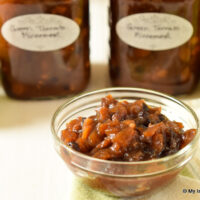
Green Tomato Mincemeat
Ingredients
- 4 pounds whole green tomatoes, washed, seeds and gelatinous sacs removed, and diced small (Note: Tomatoes are weighed whole, before being cut up)
- 2 pounds tart, firm-fleshed apples (e.g., Granny Smith), washed, peeled, cored, and diced small (Note: Apples are weighed whole before being cored and cut up)
- 1 Bosc pear, washed, peeled, cored, and diced small
- 1 cup sultana raisins
- 1 cup golden raisins
- 1½ cups mixed diced candied peel, diced candied citron, or a combination of both
- ¾ cup currants
- 1¾ cups brown sugar, firmly packed
- 1¼ cups granulated sugar
- ¾ tsp salt
- 1 tbsp cinnamon
- 1½ tsp nutmeg
- 1 tsp allspice
- 1 tsp cloves
- ¼ tsp ginger
- 1/8 tsp mace (optional)
- 1 cup apple juice
- ½ cup apple cider vinegar
- ¼ cup molasses
- 2½ tbsp freshly squeezed and strained lemon juice
- ½ cup butter, room temperature
- 2 tsp finely grated orange rind
- 1 tsp finely grated lemon rind
- 2/3 cup brandy or rum
Instructions
-
Wash jars in hot soapy water, first checking to ensure that the jars have no cracks or chips in them. Rinse well. Inspect the screw bands and discard any that have dents or rust on them. Use only brand-new lids for canning. Wash and rinse lids and set aside until needed. The lids give the jars the vacuum seal and are designed for single use only. Once they have been used, the rubber sealing compound is no longer considered effective for proper sealing so the lids should never be re-used. The screw bands, on the other hand, are reusable provided they have no dents or evidence of rust. Set out required pots and canner along with other equipment specified in the “Supplies and Equipment” section above.
-
Measure out the raisins, candied peel/citron, currants, sugar, salt, spices, apple juice, vinegar, molasses, and lemon juice.
-
Prepare and dice the tomatoes, apples and pear and place, along with the raisins, candied peel/citron, currants, sugars, salt, and spices, into large stockpot. Stir to mix.
-
Add the apple juice, apple cider vinegar, molasses, and lemon juice. Stir mixture well to combine. Bring just to the boiling point over medium-high heat then reduce heat to keep mixture at a low, very gentle, steady boil. Cook mixture, uncovered, for a total of approximately 2 – 2½ hours, or until thickened, stirring regularly to ensure it is not sticking to the pot. Adjust heat, if necessary, to ensure the mixture does not burn or scorch. Mixture should be thick yet moist but not thin/runny when it is ready to be bottled.
-
After the mincemeat has been simmering for about 1½ hours, start sterilizing the bottles and preparing the hot water canner. Fill a large pot of hot tap water, about ¾ full. Place pint jars upright, into the water (include 1-2 extra jars in case they are needed to take up space in the canner so the filled jars do not topple over during processing). Ensure the jars are fully submerged, each jar filled with water, and that the water is at least an inch over the tops of the jars. Cover, bring to a boil, and boil for 10 minutes. Turn off heat and leave the jars, covered, in the hot water to have ready to fill once the mincemeat finishes cooking.
-
While the jars are sterilizing, fill the canner about half full of hot tap water. Cover and bring to a boil to have it ready for processing of the filled jars as they must immediately go into the canner to be processed while the mincemeat is still hot. Reduce heat to keep canner water hot until needed. When the mincemeat is ready to bottle, boil a kettle of extra water to have ready, if needed, to top up the canner water with boiling water after filled jars are added.
-
When mincemeat is cooked and thickened, remove from heat and stir in the butter and orange and lemon rind along with the brandy or rum.
-
Use jar lifter tongs to carefully remove 6 of the hot sterilized jars from the water, one at a time, emptying the water from the jars back into the pot. Drain jars well.
-
Using a ladle, or a heat-proof glass measuring cup, and a wide-mouthed canning funnel, transfer mincemeat into the hot sterilized jars, leaving 1/2” headroom in each jar to allow for expansion during the hot water processing. Remove any trapped air bubbles in the jars with a chopstick or small heatproof, non-metallic spatula. Add more mincemeat, if necessary, to top up the jars to ½“ from rim. Wipe the jar rims with a clean damp cloth to remove any stickiness or mincemeat particles that could prevent the lids from sealing properly to the jars.
-
Center washed lids on jars so the sealing compound on the lid edges aligns with the jar rims. Fingertip tighten the ring/screw bands until resistance is encountered. Do not over-tighten.
-
Using jar lifter tongs, carefully place filled jars upright in wire basket positioned in the canner, ensuring jars do not touch each other or fall over. If necessary, depending on your style of canner, and how many filled jars of mincemeat there are, add the extra hot empty jar(s), upright, to the basket to fill up space so the filled jars do not topple over. Let the empty jar(s) fill with water from the canner as they are submerged. Ensure the water level is at least 1” above the tops of jars, adding more boiling water as necessary. Cover with canner lid. Return the water to a full rolling boil over high heat then decrease the heat to just keep the water at a good strong rolling boil but not boiling over. Process jars in the hot water bath for 15 minutes, adjusting time as and if necessary for altitude. Start timing the processing from the point at which a full rolling boil is reached after jars have been added to the canner. At the end of the processing time, turn off heat and remove canner lid.
-
Let jars sit in the hot water for 5 minutes then, using jar lifter tongs, carefully remove the jars filled with mincemeat, upright and one at a time, and transfer them to a heat-proof cutting board, that has been covered with a towel, to cool completely. Listen for the “pop” or “ping” sound as the bottles seal over the next few minutes or hours. The lids of properly sealed jars will curve downward. Let jars rest, undisturbed, on counter for 24 hours. Then, test each jar for proper sealing by gently pressing down on the center of each jar lid. If the lid is already pressed downward, and does not pop back up, it is properly sealed. Any jars that do not pass this test should have the mincemeat transferred to a freezer container and frozen for later use or, alternatively, refrigerated when cooled and used in a recipe within a few days. Store properly sealed bottles in cool, dark place. The mincemeat benefits from maturing for at least a month before using. This allows the flavors to develop and deepen. Refrigerate any leftover mincemeat for up to 5 days once jar has been opened.
-
In lieu of hot water processing, the mincemeat may be frozen in airtight freezer containers. To freeze, allow the mincemeat to cool to room temperature then transfer into freezer containers of desired size, leaving sufficient headroom at top of each container to allow for expansion during freezing. To use, thaw mincemeat naturally and then use as directed in any recipe calling for mincemeat as an ingredient.
Recipe Notes
Yield: Apx. 10 – 12 cups
NOTE: Exact yield is difficult to project as it depends on the quality and maturity of the green tomatoes, the rate and heat at which the mincemeat is cooked, and how cooked down the mixture is. The recipe should yield 10-12 cups so prepare 6 pint jars for the canning. At the end of bottling, if there is insufficient mincemeat to completely fill another bottle, either refrigerate and use the fresh mincemeat in a recipe within a few days or freeze it for later use. Bottles should be filled to ½“ from rim when preparing them for processing in the hot water.
[Copyright My Island Bistro Kitchen]