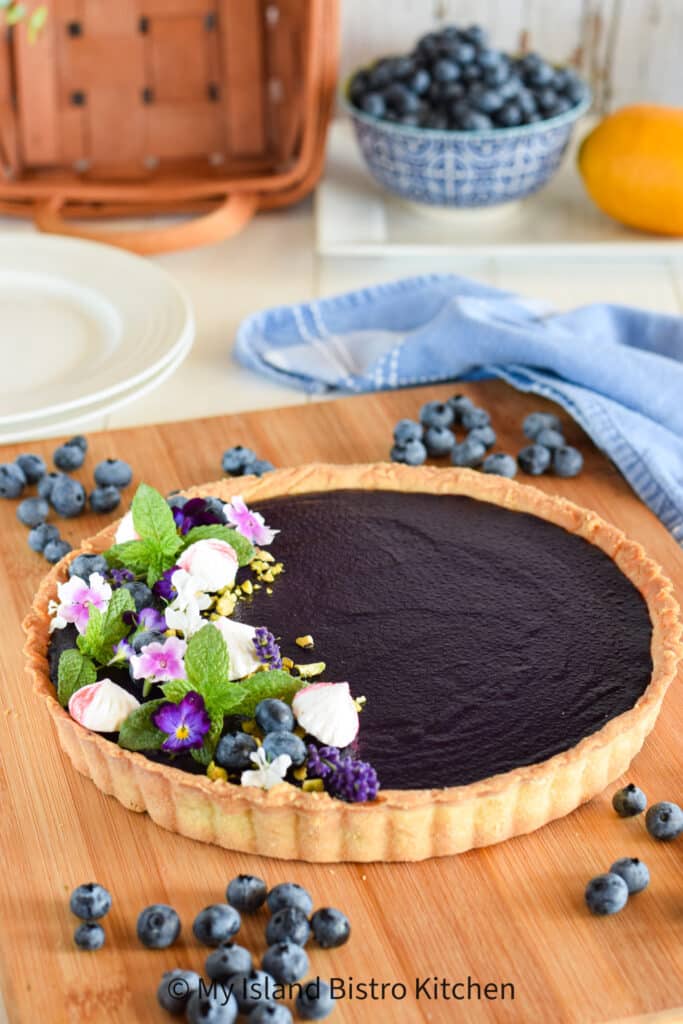
Today’s dessert is the lovely Earl Grey Blueberry and Lemon Tart. This divine tart features highbush blueberries (infused with Earl Grey tea) in a silky-smooth filling which is then placed in a buttery rich and tender Pâte Sucrée shell. Simply, this is a decadent dessert of fine restaurant quality!
In the post that accompanies my recipe for a Strawberry-Rhubarb Tart, I wrote extensively about the difference between tarts and pies and how to make Pâte Sucrée. Rather than repeat all the same information in this post, I will direct readers to the post here. If you are unfamiliar with making fruit curd tarts, I recommend taking a read or two of the afore-mentioned post.
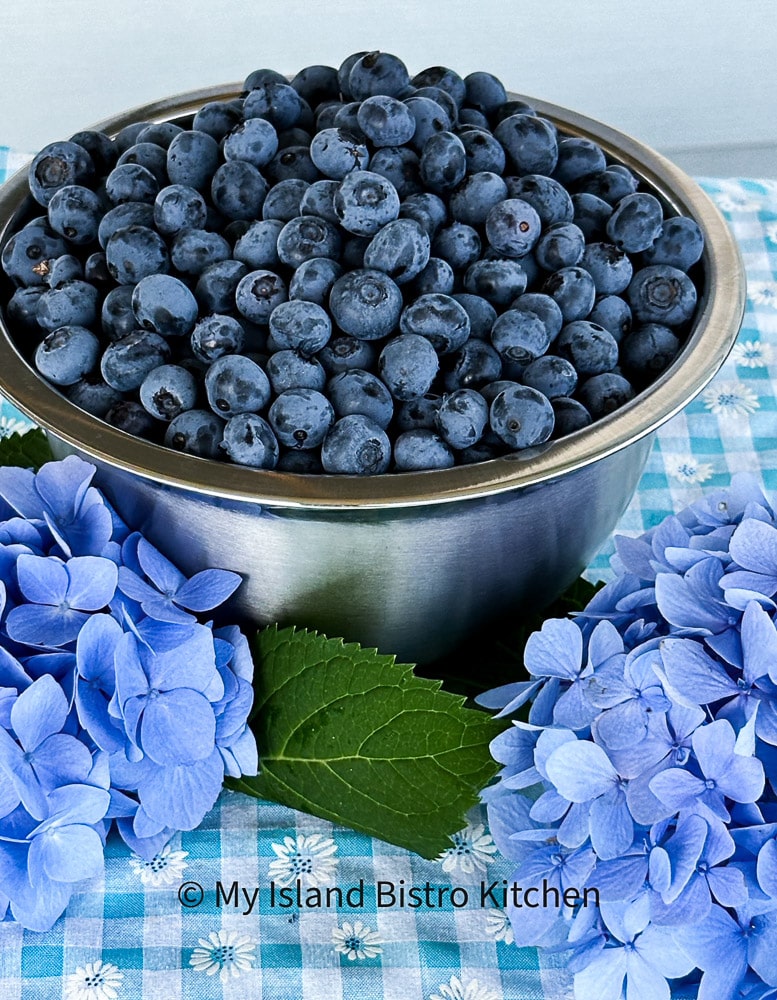
The curd filling for this tart is made with high bush blueberries, any variety. Since the berries are going to be cooked to release their juice, either fresh or frozen berries can be used. One-half cup of the combined blueberry-lemon juice will be required for this recipe. Six ounces/171 grams of blueberries should be sufficient, when combined with the lemon juice, and after cooking and straining, to equal one-half cup. If you are uncertain of the quality of the berries, you may wish to cook an additional ounce of blueberries to ensure you have enough juice for the recipe. Regardless how much juice strains out from the cooked blueberry-lemon mixture, only use ½ cup of the juice as otherwise, the filling may be too soft and runny and it may be too much filling for the pan capacity.
The purpose of the Earl Grey teabag is to infuse the filling with the tea’s floral and citrusy notes which add to the flavor profile of the tart. Slightly dampen the teabag with water to start the release of the tea flavor when it is placed in the saucepan with the blueberries and lemon juice.
The goal with a tart is to be able to see the pretty filling which is why it is not common to see tarts completely covered in meringue as would be the case for a lemon meringue pie, for example. The tart can be served perfectly plain, dusted with icing sugar just at time of serving, or garnished with nuts, fruits, flowers, etc., to complement the tart filling.

There are some steps and time involved with making this Earl Grey Blueberry and Lemon Tart but I think you will find the effort is rewarded with a sublimely delightful dessert.

Earl Grey Blueberry and Lemon Tart
Ingredients:
Pâte Sucrée:
1 1/8 cups all-purpose flour (or gluten-free 1-to-1 or cup-for-cup baking flour, if required)
1/8 cup almond flour
1/3 cup sifted icing sugar (aka powdered sugar or confectioner’s sugar)
¼ tsp salt
½ cup cold unsalted butter, diced into ½“ pieces
1 cold egg yolk
2 tbsp cold cream
Filling:
6oz/171g highbush blueberries, crushed with a vegetable masher (See Note 1 below)
1 Earl Grey teabag, very slightly dampened with water
3 tbsp freshly squeezed and strained lemon juice
2 tsp finely grated lemon zest
4 large whole eggs, room temperature
4 large egg yolks, room temperature (See Note 2 below)
2/3 cup caster sugar (aka instant dissolving sugar or berry sugar)
1/16 tsp salt
½ cup unsalted butter (room temperature), cubed
Equipment and Supplies Required:
Digital Scales for weighing fruit
9”x1” fluted tart pan with removable bottom
Vegetable Masher for mashing blueberries
Lemon Squeezer for extracting lemon juice
Microplane for zesting lemon
Pastry Cutter
Rolling Pin
Fine wire mesh sieve for straining fruit for juice and cooked filling
Candy or Instant Read Thermometer for testing doneness of filling
Pie weights or dry beans
Parchment Paper
Offset Spatula
Method:
Pastry:
Measure all-purpose flour, almond flour, icing sugar, and salt into medium-sized bowl. Combine with a whisk.
Toss the cold butter pieces into the dry ingredients to coat them. Using a pastry cutter, cut the butter into the dry ingredients until mixture resembles the size and texture of coarse rolled oats.
In measuring cup, combine the egg yolk with the cream. Stir with fork or small whisk to break up yolk and combine with the cream. Slowly add the liquid ingredients to the pastry ingredients, stirring with a fork. Mixture will be a shaggy texture at this point. Transfer mixture to a lightly floured work surface and, with hands, bring mixture together to form a disk shape about 5”- 6” in diameter. Do not overwork dough. Wrap dough disk tightly in plastic wrap and refrigerate for about 1 hour.
Grease a 9”x1” fluted tart pan, ensuring each crevice is well greased.
On a lightly floured work surface, roll chilled dough to desired thickness and form into a circle, large enough to fit the tart pan (note that not all of the pastry may be required, depending on desired thickness of crust – see Note 3 below). Transfer pastry to tart pan, gently pushing the pastry down to fit into each of the pan’s fluted sides without stretching the pastry. Roll the rolling pin across the top of the tart pan to remove excess pastry and create a tidy edge flush with pan rim. Dock pastry bottom in several places with fork tines to prevent air pockets from forming while the crust bakes. Refrigerate shell for about 1 hour.
While pastry shell is chilling, position oven rack in lower third of oven and preheat oven to 350°F.
Crumple and distress a piece of parchment paper large enough to mold around the inside of the tart pan, allowing enough overhang by which to grasp it to remove the beans or pie weights that will be placed in it for blind baking and which will be removed part way through the crust baking process. This crumpling/distressing procedure will weaken the parchment paper, allowing it to be more pliable for fitting into the tart pan. Depending on the quality of parchment paper, repeat with a second piece of distressed parchment paper, if necessary. The paper lining needs to be strong enough to hold the beans when they are being lifted from the tart shell part way through the baking.
Remove the tart shell from the refrigerator and place on a rimmed cookie sheet or pizza pan. Carefully fit the distressed parchment paper inside the tart shell. Repeat with the second layer of parchment paper, if necessary. Add ceramic pie weights or dry uncooked beans, filling the tart pan about 2/3 to ¾ full, ensuring the weights are evenly distributed and placed as far as possible up the sides of the tart pan.
Transfer tart shell to the oven and bake for 15 minutes. Remove shell from oven and carefully remove the parchment paper and pie weights and transfer them to a heatproof bowl. Be very careful as the pie weights will be hot! As some of the earlier pierced holes in the shell bottom may have filled in during the baking process with the pie weights, further pierce the tart shell in several places, if necessary, to prevent it from forming air bubbles as it continues to bake. Return tart shell to oven and bake for another 18-20 minutes or until pastry has a dry appearance and is lightly golden brown. Cool shell completely in pan on wire rack before adding filling.
Filling:
Set out the eggs and butter to bring them to room temperature. Crush the blueberries with a vegetable masher. Grate the lemon rind. Squeeze and strain the lemon juice. Measure all remaining ingredients.
Combine crushed blueberries, dampened Earl Grey teabag, lemon juice, and lemon zest into a heavy-bottomed saucepan. Bring mixture just to the boiling point over medium heat then immediately reduce to a simmer. Cook slowly, stirring occasionally and continuing to mash blueberries with masher (being careful to avoid contact with the tea bag so as not to tear it), for approximately 8-10 minutes, or until mixture is soft and mushy.
Remove and discard Earl Grey teabag and strain mixture through a fine wire mesh sieve into a heatproof bowl to extract the juice. Use the back of a large spoon to very gently press the pulp to extract more juice. Discard the blueberry pulp. Straining the juice a second time through a clean fine wire mesh sieve to refine it further and remove any traces of the fruit pulp impurities is recommended for a silky smooth filling. Discard any remaining pulp and solids. This should equal ½ cup of strained blueberry-lemon juice needed for the recipe. If it strains out more than ½ cup of juice, only use the ½ cup called for in the recipe. If it strains out slightly less than ½ cup of juice, up to ½ tablespoon of strained freshly squeezed lemon juice may be added to equal ½ cup of juice. (See Note 1 below) If you are uncertain of the quality of the berries, and for greater certainty of having enough blueberry juice to equal the amount recipe requires, you may wish to cook an additional ounce of blueberries.
Whisk the egg yolks and whole eggs together well in a heavy bottomed saucepan. Set aside.
Combine the strained blueberry-lemon juice with the caster sugar and salt in a heavy-bottomed saucepan over medium heat (See Note 4 below). Cook, stirring frequently, until the sugar dissolves and small bubbles appear around the edge of the pan. Remove pan from heat and slowly drizzle and whisk the hot juice-sugar mixture into the eggs to temper them so they do not curdle. Cook over medium-low heat until mixture reaches 170°F on a candy or instant-read thermometer.
When the filling is nearly ready, position oven rack in center of oven and preheat oven to 350°F.
Remove blueberry-lemon curd filling from the heat and strain mixture through a fine wire mesh sieve into large heatproof measuring cup or bowl. Stir in the butter until melted and combined with filling. Place tart pan on cookie sheet or pizza pan. Transfer filling to cooled pastry shell and level out and smooth filling with an offset spatula. Bake tart at 350°F for about 8-10 minutes to set. Cool tart completely on wire rack then refrigerate until set, approximately 3-4 hours, before serving.
Carefully remove outer ring of tart pan. If desired, slide large bench scraper under tart to remove it from pan bottom and transfer to serving plate or tray.
Top of tart may be decorated as desired or left plain. Dust tart top with icing (confectioner’s) sugar, if desired, just at time of serving. Slice into wedges and garnish with fresh blueberries and/or a dollop of whipped cream. Keep tart refrigerated until serving time.
Yield: Apx. 8 slices
NOTE 1: The exact amount of blueberry juice extracted from the blueberries is hard to predict with 100% accuracy because so much depends on the quality and age of the berries and their water content as well as their growing conditions. If the strained amount of combined blueberry-lemon juice is slightly less than the ½ cup required for the filling in this recipe, up to ½ tbsp of fresh, strained lemon juice can be added to equal ½ cup of juice. If the amount of strained juice results in more than ½ cup, only use the ½ cup called for in the recipe as this amount has been tested to achieve the optimal texture of the filling. Adding more juice than called for in the recipe is likely to yield a filling that is too soft and runny to cut and plate well and may result in too much filling for the tart pan capacity.
NOTE 2: The egg whites are not required for this recipe as meringue is not a typical topping for these types of tarts. The egg whites can be refrigerated for up to 3 days and used for another purpose (e.g., Meringues, French Macarons, etc.)
NOTE 3: Not all of the pastry may be required for the tart as amount used will depend on personal preference for thickness of crust. Any leftover pastry may be tightly wrapped in plastic wrap, placed in an airtight freezer bag, labelled, and frozen for another purpose.
NOTE 4: If you don’t have a heavy bottomed saucepan in which to make the filling, the filling can be made in a heatproof bowl set over simmering water to ensure it does not scorch during cooking.

Connect with My Island Bistro Kitchen on Social Media
Join the Facebook page for My Island Bistro Kitchen: https://www.facebook.com/MyIslandBistroKitchen/
Follow “the Bistro” on “X” (formerly Twitter): https://twitter.com/PEIBistro/
See the drool-worthy gallery of mouth-watering food photos from My Island Bistro Kitchen on Instagram: https://www.instagram.com/peibistro/
Follow “the Bistro” on Pinterest at https://www.pinterest.ca/peibistro/ and pin one of the Pinterest-ready photos at the end of this posting to your favorite Pinterest boards!
You May Also Enjoy This Other Fruit Curd Tart Recipe from My Island Bistro Kitchen:

Earl Grey Blueberry and Lemon Tart
Ingredients
Pâte Sucrée:
- 1 1/8 cups all-purpose flour (or gluten-free 1-to-1 or cup-for-cup baking flour, if required)
- 1/8 cup almond flour
- 1/3 cup sifted icing sugar (aka powdered sugar or confectioner’s sugar)
- ¼ tsp salt
- ½ cup cold unsalted butter, diced into ½“ pieces
- 1 cold egg yolk
- 2 tbsp cold cream
Filling:
- 6 oz/171g highbush blueberries, crushed with a vegetable masher (See Note 1 below)
- 1 Earl Grey teabag, very slightly dampened with water
- 3 tbsp freshly squeezed and strained lemon juice
- 2 tsp finely grated lemon zest
- 4 large whole eggs, room temperature
- 4 large egg yolks, room temperature (See Note 2 below)
- 2/3 cup caster sugar (aka instant dissolving sugar or berry sugar)
- 1/16 tsp salt
- ½ cup unsalted butter (room temperature), cubed
Instructions
Pastry:
-
Measure all-purpose flour, almond flour, icing sugar, and salt into medium-sized bowl. Combine with a whisk.
-
Toss the cold butter pieces into the dry ingredients to coat them. Using a pastry cutter, cut the butter into the dry ingredients until mixture resembles the size and texture of coarse rolled oats.
-
In measuring cup, combine the egg yolk with the cream. Stir with fork or small whisk to break up yolk and combine with the cream. Slowly add the liquid ingredients to the pastry ingredients, stirring with a fork. Mixture will be a shaggy texture at this point. Transfer mixture to a lightly floured work surface and, with hands, bring mixture together to form a disk shape about 5”- 6” in diameter. Do not overwork dough. Wrap dough disk tightly in plastic wrap and refrigerate for about 1 hour.
-
Grease a 9”x1” fluted tart pan, ensuring each crevice is well greased.
-
On a lightly floured work surface, roll chilled dough to desired thickness and form into a circle, large enough to fit the tart pan (note that not all of the pastry may be required, depending on desired thickness of crust – see Note 3 below). Transfer pastry to tart pan, gently pushing the pastry down to fit into each of the pan’s fluted sides without stretching the pastry. Roll the rolling pin across the top of the tart pan to remove excess pastry and create a tidy edge flush with pan rim. Dock pastry bottom in several places with fork tines to prevent air pockets from forming while the crust bakes. Refrigerate shell for about 1 hour.
-
While pastry shell is chilling, position oven rack in lower third of oven and preheat oven to 350°F.
-
Crumple and distress a piece of parchment paper large enough to mold around the inside of the tart pan, allowing enough overhang by which to grasp it to remove the beans or pie weights that will be placed in it for blind baking and which will be removed part way through the crust baking process. This crumpling/distressing procedure will weaken the parchment paper, allowing it to be more pliable for fitting into the tart pan. Depending on the quality of parchment paper, repeat with a second piece of distressed parchment paper, if necessary. The paper lining needs to be strong enough to hold the beans when they are being lifted from the tart shell part way through the baking.
-
Remove the tart shell from the refrigerator and place on a rimmed cookie sheet or pizza pan. Carefully fit the distressed parchment paper inside the tart shell. Repeat with the second layer of parchment paper, if necessary. Add ceramic pie weights or dry uncooked beans, filling the tart pan about 2/3 to ¾ full, ensuring the weights are evenly distributed and placed as far as possible up the sides of the tart pan.
-
Transfer tart shell to the oven and bake for 15 minutes. Remove shell from oven and carefully remove the parchment paper and pie weights and transfer them to a heatproof bowl. Be very careful as the pie weights will be hot! As some of the earlier pierced holes in the shell bottom may have filled in during the baking process with the pie weights, further pierce the tart shell in several places, if necessary, to prevent it from forming air bubbles as it continues to bake. Return tart shell to oven and bake for another 18-20 minutes or until pastry has a dry appearance and is lightly golden brown. Cool shell completely in pan on wire rack before adding filling.
Filling:
-
Set out the eggs and butter to bring them to room temperature. Crush the blueberries with a vegetable masher. Grate the lemon rind. Squeeze and strain the lemon juice. Measure all remaining ingredients.
-
Combine crushed blueberries, dampened Earl Grey teabag, lemon juice, and lemon zest into a heavy-bottomed saucepan. Bring mixture just to the boiling point over medium heat then immediately reduce to a simmer. Cook slowly, stirring occasionally and continuing to mash blueberries with masher (being careful to avoid contact with the tea bag so as not to tear it), for approximately 8-10 minutes, or until mixture is soft and mushy.
-
Remove and discard Earl Grey teabag and strain mixture through a fine wire mesh sieve into a heatproof bowl to extract the juice. Use the back of a large spoon to very gently press the pulp to extract more juice. Discard the blueberry pulp. Straining the juice a second time through a clean fine wire mesh sieve to refine it further and remove any traces of the fruit pulp impurities is recommended for a silky smooth filling. Discard any remaining pulp and solids. This should equal ½ cup of strained blueberry-lemon juice needed for the recipe. If it strains out more than ½ cup of juice, only use the ½ cup called for in the recipe. If it strains out slightly less than ½ cup of juice, up to ½ tablespoon of strained freshly squeezed lemon juice may be added to equal ½ cup of juice. (See Note 1 below) If you are uncertain of the quality of the berries, and for greater certainty of having enough blueberry juice to equal the amount recipe requires, you may wish to cook an additional ounce of blueberries.
-
Whisk the egg yolks and whole eggs together well in a heavy bottomed saucepan. Set aside.
-
Combine the strained blueberry-lemon juice with the caster sugar and salt in a heavy-bottomed saucepan over medium heat (See Note 4 below). Cook, stirring frequently, until the sugar dissolves and small bubbles appear around the edge of the pan. Remove pan from heat and slowly drizzle and whisk the hot juice-sugar mixture into the eggs to temper them so they do not curdle. Cook over medium-low heat until mixture reaches 170°F on a candy or instant-read thermometer.
-
When the filling is nearly ready, position oven rack in center of oven and preheat oven to 350°F.
-
Remove blueberry-lemon curd filling from the heat and strain mixture through a fine wire mesh sieve into large heatproof measuring cup or bowl. Stir in the butter until melted and combined with filling. Place tart pan on cookie sheet or pizza pan. Transfer filling to cooled pastry shell and level out and smooth filling with an offset spatula. Bake tart at 350°F for about 8-10 minutes to set. Cool tart completely on wire rack then refrigerate until set, approximately 3-4 hours, before serving.
-
Carefully remove outer ring of tart pan. If desired, slide large bench scraper under tart to remove it from pan bottom and transfer to serving plate or tray.
-
Top of tart may be decorated as desired or left plain. Dust tart top with icing (confectioner’s) sugar, if desired, just at time of serving. Slice into wedges and garnish with fresh blueberries and/or a dollop of whipped cream. Keep tart refrigerated until serving time.
Recipe Notes
Yield: Apx. 8 slices
Copyright My Island Bistro Kitchen
NOTE 1: The exact amount of blueberry juice extracted from the blueberries is hard to predict with 100% accuracy because so much depends on the quality and age of the berries and their water content as well as their growing conditions. If the strained amount of combined blueberry-lemon juice is slightly less than the ½ cup required for the filling in this recipe, up to ½ tbsp of fresh, strained lemon juice can be added to equal ½ cup of juice. If the amount of strained juice results in more than ½ cup, only use the ½ cup called for in the recipe as this amount has been tested to achieve the optimal texture of the filling. Adding more juice than called for in the recipe is likely to yield a filling that is too soft and runny to cut and plate well and may result in too much filling for the tart pan capacity.
NOTE 2: The egg whites are not required for this recipe as meringue is not a typical topping for these types of tarts. The egg whites can be refrigerated for up to 3 days and used for another purpose (e.g., Meringues, French Macarons, etc.)
NOTE 3: Not all of the pastry may be required for the tart as amount used will depend on personal preference for thickness of crust. Any leftover pastry may be tightly wrapped in plastic wrap, placed in an airtight freezer bag, labelled, and frozen for another purpose.
NOTE 4: If you don’t have a heavy bottomed saucepan in which to make the filling, the filling can be made in a heatproof bowl set over simmering water to ensure it does not scorch during cooking.
PIN ME TO YOUR FAVORITE PINTEREST BOARDS!
