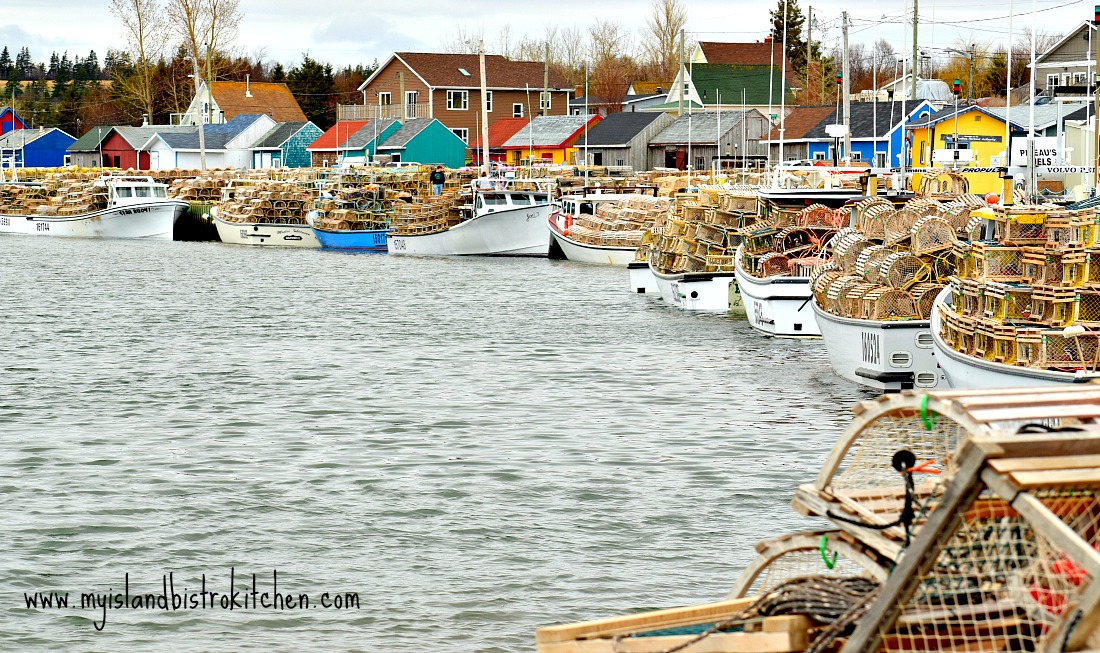
Eve of Setting Day in the Fishing Village of North Rustico, PEI, Canada
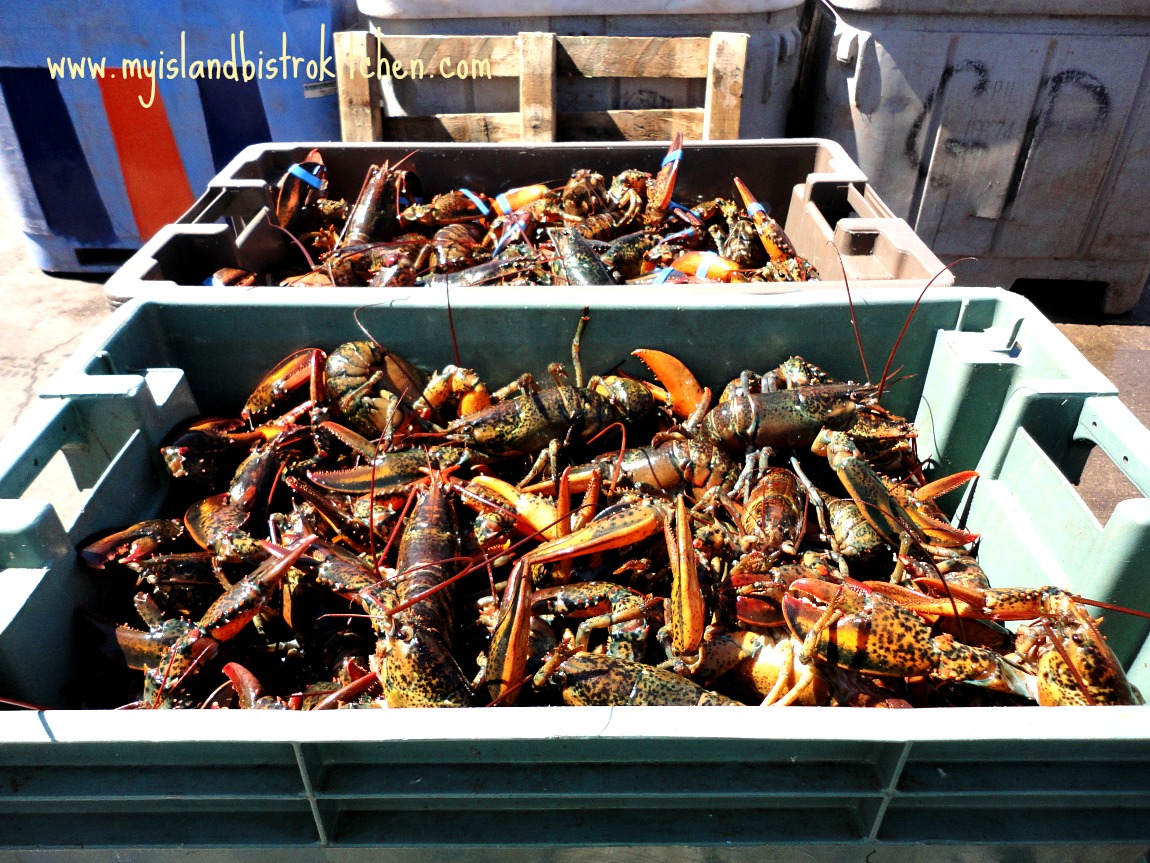
Living where we do, here in PEI, we have access to fresh local lobster and we make the most of it! The lobster fishery plays a major part in PEI’s economy and many people work in one of the many facets of this industry.
Fresh Catch of the Day – PEI Lobsters
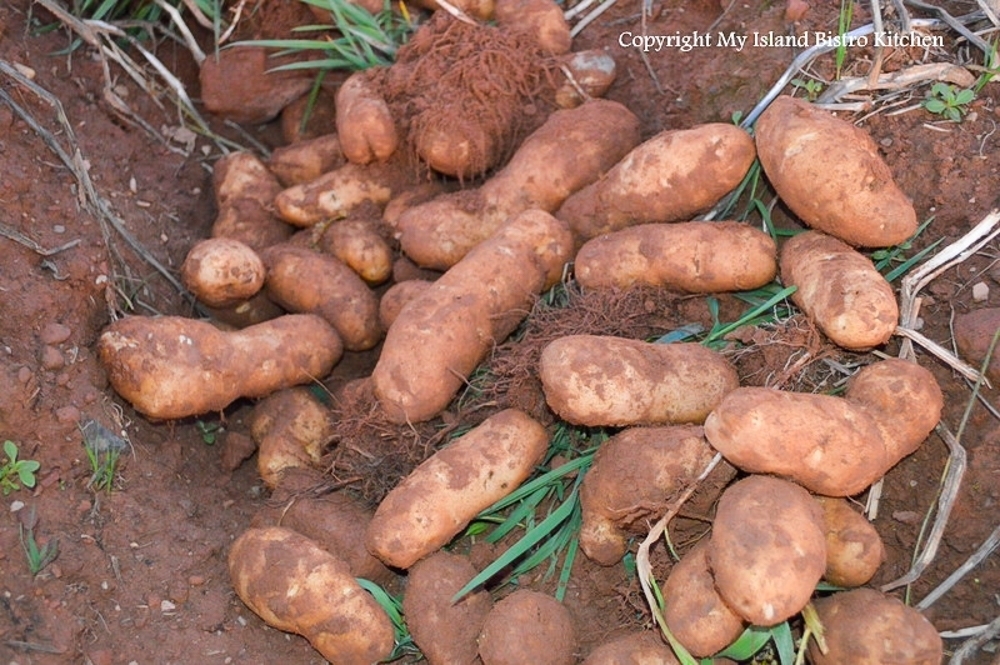
We are blessed on the Island with great food from the waters that surround our Island and from the rich red soil of our fertile land.
PEI Potatoes
Combining foods from the sea and land, my recipe for Lobster Chowder features fresh lobster and potatoes, both foods for which PEI is known. Some creamed corn, milk, cream, and a flavorful lobster stock make this a rich, decadent, and delectable chowder. Follow the step-by-step preparation and cooking directions to create a lobster chowder feast. Continue reading PEI Lobster Chowder Recipe→
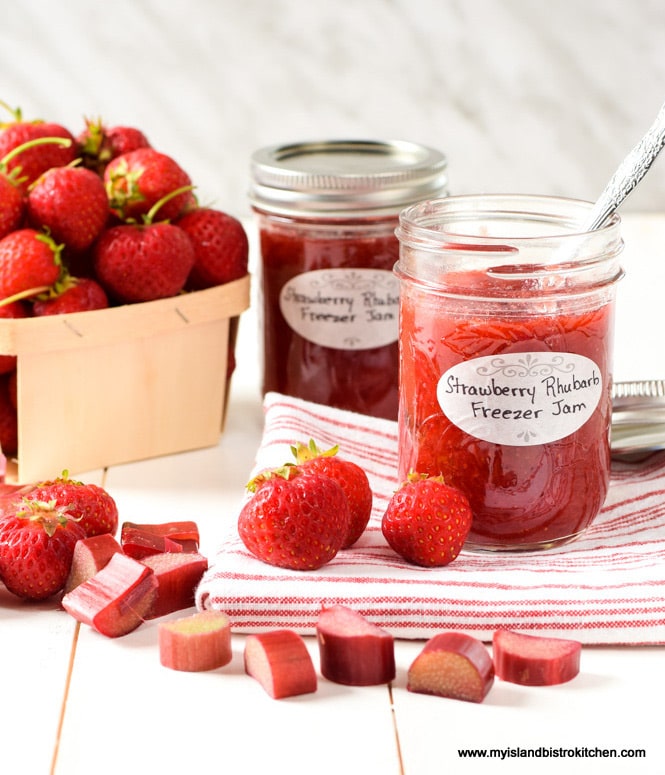
This Strawberry Rhubarb Freezer Jam boasts wonderful flavour and is very quick and easy to make. Because it is to stored in the freezer, it does not require a long cooking time or the hot water canning process. Continue reading Strawberry Rhubarb Freezer Jam Recipe→
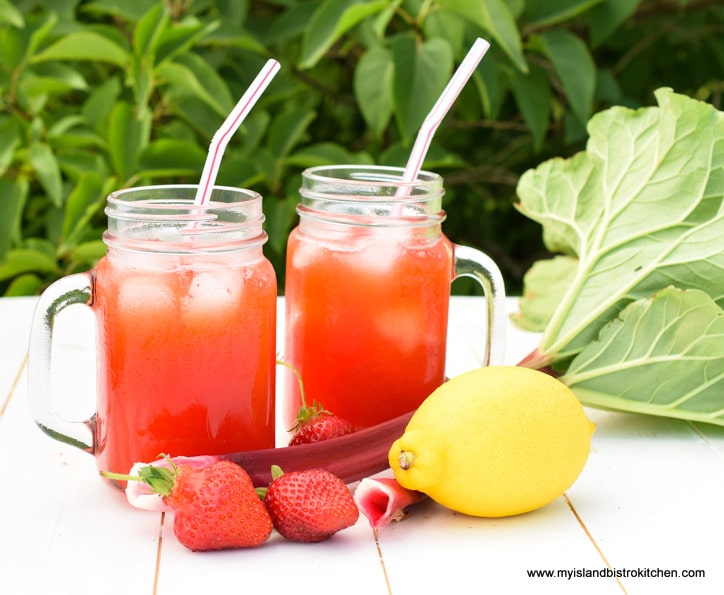
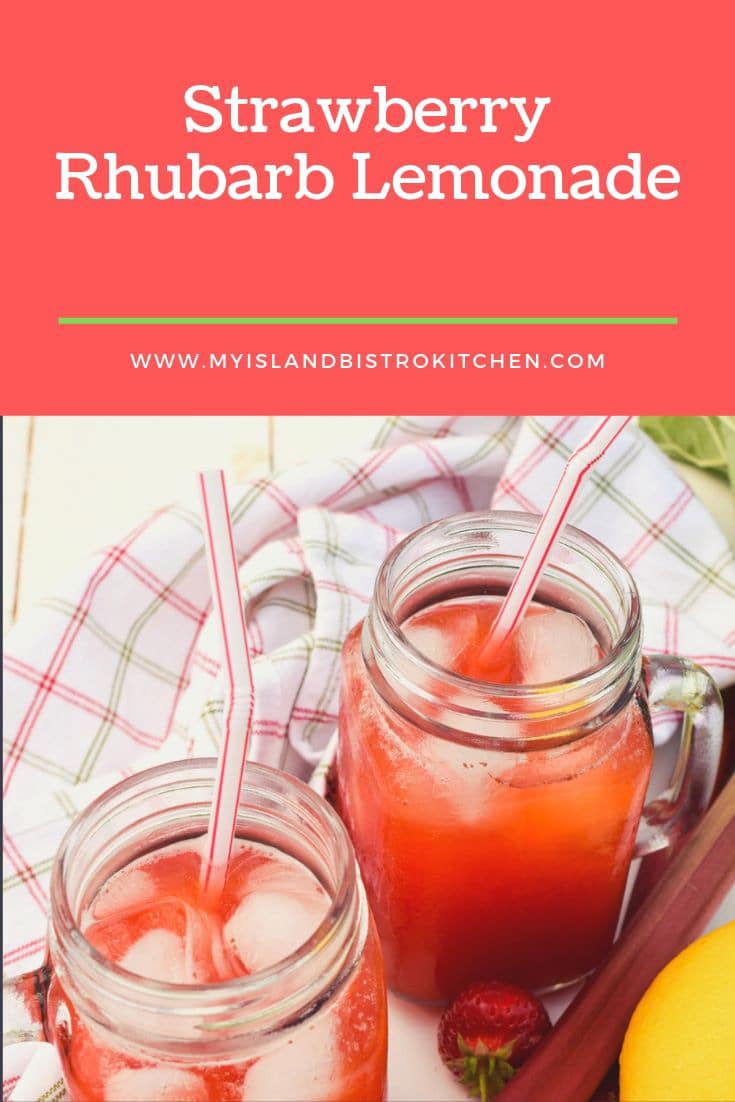
When the summer days are hot and thirst takes over, a tall glass of refreshing lemonade is just what is called for. Strawberry and rhubarb are always a winning flavour combination and they team up to make a wonderful Strawberry and Rhubarb Lemonade. There is no need for any addition of coloring in this drink as the deep red strawberries and bright red rhubarb impart their own shades into this colorful drink.
Strawberry Rhubarb Lemonade
This is one of those drinks I make when the strawberries and rhubarb are in season because this lemonade freezes very well in an airtight container. This makes it a great drink to have on hand for those hot summer days.
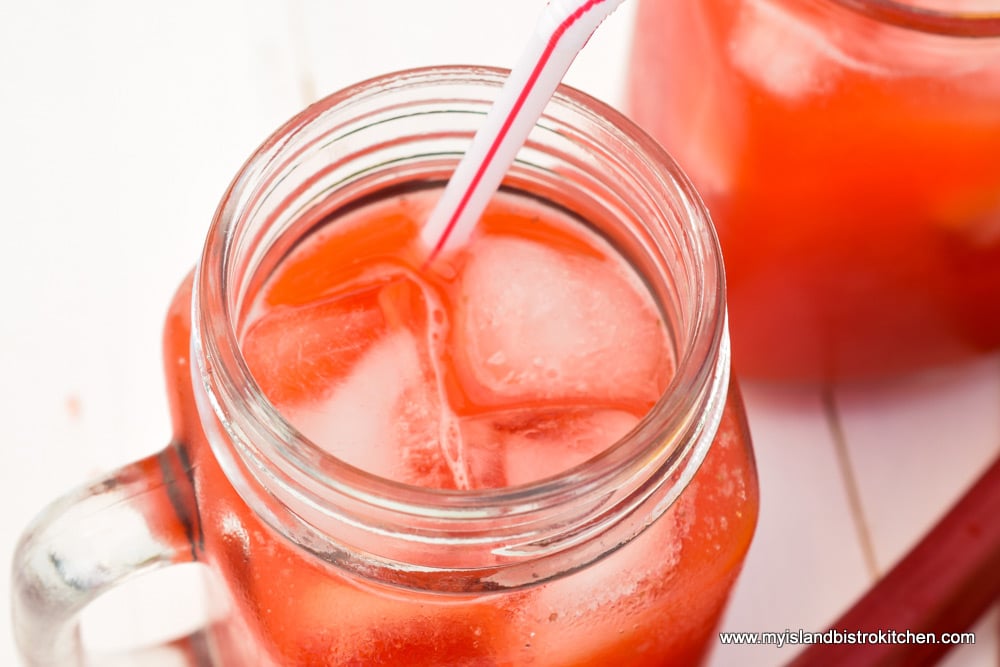
Strawberry Rhubarb Lemonade
Serve the lemonade plain over ice or half fill a glass with the lemonade and top it up with your favorite clear soda. If so inclined, an ounce of your favorite libation may be added to the lemonade.
[Printable recipe follows at end of post]
Strawberry Rhubarb Lemonade
Ingredients:
1½ cups water
1 cup super-fine sugar (aka caster sugar or instant dissolving sugar)
1 cup freshly squeezed lemon juice
2 tbsp coarsely grated lemon rind
¾ lb rhubarb, chopped into 1” chunks
1 cup water
1/3 cup super-fine sugar
2 cups fresh strawberries, sliced
1¼ cups water
Pinch salt
Method:
For the simple syrup: In small saucepan, combine the 1½ cups water and 1 cup sugar together. Bring to a boil over medium heat, stirring constantly, until sugar is completely dissolved. Reduce heat to medium-low and boil gently for 3-4 minutes, stirring occasionally. Remove from heat and cool to room temperature (apx. 30-40 minutes). Add the lemon juice and lemon rind. Let mixture stand for at least an hour (or up to three hours) to allow the flavor to develop. Strain mixture twice through a fine mesh sieve to remove the lemon pulp and rind. Discard the pulp and rind.
For the rhubarb and strawberry juice: Combine the rhubarb, 1 cup of water and sugar in a large pot. Cover and bring to a boil then reduce heat to medium-low and cook for approximately 5 minutes. Add the strawberries and 1¼ cups water along with a pinch of salt. Cover and cook for about 5 minutes longer, or until rhubarb and strawberries are softened. Remove from heat and let stand for about 20 minutes. Use a food masher to loosely mash and break down the pulp. Place a large fine wire mesh sieve over a heatproof bowl. Line the sieve with a double layer of dampened cheesecloth. Pour the rhubarb and strawberry mixture into the sieve, letting the juice drip through. Use the back of a large spoon to very gently press the pulp in order to extract as much of the juice from the fruit as possible. Discard solids.
To assemble: In large jug or bottle, combine the simple syrup with the strained rhubarb and strawberry juice. Stir well. Chill.
To serve: Stir the chilled lemonade. Fill a glass approximately one-half full of ice cubes and add the lemonade. Garnish with a lemon wheel or fresh strawberry, if desired.
Additional Serving Suggestions:
Fill glass one-half full of lemonade. Top with sparkling water or clear soda such as lemon-lime, sprite, or grapefruit. Finish with ice cubes and a sprig of fresh mint.
Add 1 oz of your favorite libation to a glass half-filled with ice cubes. Top with lemonade. Garnish with lemon wedge and strawberry.
Lemonade will keep, covered, in the refrigerator for 3-4 days. Freezes well in airtight container.
Yield: Approximately 5-6 cups, depending on water content in fruit
With a perfect blend of sweet strawberries and tart rhubarb, this Strawberry Rhubarb Lemonade is a refreshing and thirst-quenching summertime sipper.
Servings6
My Island Bistro KitchenMy Island Bistro Kitchen
Ingredients
1½cupswater
1cupsuper-fine sugar(aka caster sugar or instant dissolving sugar)
1cupfreshly squeezed lemon juice
2tbspcoarsely grated lemon rind
¾lbrhubarb,chopped into 1” chunks
1cupwater
1/3cupsuper-fine sugar
2cupsfresh strawberries,sliced
1¼cupswater
Pinchsalt
Instructions
For the simple syrup: In small saucepan, combine the 1½ cups water and 1 cup sugar together. Bring to a boil over medium heat, stirring constantly, until sugar is completely dissolved. Reduce heat to medium-low and boil gently for 3-4 minutes, stirring occasionally. Remove from heat and cool to room temperature (apx. 30-40 minutes). Add the lemon juice and lemon rind. Let mixture stand for at least an hour (or up to three hours to allow the flavor to develop. Strain mixture twice through a fine mesh sieve to remove the lemon pulp and rind. Discard the pulp and rind.
For the rhubarb and strawberry juice: Combine the rhubarb, 1 cup of water and sugar in a large pot. Cover and bring to a boil then reduce heat to medium-low and cook for approximately 5 minutes. Add the strawberries and 1¼ cups water along with a pinch of salt. Cover and cook for about 5 minutes longer, or until rhubarb and strawberries are softened. Remove from heat and let stand for about 20 minutes. Use a food masher to loosely mash and break down the pulp. Place a large fine wire mesh sieve over a heatproof bowl. Line the sieve with double layer of dampened cheesecloth. Pour the rhubarb and strawberry mixture into the sieve, letting the juice drip through. Use the back of a large spoon to very gently press the pulp in order to extract as much of the juice from the fruit as possible. Discard solids.
To assemble: In large jug or bottle, combine the simple syrup with the strained rhubarb and strawberry juice. Stir well. Chill.
To serve: Stir the chilled lemonade. Fill a glass approximately one-half full of ice cubes and add the lemonade. Garnish with a lemon wheel or fresh strawberry, if desired.
Additional Serving Suggestions:
Fill glass one-half full of lemonade. Top with sparkling water or clear soda such as lemon-lime, sprite, or grapefruit. Finish with ice cubes and a sprig of fresh mint.
Add 1 oz of your favorite libation to a glass half-filled with ice cubes. Top with lemonade. Garnish with lemon wedge and strawberry.
Lemonade will keep, covered, in the refrigerator for 3-4 days. Freezes well in airtight container.
Recipe Notes
Yield: Approximately 5-6 cups, depending on water content in fruit
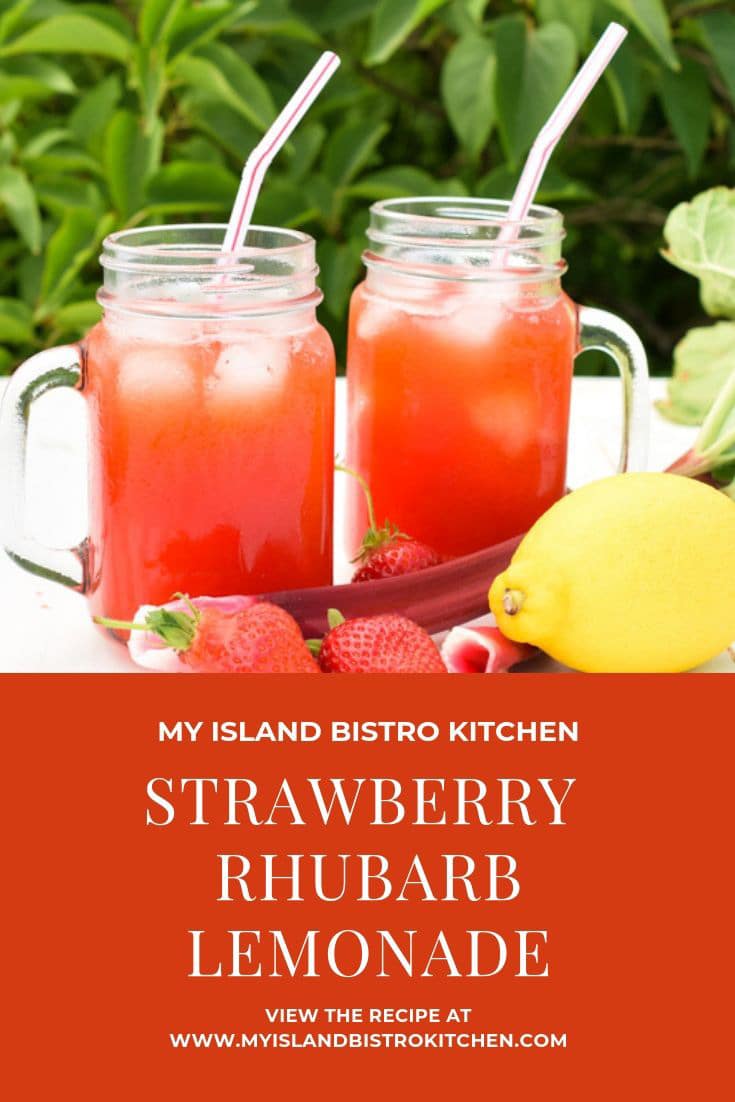
Pin Me To Pinterest!
Strawberry Rhubarb Lemonade
For other great lemonade recipes from My Island Bistro Kitchen, click on the links below:
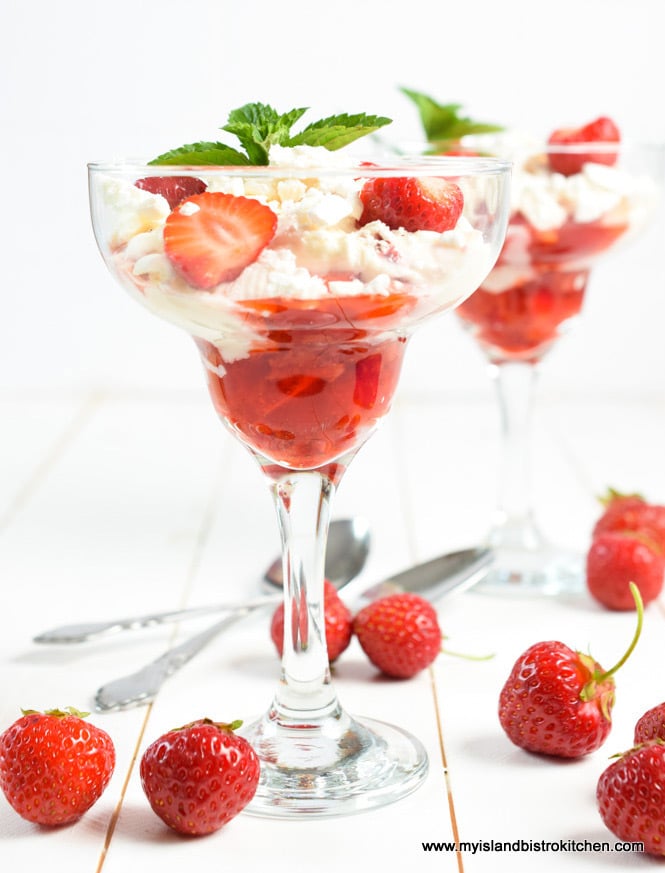
There is much folklore over the origins of Eton Mess, a parfait-like dessert that is named for the prestigious English college in Berkshire, England, across the River Thames from Windsor. Continue reading Strawberry Eton Mess Dessert→
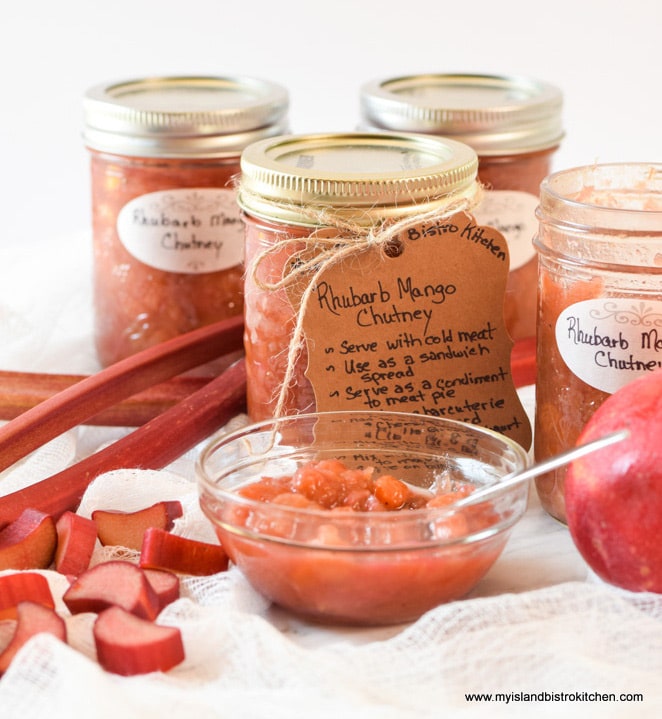
This Rhubarb and Mango Chutney is a mildly spicy condiment. Combining the tart rhubarb with the sweet fresh mango and a variety of spices produces a fabulous flavour combination that teeters between the sweet and savory. Continue reading Rhubarb and Mango Chutney→
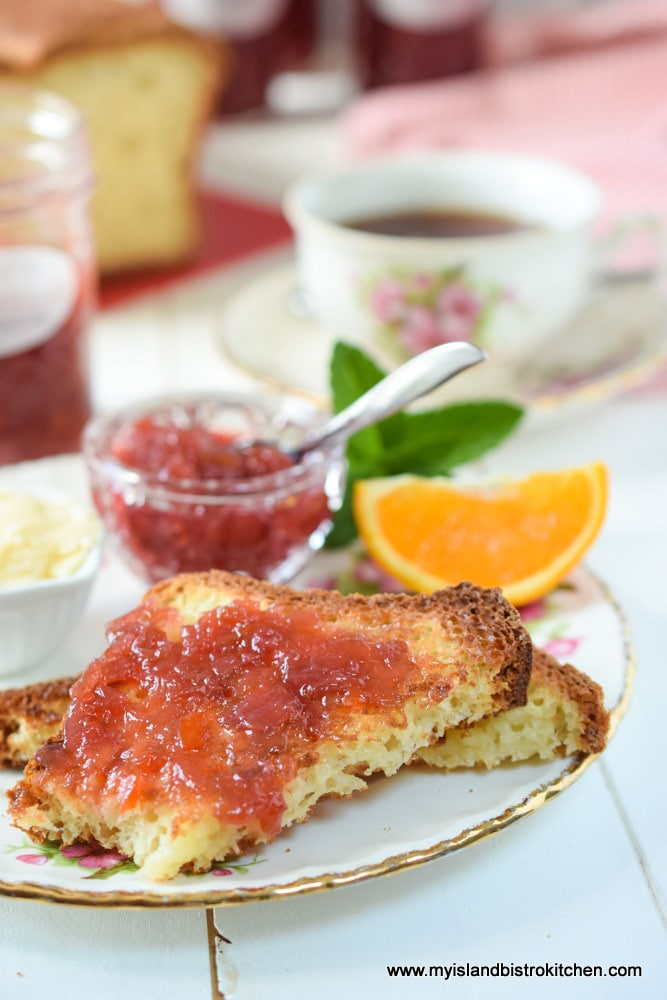
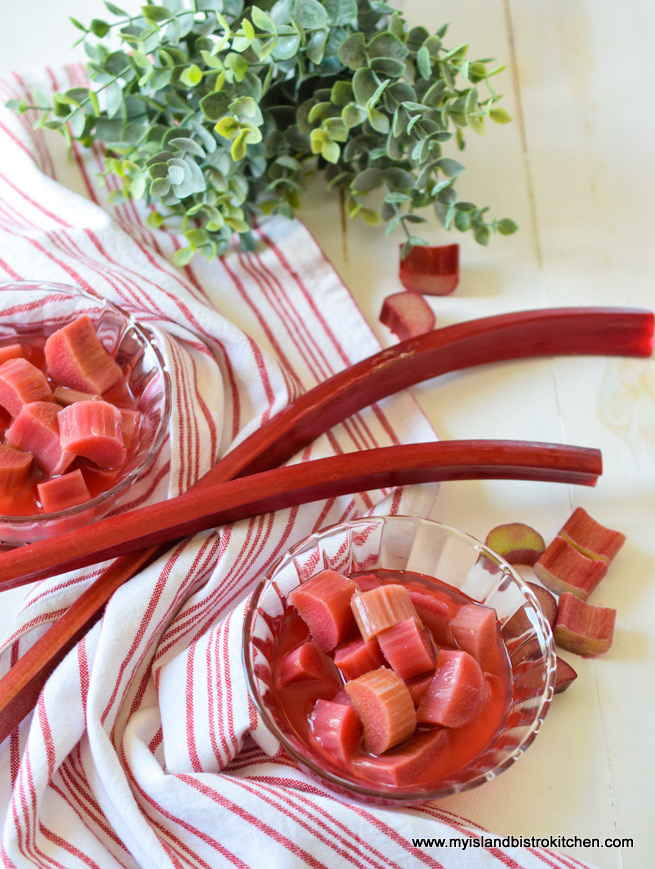
Jamming and preserving season here in PEI starts with rhubarb, one of the first treats from the garden. The two crowns of rhubarb in our garden produce lots of rhubarb for use when it is in season and to freeze for later enjoyment.
Rhubarb Patch of Two Crowns
One of the first things I make with rhubarb as soon as it is ready is this wonderful Rhubarb Marmalade I have been making for years. The marmalade only takes five ingredients – rhubarb, granulated sugar, an orange, half a pink grapefruit, and half of a lemon. The color of the rhubarb marmalade is a lovely deep shade and its flavour is fresh and slightly tart. Continue reading Rhubarb Marmalade Recipe→
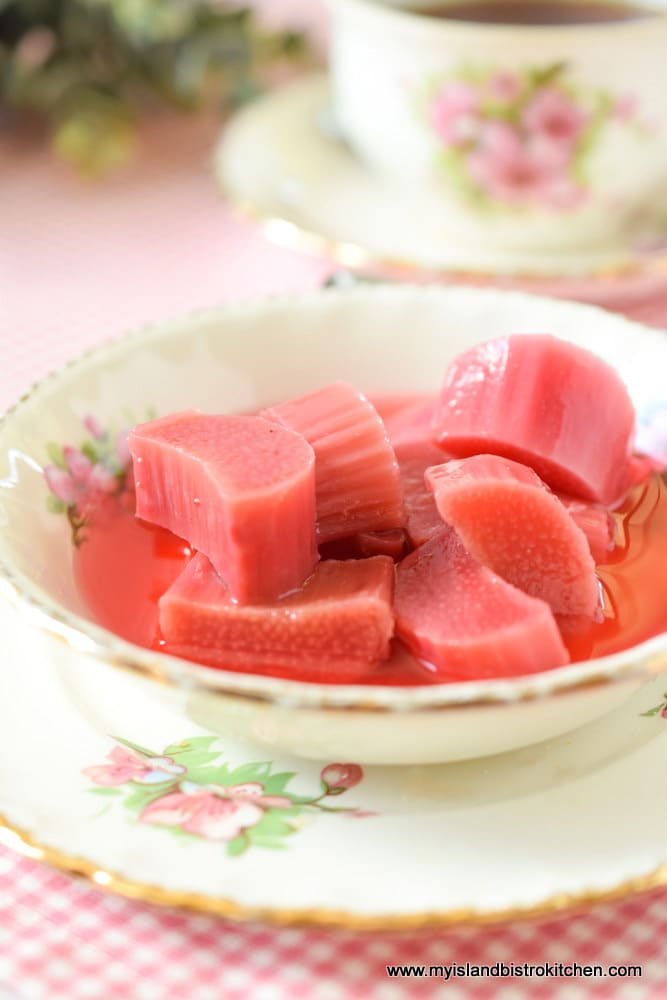
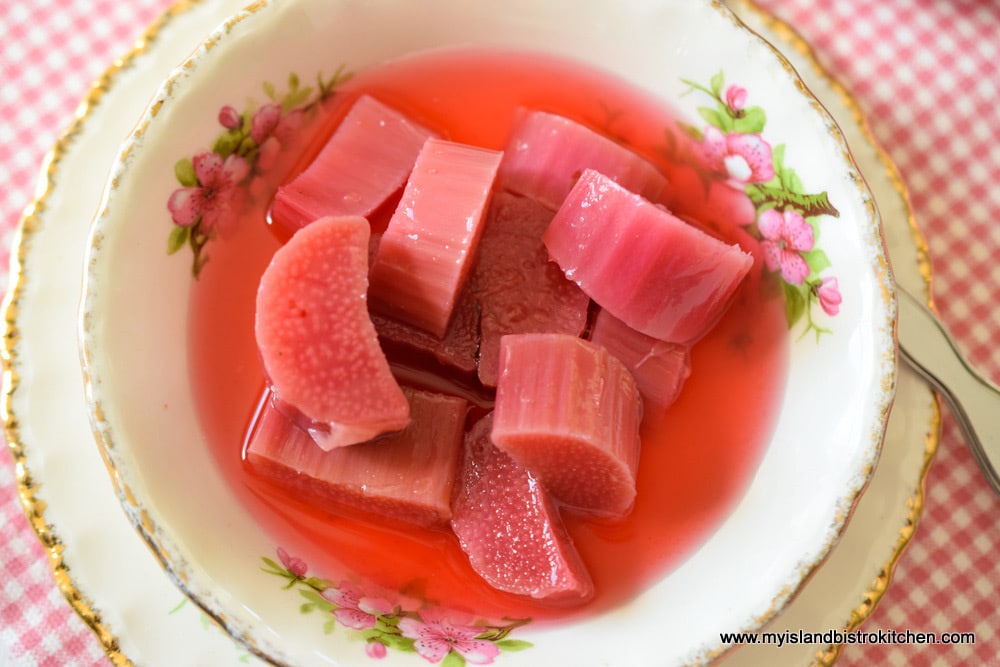
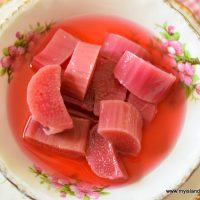
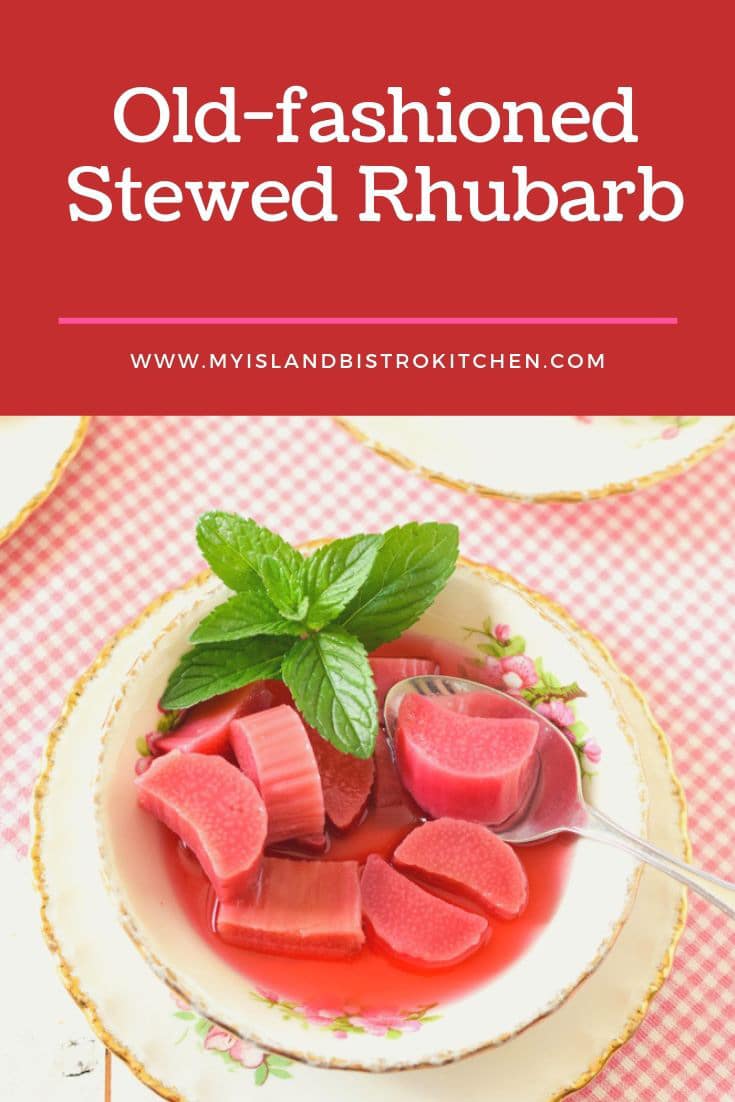
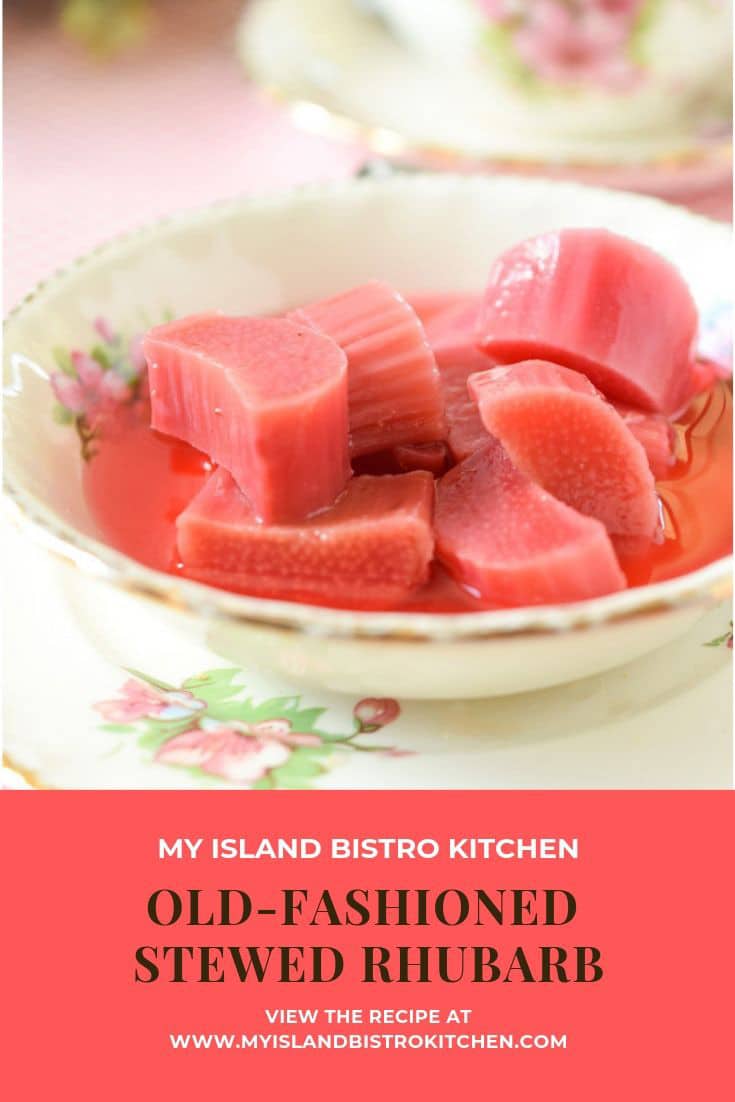
Old-fashioned stewed rhubarb is so simple to make and so tasty. During my growing up years, stewed rhubarb was a staple in the refrigerator during rhubarb season. My mother and grandmother both cooked the rhubarb slowly in a water and sugar mixture in the oven. This helped to retain the shape of the rhubarb and also its lovely rosy color. Cooking it on the stove, or in the oven at a higher temperature, would turn the rhubarb into sauce which is entirely different from this stewed rhubarb recipe.
While neither my mother or grandmother added anything to their stewed rhubarb, I add a small amount of pulp-free orange juice and a sprinkle of nutmeg which I think enhances the syrup in which the rhubarb is stewed and with which it is served.
Stewed Rhubarb
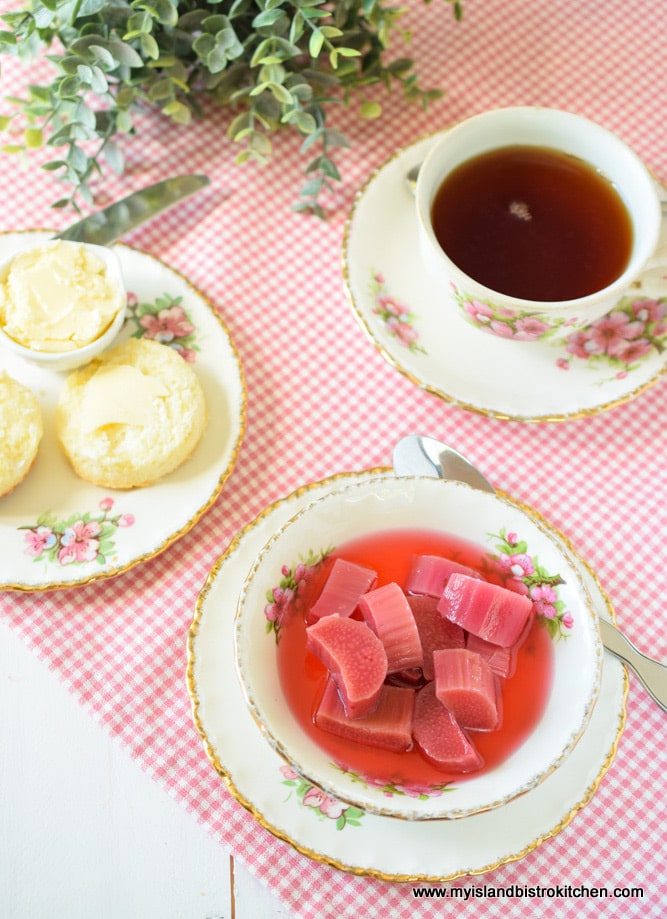
My grandmother would often serve this stewed rhubarb with biscuits made with homemade cream and slathered with homemade butter. She lived on a farm so had fresh cream daily and it was used liberally. (You can find my tea biscuit recipe here.) Stewed rhubarb would often be dessert after supper.
Stewed Rhubarb
I freeze a lot of rhubarb for winter usage and will often have a dish of stewed rhubarb in the fridge any time over the year because it can easily be made with frozen rhubarb.
Stewed Rhubarb
Made with only five basic ingredients, it doesn’t get much simpler (or more tasty) than Old-fashioned Stewed Rhubarb.
[Printable recipe follows at end of post]
Stewed Rhubarb
Ingredients:
1 lb rhubarb, chopped into ¾“ pieces (approximately 3¾ cups chopped)
¾ cup hot water
1 cup + 1 tbsp granulated sugar
1½ tbsp pulp-free orange juice
1/8 tsp nutmeg
Method:
Preheat oven to 235°F oven.
In small saucepan over medium high heat, bring the hot water and sugar to a boil then reduce heat to simmer for 4 minutes.
Place rhubarb in casserole (apx. 2-quart size). Add the orange juice and nutmeg to the hot water and sugar mixture and pour over the rhubarb. Cover and place in oven for approximately 55-65 minutes, or until rhubarb is fork tender. Do not overcook or rhubarb will lose its shape and turn into sauce.
Yield: Apx. 5-6 servings
If you have made this recipe and enjoyed it and/or wish to share it with your friends and family, please do so on social media but be sure to share the direct link to this posting from my website.
Connect with My Island Bistro Kitchen on Social Media
Follow “the Bistro” on Pinterest at https://www.pinterest.ca/peibistro/ and pin the Pinterest-ready photo found at the end of this post to your favorite Pinterest boards.
Ruby red rhubarb stewed slowly in the oven to retain its shape and color makes a wonderful light dessert, especially when served with homemade biscuits. May be made with either fresh or frozen rhubarb.
Course
Dessert
Cuisine
Canadian
Keyword
rhubarb
Servings6
My Island Bistro KitchenMy Island Bistro Kitchen
Ingredients
1lbrhubarb,chopped into ¾“ pieces (approximately 3¾ cups chopped)
¾cuphot water
1cup+ 1 tbsp granulated sugar
1½tbsppulp-free orange juice
1/8tspnutmeg
Instructions
Preheat oven to 235°F oven.
In small saucepan over medium high heat, bring the hot water and sugar to a boil then reduce heat to simmer for 4 minutes.
Place rhubarb in casserole (apx. 2-quart size). Add the orange juice and nutmeg to the hot water and sugar mixture and pour over the rhubarb. Cover and place in oven for approximately 55-65 minutes, or until rhubarb is fork tender. Do not overcook or rhubarb will lose its shape and turn into sauce.
Recipe Notes
Yield: Apx. 5-6 servings
[Copyright My Island Bistro Kitchen]
For other great rhubarb dessert recipes from My Island Bistro Kitchen, click on the links below:
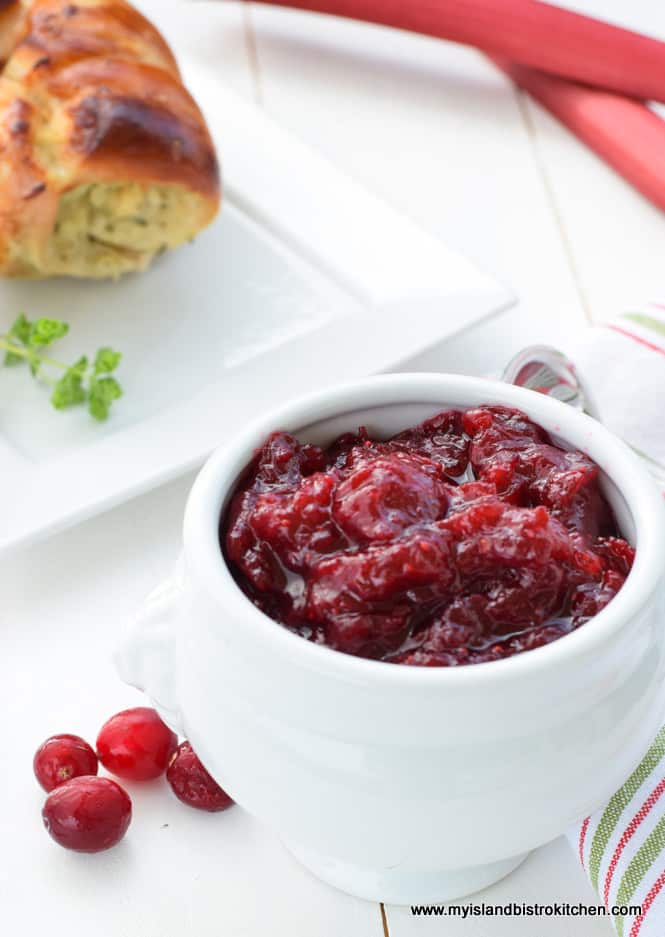
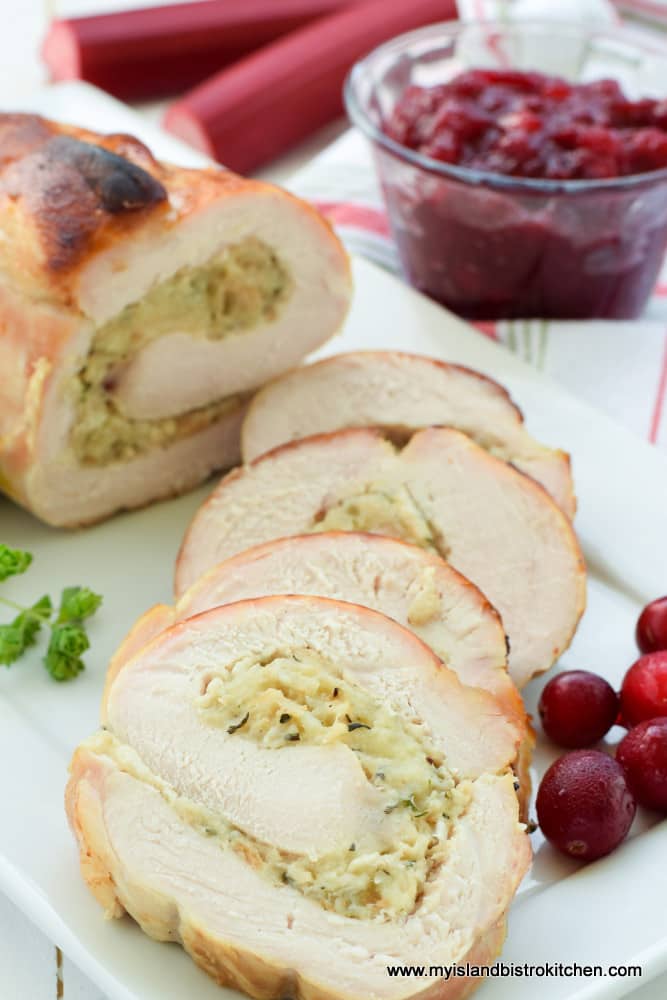
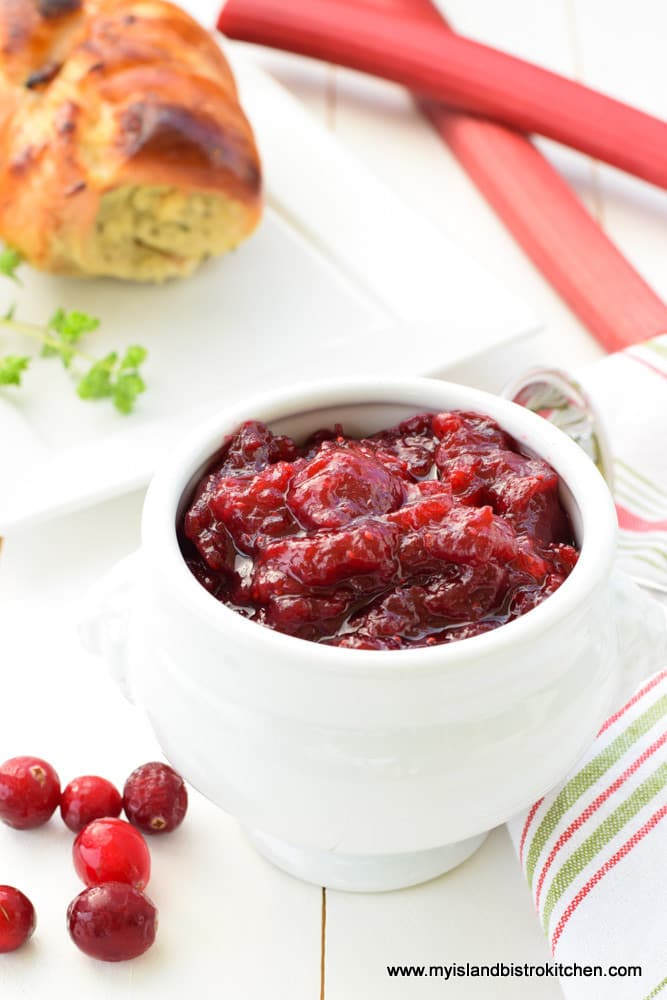
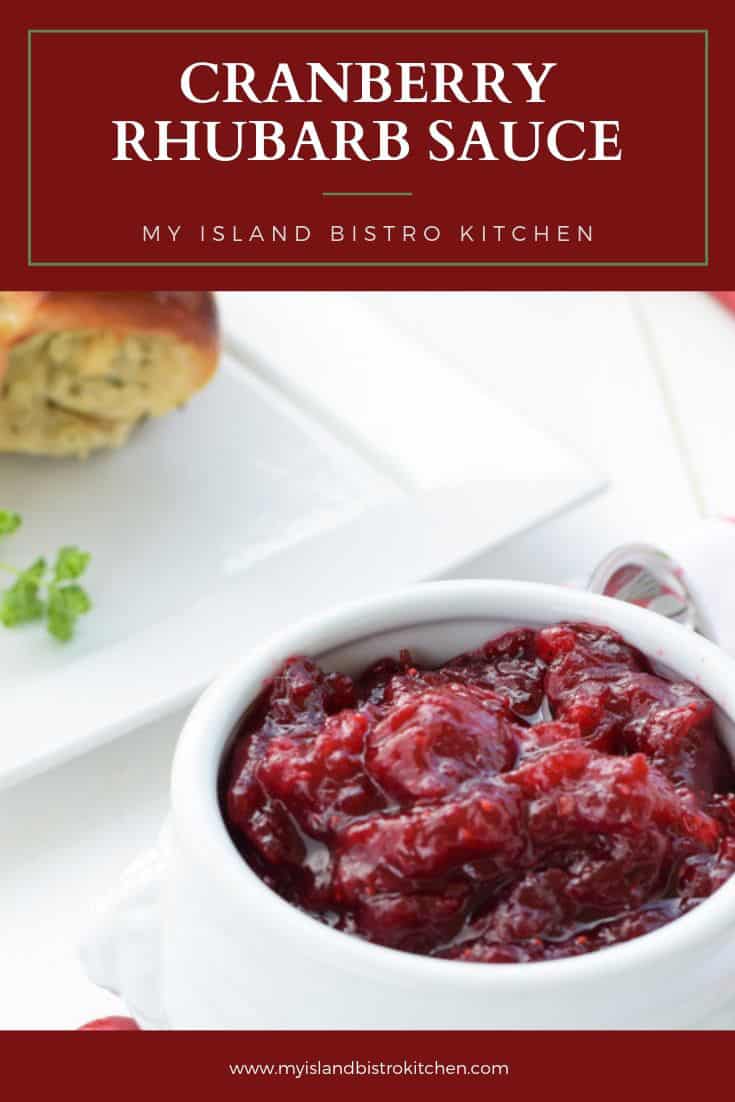
It’s hard for me to imagine a roast turkey or chicken dinner without homemade cranberry sauce. Sometimes, I will make the sauce with just cranberries while other times, I will blend flavours as in the case of this Cranberry Rhubarb Sauce which combines the tart cranberries with the equally tart rhubarb. Lovely tang and extraordinarily rich color to this tasty sauce.
This Cranberry Rhubarb Sauce may be made with either fresh or frozen cranberries and rhubarb so it’s possible to make it year-round. This is a good thing because cranberries and rhubarb are not in-season locally together at the same time.
This condiment complements a roast poultry dinner very well. Try mixing it with some mayonnaise for a lovely spread on a cold chicken or turkey sandwich.
Rolled Stuffed Turkey Breast Served with Cranberry Rhubarb Sauce
I like my cranberry sauces to be very thick and not runny. The secret to making a thick cranberry sauce is to, first, make a simple syrup of water and sugar before adding the cranberries and rhubarb. The trick to getting a thickened sauce is to stir it both while it is cooking and cooling. Stir it plenty during the cooling process – it will appear somewhat watery when it comes off the stove but, by stirring it frequently as it cools, it will thicken well.
Cranberry Rhubarb Sauce
This sauce, like my other cranberry sauces, freezes well. I often make up a batch or two at a time and freeze it in airtight serving-size dishes of desired size. To thaw, simply remove the sauce from the freezer and thaw at room temperature for an hour or so (depending on the size of container, of course).
[Printable recipe follows at end of posting]
Cranberry Rhubarb Sauce
Ingredients:
2/3 cup granulated sugar
1/3 cup light brown sugar
1 cup water minus 1 tablespoon
1½ cups cranberries, fresh or frozen (approximately 6 oz)
¾ cup rhubarb, fresh or frozen, chopped into ¼“ chunks (approximately 3 oz)
2 tbsp peeled apple, finely chopped
1/4 cup orange juice
1 tsp lime juice (optional)
¼ tsp cinnamon
1/8 tsp nutmeg
1/16 tsp ginger
1 star anise pod (optional)
2 tsp finely grated orange rind
Method:
In medium-sized saucepan, over medium heat, bring sugars and water to boil. Boil, uncovered, for 5 minutes over medium-high heat, stirring occasionally.
Add cranberries, rhubarb, apple, and orange and lime juices. Bring to a boil. Cook, uncovered, over medium-low heat, stirring periodically throughout the cooking process, for about 8 minutes. Add the spices and star anise pod. Increase heat to return mixture to the boiling point then reduce heat to medium-low and continue to stir the sauce periodically while cooking it for another 10 minutes or until mixture thickens.
Remove saucepan from heat and discard the star anise pod. Add orange rind. Stir frequently as the sauce cools to help it to thicken.
Store, covered, in refrigerator for up to 5 days or freeze for longer storage.
Yield: Apx. 1 2/3 cups
For other Cranberry Sauce recipes, click on the links below:
1½cupscranberries,fresh or frozen (approximately 6 oz)
¾cuprhubarb,fresh or frozen, chopped into ¼“ chunks (approximately 3 oz)
2tbsppeeled apple,finely chopped
1/4cuporange juice
1tsplime juice(optional)
¼tspcinnamon
1/8tspnutmeg
1/16tspginger
1star anise pod(optional)
2tspfinely grated orange rind
Instructions
In medium-sized saucepan, over medium heat, bring sugars and water to boil. Boil, uncovered, for 5 minutes over medium-high heat, stirring occasionally.
Add cranberries, rhubarb, apple, and orange and lime juices. Bring to a boil. Cook, uncovered, over medium-low heat, stirring periodically throughout the cooking process, for about 8 minutes. Add the spices and star anise pod. Increase heat to return mixture to the boiling point then reduce heat to medium-low and continue to stir the sauce periodically while cooking it for another 10 minutes or until mixture thickens.
Remove saucepan from heat and discard the star anise pod. Add orange rind. Stir frequently as the sauce cools to help it to thicken.
Store, covered, in refrigerator for up to 5 days or freeze for longer storage.
Recipe Notes
Yield: Apx. 1 2/3 cups
[Copyright My Island Bistro Kitchen]
If you have made this recipe and enjoyed it and/or wish to share it with your friends and family, please do so on social media but be sure to share the direct link to this posting from my website.
Connect with My Island Bistro Kitchen on Social Media
Follow “the Bistro” on Pinterest at https://www.pinterest.ca/peibistro/ and pin the Pinterest-ready photo found at the end of this post to your favorite Pinterest boards.
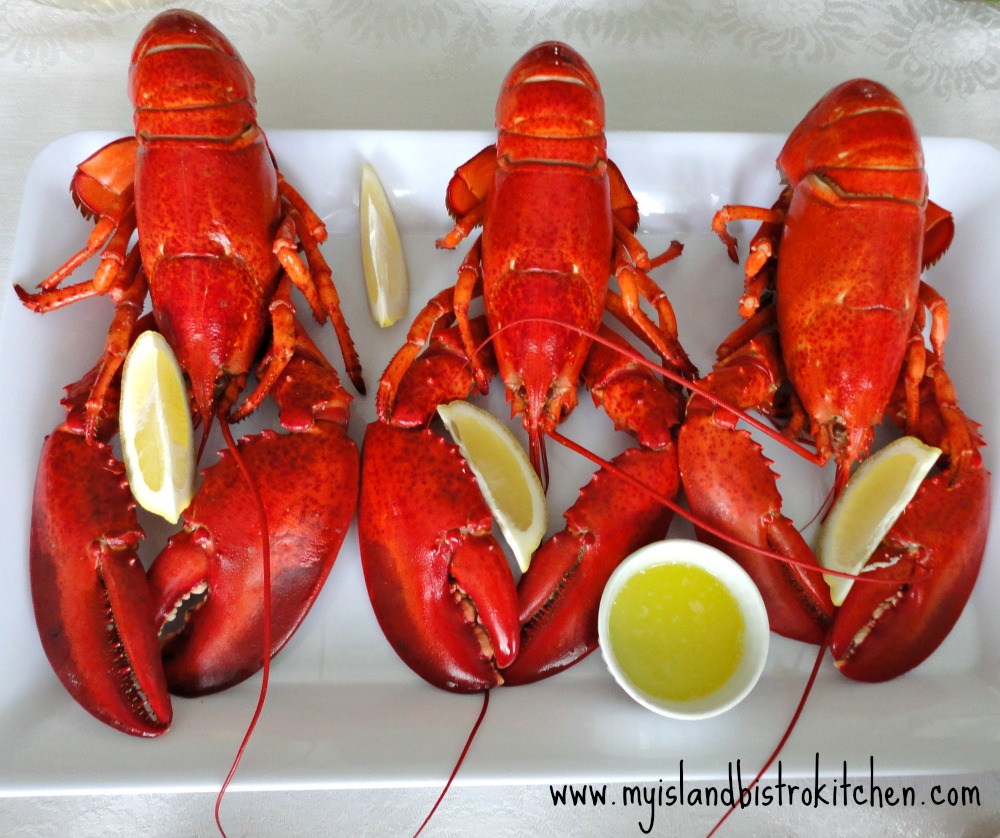
Living in PEI, we are accustomed to high quality local seafood. When lobster is in season, I try to make the most of it, enjoying it steamed and fresh from the shell with the tender meat dipped in melted butter.
Steamed Lobster in the Shell
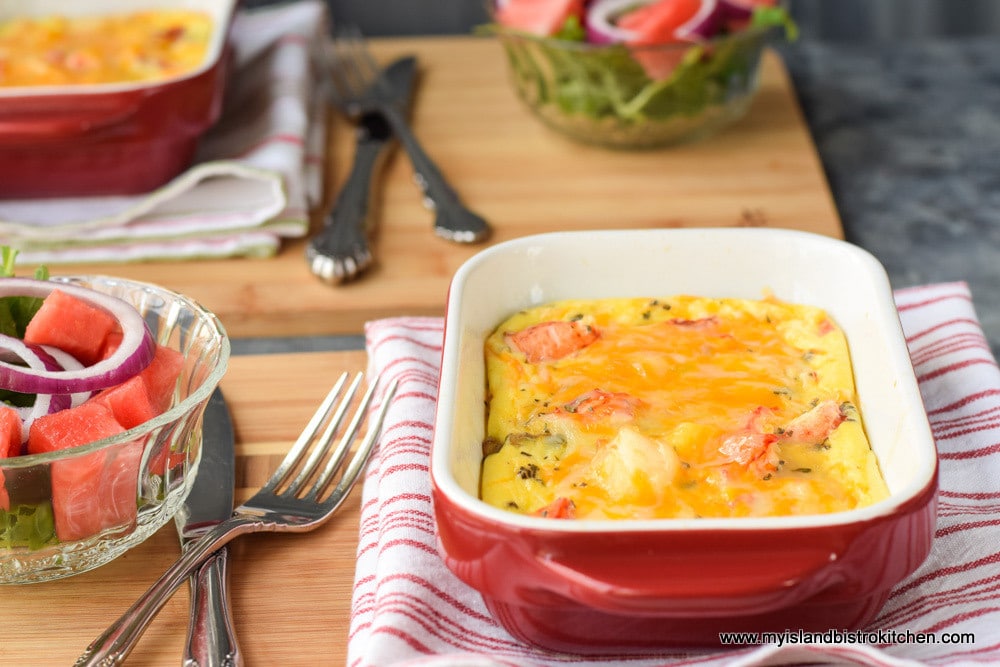
Once I have had a couple of good “feeds” of lobster with homemade potato salad and rolls, I start using the meat as an ingredient in other recipes like this easy-to-make oven-baked Lobster Frittata.
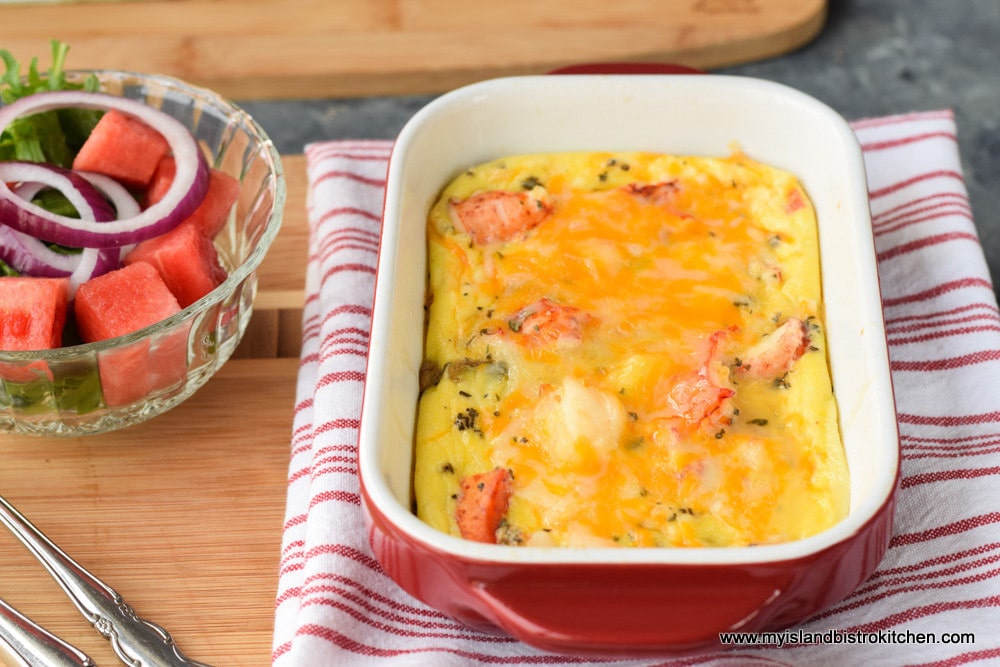
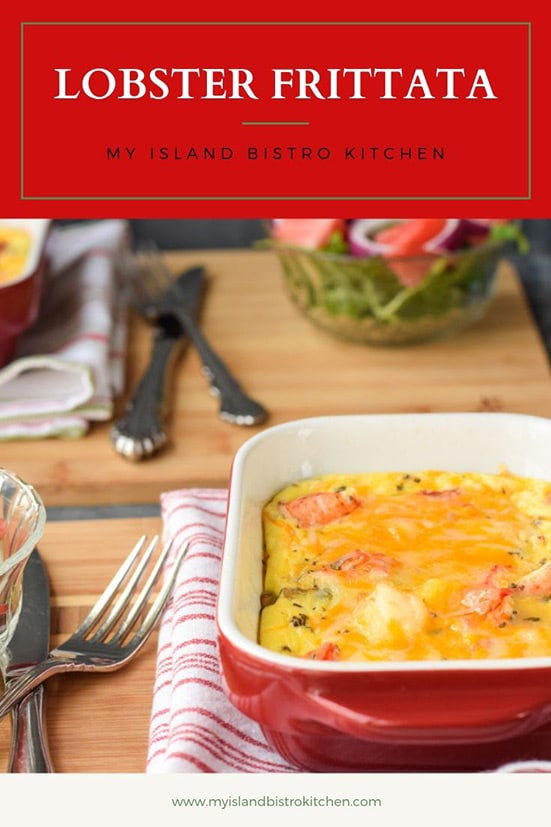
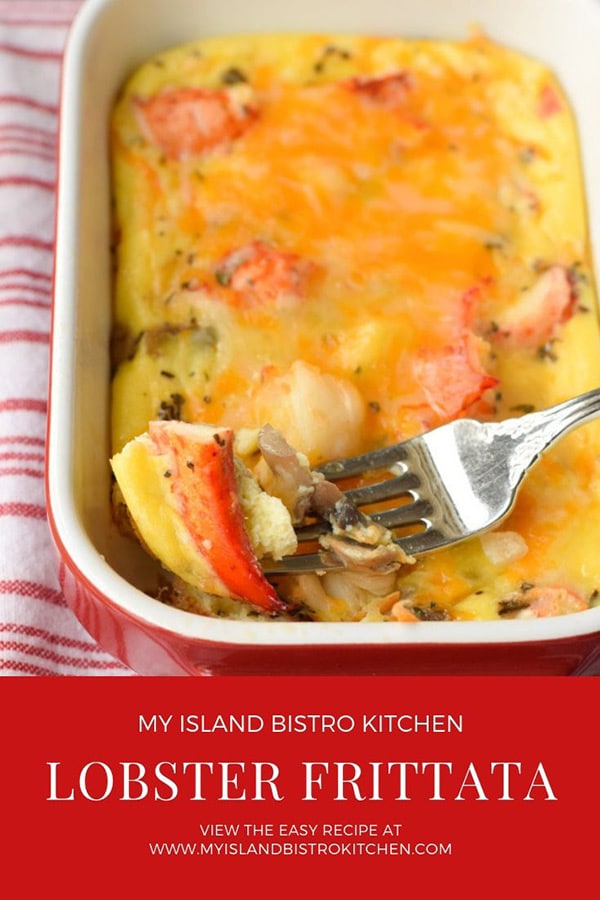
Oven-baked Lobster Frittata
Frittata is an Italian dish that is a cross between a crustless quiche and an open-faced omelette, probably leaning more toward similarity with the quiche. The main difference between a frittata and an omelette is that, for a frittata, the filling ingredients are cooked with the egg mixture versus being added just before an omelette is folded in half to finish cooking.
Traditionally, frittatas are made on the stovetop, either completely or, sometimes, they are partially cooked on the stove and then finished in the oven. However, it is quite acceptable to completely bake the frittata in the oven which is the method I am using for the Lobster Frittata.
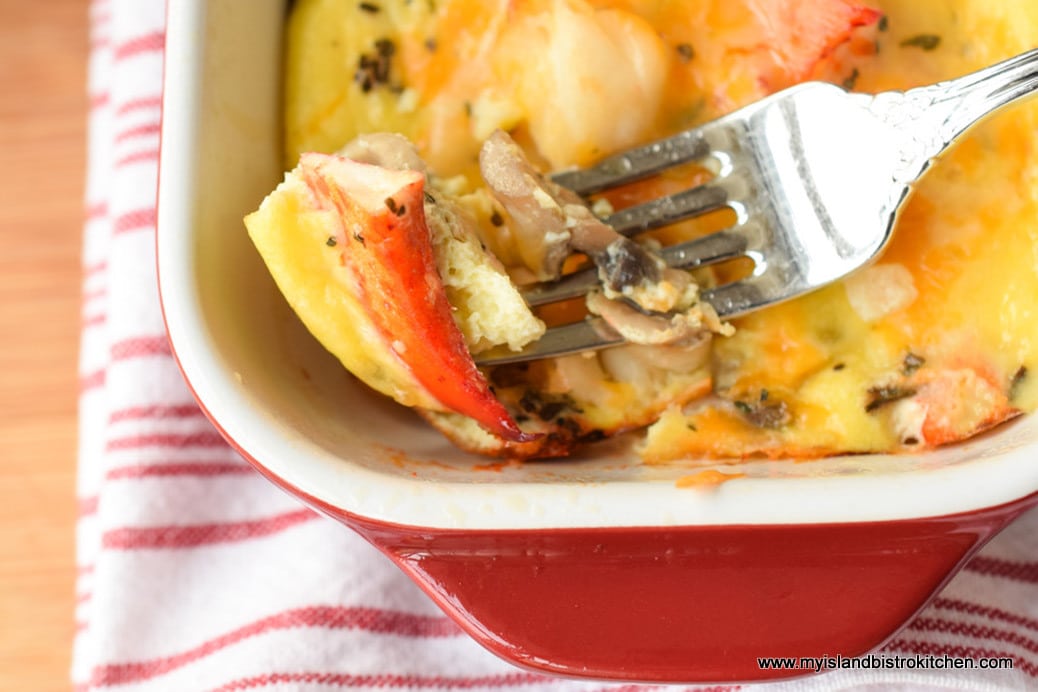
Baked Lobster Frittata
There are two main tips for making this frittata. First, use cream, blend, or whole milk but never fat-reduced milk as it makes the frittata’s custard too runny and watery. The second tip is to pre-cook the vegetables to get rid of some of their liquid and also to ensure that they are sufficiently cooked. If they were added raw with the egg custard, they would not be sufficiently cooked in the same amount of time it takes to properly bake the frittata and they would release too much liquid into the egg custard. Even with the pre-cooking, the vegetables will still have a lot of moisture in them. For this reason, I recommend transferring them from the sauté pan to a paper-towel lined bowl to sop up the excess moisture before they are added to the egg custard mixture.
Frittata is a great brunch, lunch, dinner, or picnic fare, making it very versatile. It can be eaten hot from the oven or at room temperature. Serve with a side of toast, salad, homefries, or fresh fruit.
Baked Lobster Frittata
I use individual small 6″x4″ baking, or gratin, dishes for this recipe. Oblong baking dishes that have 1½ – 1¾ cups capacity work well for this recipe as the egg mixture will puff up somewhat and room needs to be allotted for that. If you don’t have individual baking dishes that are approximately 6”x4” inches, you could use one baking dish that would be large enough to hold the entire amount of ingredients.
Bake the frittatas on the middle rack in a preheated oven. It is important not to overbake frittata as it will become somewhat tough and leathery. This Lobster Frittata takes between 18-22 minutes when baked in the dishes called for in the recipe. When the frittata is perfectly baked, the eggs should be set and no longer runny.
[Printable recipe follows at end of posting]
Oven-baked Lobster Frittata
Ingredients:
4 large eggs
2½ tbsp cream
Salt and Pepper
¼ – ½ tsp Herbes de Provence
1 tbsp olive oil
3 tbsp onion, chopped
1 – 2 cloves garlic, minced
5-6 slices zucchini, halved or quartered
5-6 button mushrooms, sliced
3 tbsp red bell pepper, chopped
4 oz cooked lobster, coarsely chopped
2 tbsp finely grated Parmesan cheese
1/3 cup shredded sharp cheddar cheese
¼ cup shredded sharp cheddar cheese
Method:
Place oven rack in center of oven. Preheat oven to 350°F.
Heat oil in small skillet. Sauté, over medium heat, the onions, garlic, zucchini, mushrooms, and red bell pepper for 4-6 minutes, until vegetables start to soften. Transfer to small bowl double lined with paper towel to absorb the moisture from the sautéed vegetables.
Whisk the eggs just enough to break them up and mix the whites with the yolks. Whisk in the cream. Season with salt and pepper and the Herbes de Provence.
Spray two 6”x4” baking dishes with cooking spray, each dish having 1½ – 1¾ cup capacity. Divide the vegetables and lobster equally between the two dishes. Sprinkle with the Parmesan cheese and first amount of cheddar cheese. Pour egg mixture over the vegetables, lobster, and cheese, dividing equally between the two dishes. Place on baking sheet and transfer to oven. Bake for 18-22 minutes, or until frittatas are puffed up and just set in the center. Add the remaining cheese for the last 2-3 minutes of baking.
Serve with a side salad, toast, fresh fruit, or homefries.
Place oven rack in center of oven. Preheat oven to 350°F.
Heat oil in small skillet. Sauté, over medium heat, the onions, garlic, zucchini, mushrooms, and red bell pepper for 4-6 minutes, until vegetables start to soften. Transfer to small bowl double lined with paper towel to absorb the moisture from the sautéed vegetables.
Whisk the eggs just enough to break them up and mix the whites with the yolks. Whisk in the cream. Season with salt and pepper and the Herbes de Provence.
Spray two 6”x4” baking dishes with cooking spray, each dish having 1½ - 1¾ cup capacity. Divide the vegetables and lobster equally between the two dishes. Sprinkle with the Parmesan cheese and first amount of cheddar cheese. Pour egg mixture over the vegetables, lobster, and cheese, dividing equally between the two dishes. Place on baking sheet and transfer to oven. Bake for 18-22 minutes, or until frittatas are puffed up and just set in the center. Add the remaining cheese for the last 2-3 minutes of baking.
Serve with a side salad, toast, fresh fruit, or homefries.
If you have made this recipe and enjoyed it and/or wish to share it with your friends and family, please do so on social media but be sure to share the direct link to this posting from my website.
Connect with My Island Bistro Kitchen on Social Media
Follow “the Bistro” on Pinterest at https://www.pinterest.ca/peibistro/ and pin the Pinterest-ready photo found at the end of this post to your favorite Pinterest boards.
For other great lobster dish recipes from My Island Bistro Kitchen, click on the links below:
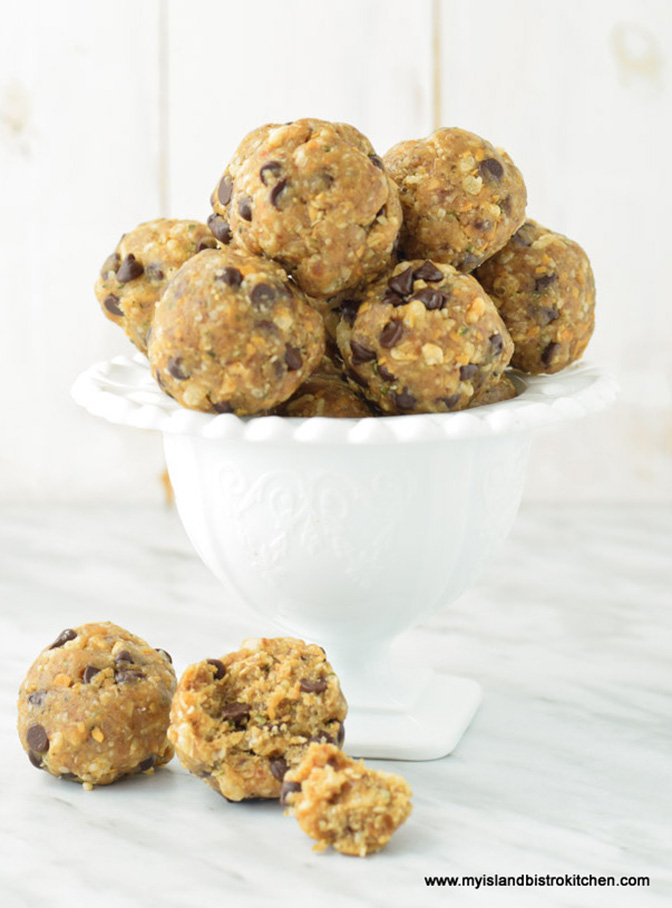
Energy bites (sometimes called energy balls, power balls, protein balls, or bliss balls) are a super tasty and convenient on-the-go snack.
My recipe for Peanut Butter Coconut Energy Bites is easy to make. They require no cooking or baking (provided, of course, that you buy the coconut already toasted and you don’t have to turn on the oven to toast coconut) — bonus ! Made with a blend of carefully selected ingredients that pair well together, these tasty treats provide a great energy boost, particularly mid-afternoon when energy typically starts to wane for many. Continue reading Peanut Butter Coconut Energy Bites→
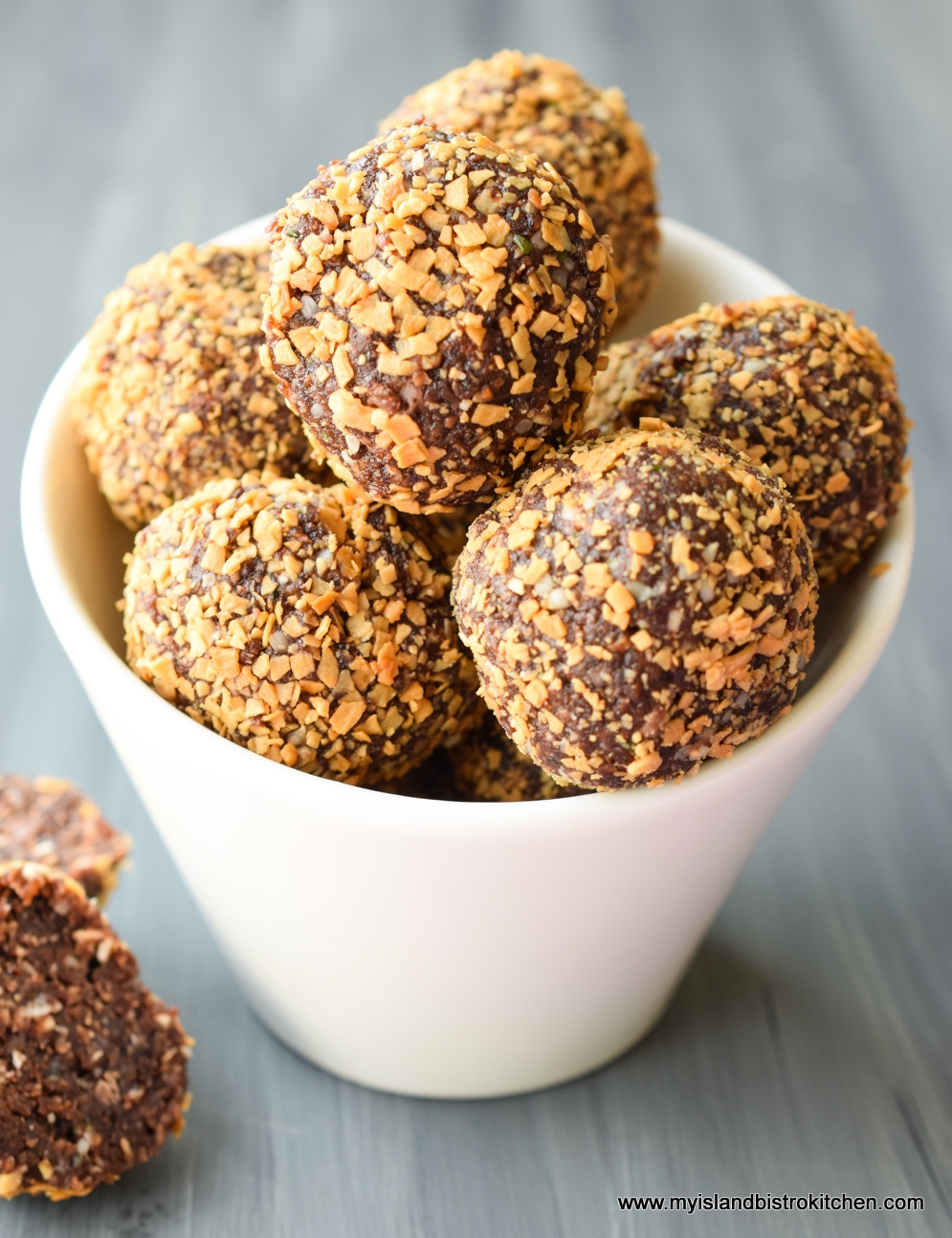
Sometimes called energy balls, power balls, protein balls, or bliss balls, these trendy snacks are tasty little morsels. The recipe I am sharing today is for No-bake Chocolate Almond Bliss Balls, so named because they are, well, blissfully divine! Continue reading No-bake Chocolate Almond Bliss Balls→
Comfort food has an emotional, nostalgic, and/or sentimental aspect to it. It evokes reactions to the senses of sight, taste, and smell. Think of walking into a kitchen where, for example, a roast chicken or turkey dinner is cooking. Can you visualize the golden roasted chicken or turkey? Recall the aroma? The satisfying taste? The mere sound of someone talking about homemade apple pie can summon both the smell and taste sensation of such a fabulously simple dessert. Maybe you remember the smell of bread baking in the oven at your mother’s or grandmother’s house. Can you recall the heavenly taste of the homemade bread?
These are a few classic examples of traditional comfort foods. They are typically hearty foods (not necessarily devoid of calories) that conjure up great taste sensations and perhaps wonderful memories of special people in your life with whom you associate specific foods or special events.
One of my special memories of comfort food is arriving at my grandmother’s house just as a batch of big, fat, soft molasses cookies was coming out of the oven. This particular grandmother was the epitome of the typical picture of a grandmother – gray hair in a bun, floral pinafore….and you get the picture. Even as I write this, decades later, I can still conjure up the spicy scent of the molasses cookies and the memory picture of my grandmother removing the pan of cookies from the oven of her wood stove and her sheer pleasure, sitting in her Boston rocker beside the stove, watching little hands reaching for a warm cookie and savoring every bite. Sweet memories of simple pleasures.
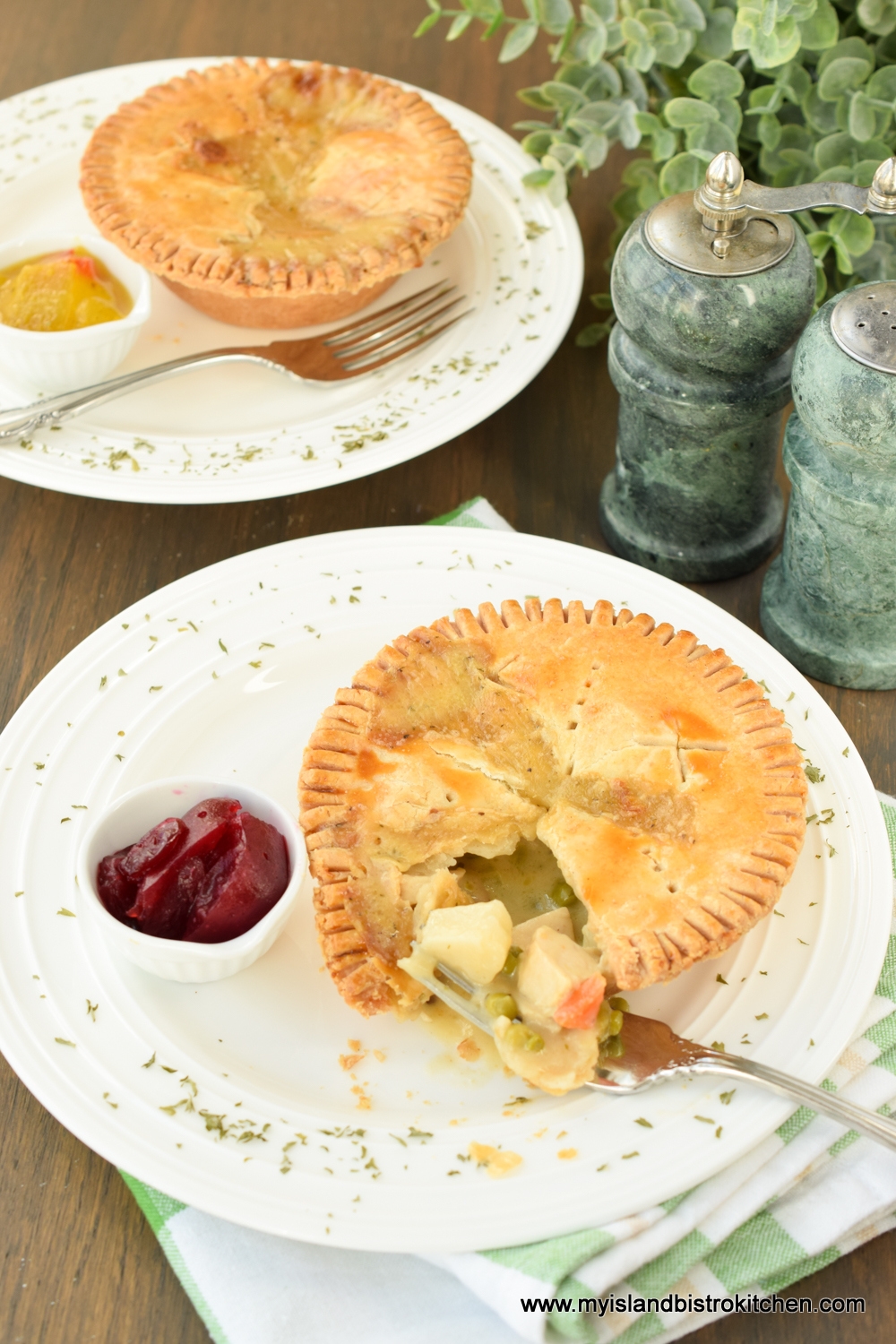
Individual Double-crusted Chicken Pot Pies
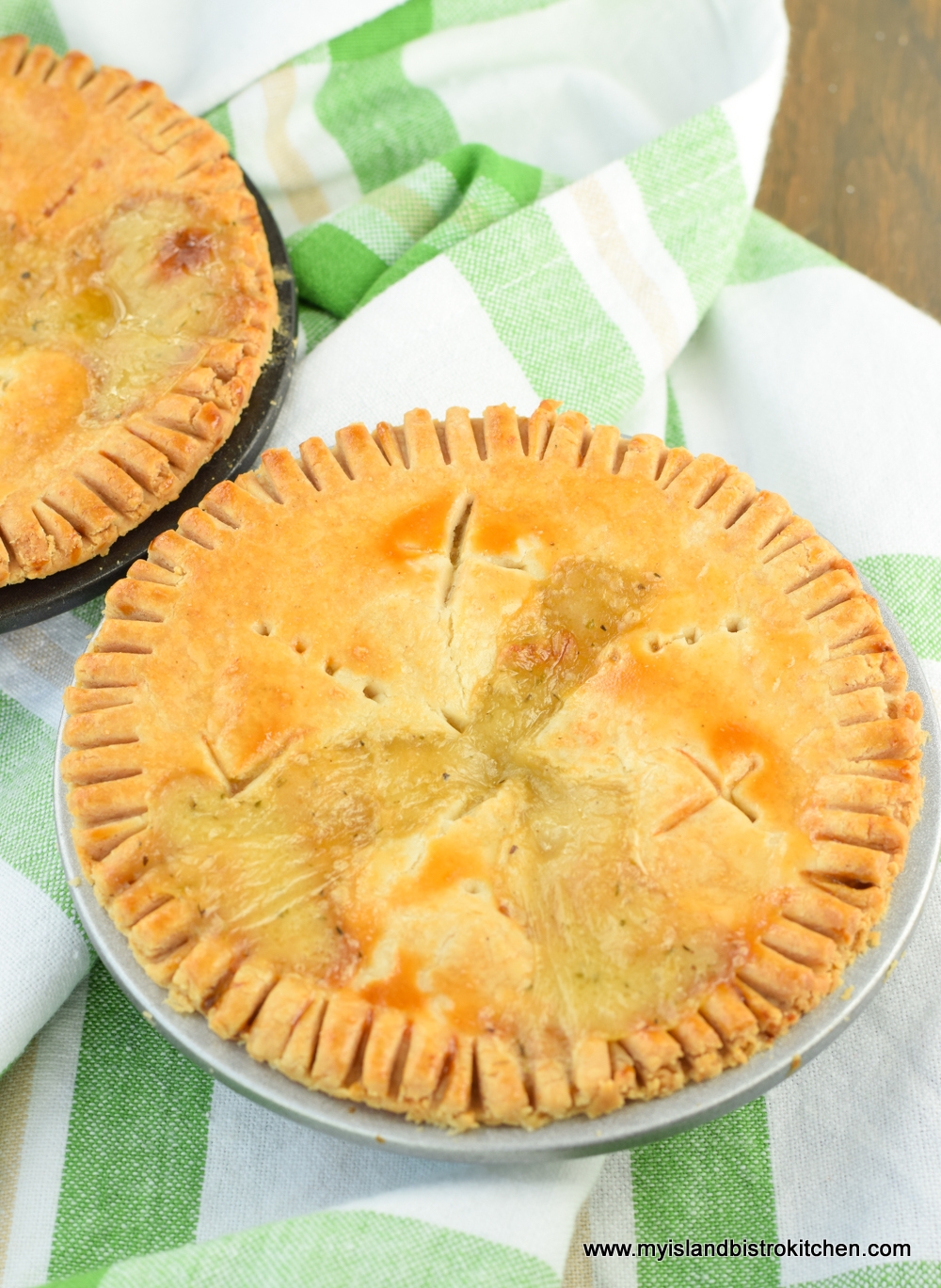
Today, I am sharing my recipe for individual-size Chicken Pot Pies that, in my view, fall nicely into the comfort food category. Getting the right seasoning and consistency for the sauce and a flaky pastry in which to encase the filling are the two big aspects of making a tasty and satisfying chicken pot pie. Once you have a good recipe for those, you have a good chicken pot pie. Continue reading Double-crusted Chicken Pot Pies→
Making gluten-free muffins can have its challenges! Getting the right blend of flours, enough rising power to achieve the perfect contoured muffin tops, and the right balance of liquid to dry ingredients, and that’s all before getting a great flavour and texture. Good news, though, I have perfected a great flour blend for these Banana Date Muffins and have worked out the necessary ratios of wet to dry ingredients to accommodate the properties of gluten-free flours! Continue reading Gluten-free Banana Date Muffins→
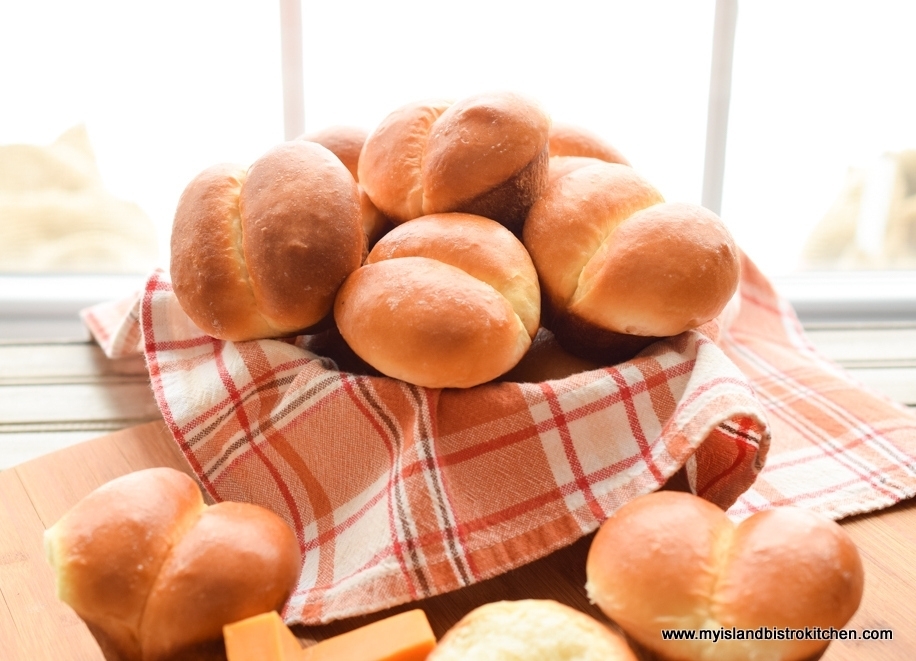
It’s hard to beat the tantalizing scent of homemade bread or dinner rolls baking in the oven. It’s even harder to pass up the wonderful flavor of freshly made warm bread or rolls slathered with a generous spread of pure butter. Do I have your attention yet? Continue reading Mouthwatering Homemade Dinner Rolls→
My cooking is sometimes inspired by my travels. Often, before traveling, I will do some research to find out what foods and dishes are local to the area so I know what dishes to try when visiting those places or what foods to look for to bring back as mementos of the visit. Continue reading Creamy Scallop Carbonara Recipe→
These gluten-free Gumdrop Cookies are very easy to make and are super tasty. They are soft and chewy, studded with colorful fruit-flavored gumdrops. Continue reading Gluten-free Gumdrop Cookies→
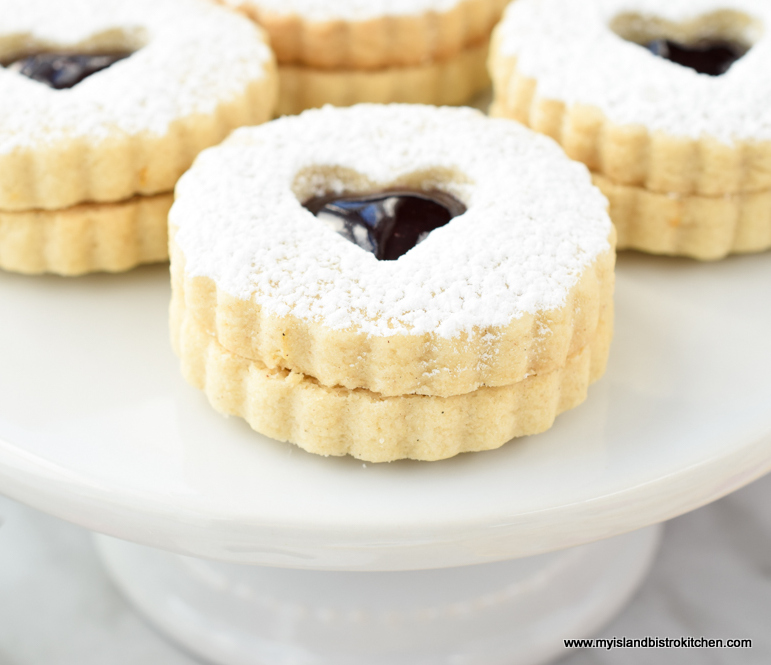
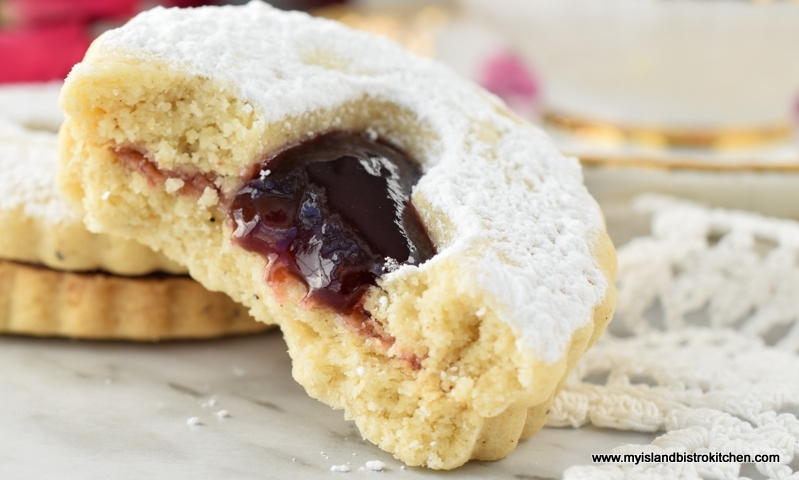
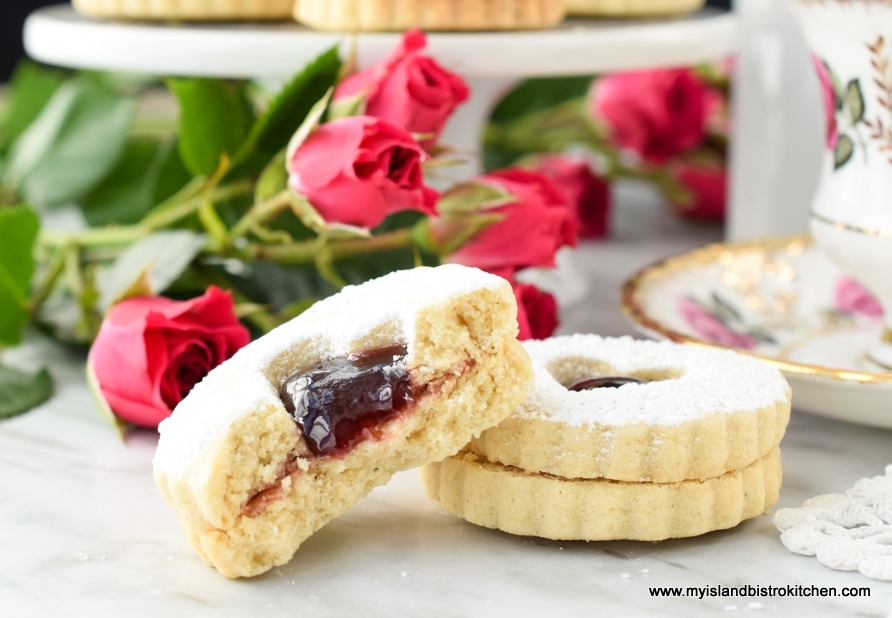
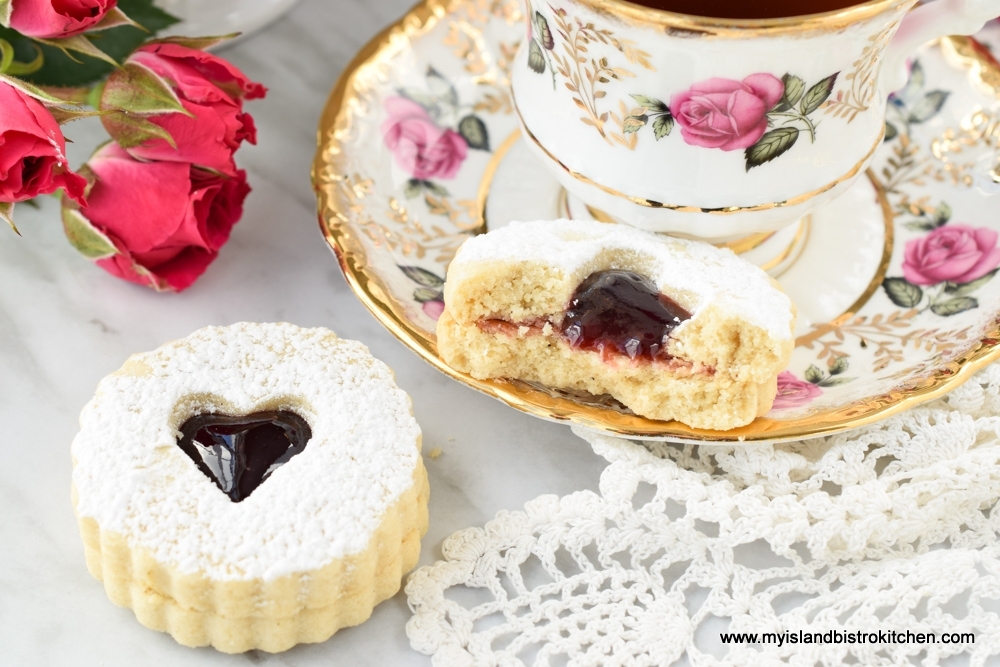
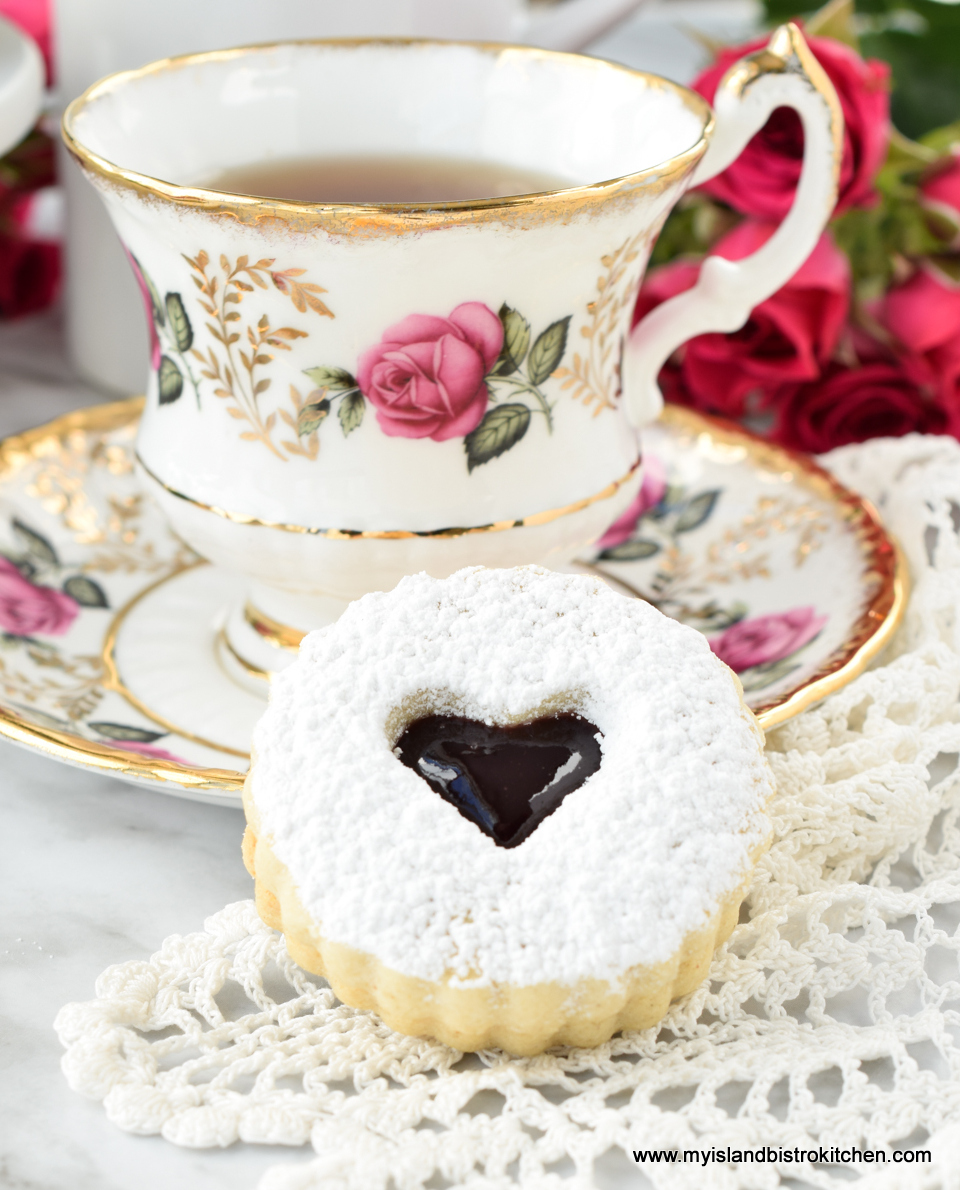
Today, I am featuring Classic Raspberry Linzer Cookies. These cookies, so-named for the Austrian Linzer Torte they replicate, are simply two shortbread-type cookies sandwiched together with jam. The cookies are commonly filled with raspberry jam which produces a very showy cookie. These cookies are traditionally found on sweet trays at Christmas but they are wonderful any time of the year. So, there is no need to wait for Christmas to enjoy them! You can legitimately actually have two cookies without feeling guilty when you eat one of these sandwich cookies – bonus!
Raspberry Linzer Cookies
The Linzer Torte, said to be the oldest cake recipe in the world and dating back to the late 1600s, is believed to have originated in the City of Linz in Austria. Made with a rich buttery crust of primarily butter, flour, and ground nuts, the torte was traditionally filled with black currant preserves and topped with a lattice crust that allowed the preserves to shine through.
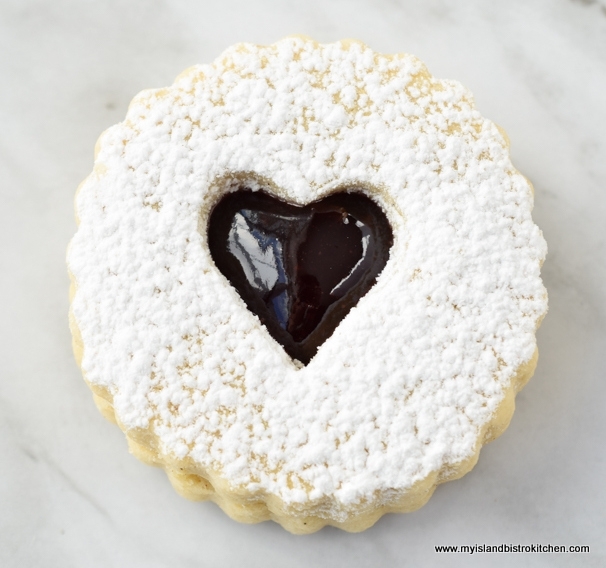
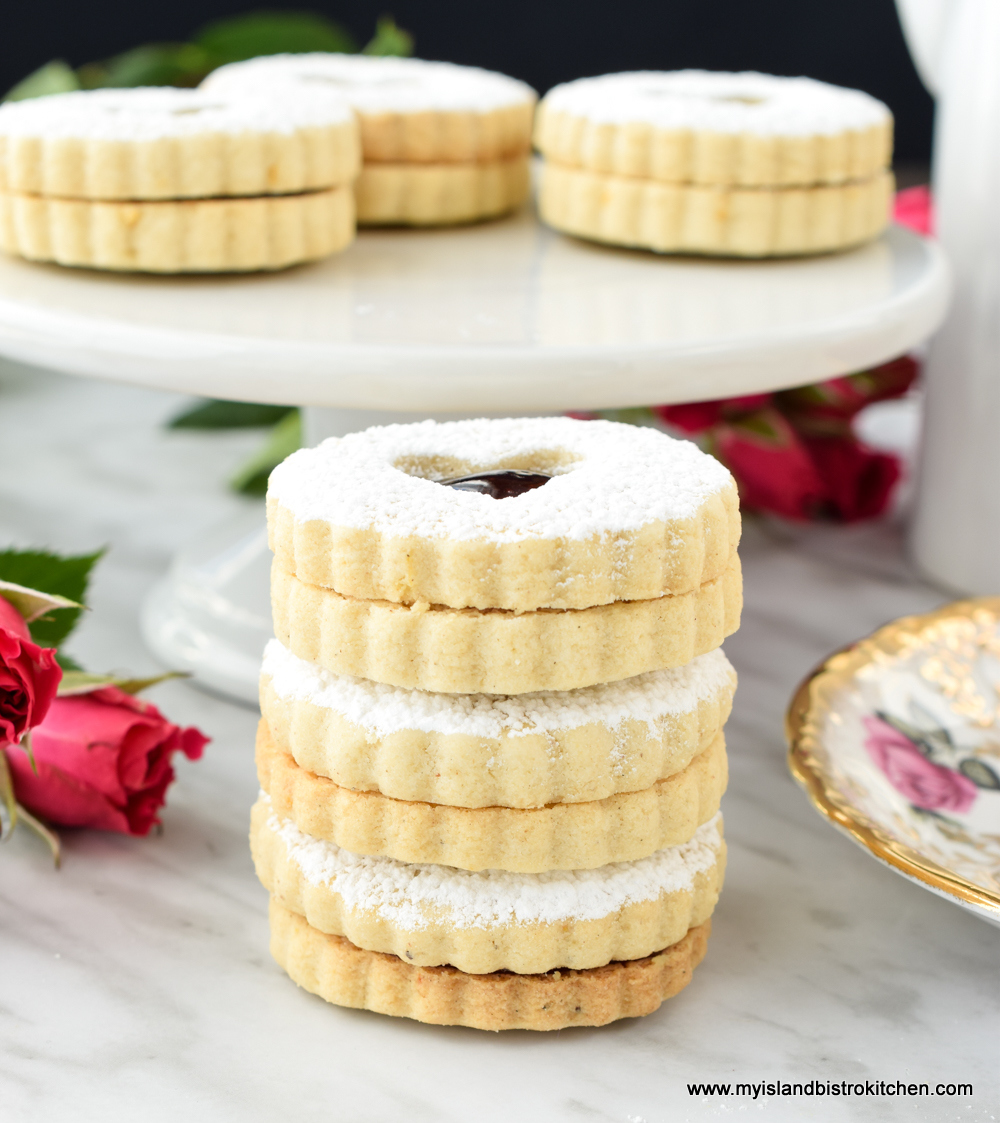
Linzer cookies are a take on the Linzer Torte put into a cookie format. Two cookies are sandwiched together with jam and the top cookie is generously dusted with powdered sugar making it very showy. To keep the jam filling visible, a simple cut-out is made in the top cookie.
Raspberry Linzer Cookies
The ingredients for the cookies are fairly basic and the texture closely resembles shortbread. That is to say, the cookies have a short, crisp, yet tender texture.
Texture of Linzer Cookies
While Linzer Cookies are obviously different than a torte, several of the ingredients are the same – butter, flour, and ground almonds. I add small amounts of cinnamon, cardamom, and cloves but in such small amounts that the flavours are very subtle. Some grated orange rind, vanilla, and almond flavoring are the only other injections of flavour into the rich buttery dough.
Classic Raspberry Linzer Cookies
To make these cookies gluten free, replace the 2¼ cups all-purpose flour with an equal amount of gluten-free 1-to-1 baking flour.
Raspberry Linzer Cookies
Tips for Making Linzer Cookies
Make sure all ingredients are at room temperature.
Do not overmix or overhandle the dough. Just mix it enough so it will cling together.
Divide the dough in half and form each half into a disc. Wrap the discs, separately, in plastic wrap and chill the dough for 35-45 minutes or until dough is firm enough to roll out. This will make the dough less sticky and easier to handle. The dough can be made up to a day ahead but it will need to be removed from the refrigerator for several minutes before rolling it out as it will be far too hard to allow the dough to be rolled out without it cracking or breaking apart.
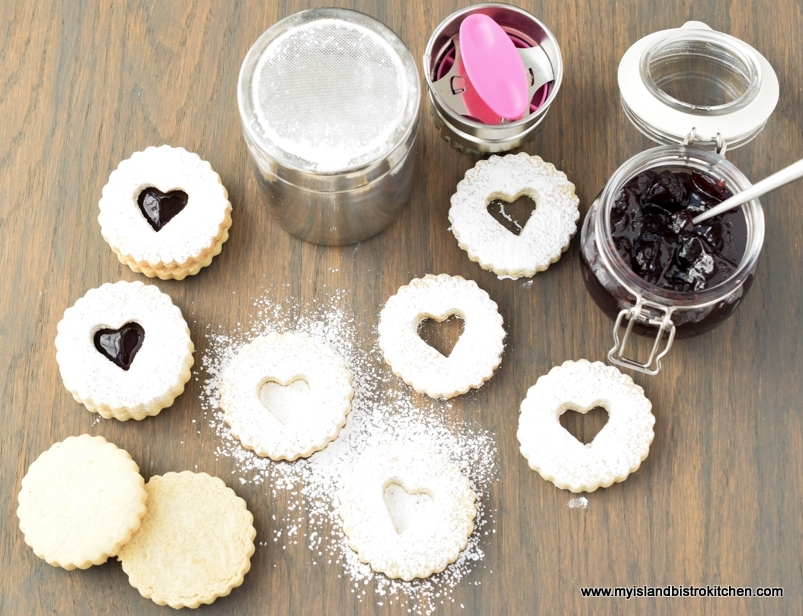
Special Linzer cookie cutters (seen at top of photo below) exist for cutting out these two-part cookies. These cutters have a plunger attachment that allows different interchangeable cut-out inserts to be used to cut out small shapes, like hearts, circles, and diamonds, in the centers of cookies. This cut-out, of course, allows the pretty jam or preserves to show through. If you don’t have a Linzer cutter, simply cut out the shape of the cookie with any 2” cookie cutter and then use a small 1” cookie cutter to cut out the center hole in half the cookie batch. Many sets of nesting cookie cutters have various sizes of cutters suitable for this purpose.
Raspberry Linzer Cookies
Work with one dough disc at a time. Roll the dough to about 1/8” thick. Two cookies will be sandwiched together so about 1/8” thickness is thick enough for each cookie half. Make sure you cut out an even number of whole cookies and cookies with the cut-outs so you will have matched pairs.
The cookies, once cut out and placed 1” apart on parchment-lined baking sheets need to go back into the refrigerator for about 20 minutes. This is an important step because the fat in the chilled cookies will take longer to melt once the cookies are placed in the oven than would room-temperature cookies. The chilling will mean the cookies will spread less as they bake and we want these cookies to hold their shape perfectly, especially the cut-out centers in the top cookies.
Do not overbake the cookies. Bake them for 11-13 minutes, just until the cookies are set and have a light golden color.
Dust the cut-out cookie tops with powdered sugar BEFORE placing them over the filled cookie bottoms (a small fine wire mesh sieve works well for this or a small metal mesh-topped can can also be used (seen in photo above)). If you wait to sugar-coat the cookies until after they have been assembled, the sugar will cover the jam filling and cause it to become cloudy and lose its clear, shimmery appearance.
Sugar-dusted Cookie Tops for Linzer Cookies
Any red jam or black currant jam can be used in these cookies. My preference is to use raspberry as the flavour blends well with the ground almonds and the orange flavoring in the cookies. I do recommend, whatever type of jam is used, that it be seedless. Do not spread the jam right to the outside edge of the bottom cookies as the jam will ooze out. Keep the jam in the center of the cookie bottoms. When the top cookie is placed on the jam-filled bottom, it will spread the jam further out in the cookie. No jam should be visible on the outside edges of Linzer cookies. If a bit more jam is desired in the cookies, use a tiny coffee spoon to carefully drop a bit more jam into the center of the assembled sandwich cookies.
Classic Raspberry Linzer Cookies
It is not recommended to freeze the assembled cookies for a couple of reasons. First, the jam is likely to soak into the cookies, especially as they thaw. This will cause the cookies to lose their crisp texture. Second, it takes up more container and freezer space to freeze the cookies in single layers so that the powdered sugar does not fall off the cookies or transfer onto the jam-filled centers, marring the look of the cookies.
Store filled cookies in airtight container in refrigerator for up to 3-4 days.
Classic Raspberry Linzer Cookies
[Printable recipe follows at end of posting]
Classic Raspberry Linzer Cookies
Ingredients:
2¼ cups all-purpose flour (to make them gluten free, substitute an equal amount of gluten-free 1-to-1 baking flour
¾ cup finely ground almonds
1 tbsp cornstarch
¾ tsp baking powder
¼ tsp cinnamon
¼ tsp cardamom
Pinch cloves
1 cup butter, room temperature (no substitutes)
2/3 cup granulated sugar
3 tbsp powdered sugar (aka icing sugar or confectioner’s sugar)
2 large egg yolks, room temperature
1 tsp vanilla
¼ tsp almond flavoring
1 tsp finely grated orange rind
Seedless raspberry jam (1/2 – ¾ cup)
Additional powdered sugar for dusting cookies
Method:
Sift dry ingredients together. Set aside.
In bowl of stand mixer fitted with paddle attachment, cream the butter at medium speed until fluffy and pale yellow. Slowly add the sugars and cream well for 2-3 minutes, scraping the sides of the bowl as necessary. Reduce speed to low and add the egg yolks, one at a time, beating well after each addition. Add the vanilla and almond flavoring as well as the grated orange rind. Mix to combine well.
With mixer set on low speed, gradually blend in the dry ingredients, mixing just until dry ingredients are fully incorporated. Do not overmix. Turn dough on to a lightly floured surface and gather the dough, working it just enough that it clings together. Divide the dough into two equal portions and form each half into a round disc. Wrap discs separately in plastic wrap and refrigerate for 35-45 minutes, or until firm enough to roll.
On lightly floured surface, roll a dough disc into 1/8” thickness. Using a 2” Linzer cookie cutter (either straight edged or fluted), cut cookies from one half the dough. Gather dough scrapes and continue cutting out the cookies until the dough is used up. These will be the cookie bottoms. Roll out remaining dough disc in the same manner for the cookie tops. To cut out the cookie tops, use the same Linzer cutter but fitted with one of the insert shapes to cut out a small 1” shape in the center of each cookie. Repeat until an equal number of cookies with cut out centers have been cut as there are whole cookies. If you do not have a Linzer cookie cutter, use any 2” cookie cutter and a 1” cutter of any shape for the center cut-out of half the cookies.
Place cookies about 1” apart on parchment-lined baking sheets. Refrigerate cookies for about 20 minutes.
Meanwhile, preheat oven to 350°F. Bake cookies on the middle oven rack for 11-13 minutes, or just until cookies are set and a light golden color. Do not overbake. Remove cookies from oven and cool on baking sheet for about 3-4 minutes then, using a flat lifter/spatula, transfer them to a wire rack to cool completely.
To assemble sandwich cookies, place the cookie halves that have the cut-out centers on a cutting board (these will be the top cookies). Dust the cookies generously with sifted powdered sugar, covering the cookies with an even coating of the sugar. On the flat side (i.e., the underneath side) of the whole cookies, spread about 1 – 1½ teaspoons jam in the center of each cookie, being careful not to spread the jam all the way to the cookie edges (stay within ¼” of the cookie edge). Place the cut-out sugar-dusted cookie tops over the jam-spread bottom cookies to create the sandwich. If desired, use a tiny spoon to carefully add a bit more jam into the center cut-out of each cookie.
Store cookies in an airtight container in the refrigerator for up to 3-4 days. To freeze cookies, package unassembled cookies between layers of parchment paper in an airtight container. Bring cookies to room temperature before filling with jam and assembling as above described.
Sugar-dusted jam-filled Linzer Cookies have a tender and crisp texture and buttery flavour complemented by ground almonds and subtle spice seasonings.
Course
Dessert
Keyword
Linzer Cookies
Servings26
My Island Bistro KitchenMy Island Bistro Kitchen
Ingredients
2¼cupsall-purpose flour (to make them gluten freesubstitute an equal amount of gluten-free 1-to-1 baking flour
¾cupfinely ground almonds
1tbspcornstarch
¾tspbaking powder
¼tspcinnamon
¼tspcardamom
Pinchcloves
1cupbutterroom temperature (no substitutes)
2/3cupgranulated sugar
3tbsppowdered sugaraka icing sugar or confectioner’s sugar
2large egg yolksroom temperature
1tspvanilla
¼tspalmond flavoring
1tspfinely grated orange rind
Seedless raspberry jam1/2 – ¾ cup
Additional powdered sugar for dusting cookies
Instructions
Sift dry ingredients together. Set aside.
In bowl of stand mixer fitted with paddle attachment, cream the butter at medium speed until fluffy and pale yellow. Slowly add the sugars and cream well for 2-3 minutes, scraping the sides of the bowl as necessary. Reduce speed to low and add the egg yolks, one at a time, beating well after each addition. Add the vanilla and almond flavoring as well as the grated orange rind. Mix to combine well.
With mixer set on low speed, gradually blend in the dry ingredients, mixing just until dry ingredients are fully incorporated. Do not overmix. Turn dough on to a lightly floured surface and gather the dough, working it just enough that it clings together. Divide the dough into two equal portions and form each half into a round disc. Wrap discs separately in plastic wrap and refrigerate for 35-45 minutes, or until firm enough to roll.
On lightly floured surface, roll a dough disc into 1/8” thickness. Using a 2” Linzer cookie cutter (either straight edged or fluted), cut cookies from one half the dough. Gather dough scrapes and continue cutting out the cookies until the dough is used up. These will be the cookie bottoms. Roll out remaining dough disc in the same manner for the cookie tops. To cut out the cookie tops, use the same Linzer cutter but fitted with one of the insert shapes to cut out a small 1” shape in the center of each cookie. Repeat until an equal number of cookies with cut out centers have been cut as there are whole cookies. If you do not have a Linzer cookie cutter, use any 2” cookie cutter and a 1” cutter of any shape for the center cut-out of half the cookies.
Place cookies about 1” apart on parchment-lined baking sheets. Refrigerate cookies for about 20 minutes.
Meanwhile, preheat oven to 350°F. Bake cookies on the middle oven rack for 11-13 minutes, or just until cookies are set and a light golden color. Do not overbake. Remove cookies from oven and cool on baking sheet for about 3-4 minutes then, using a flat lifter/spatula, transfer them to a wire rack to cool completely.
To assemble sandwich cookies, place the cookie halves that have the cut-out centers on a cutting board (these will be the top cookies). Dust the cookies generously with sifted powdered sugar, covering the cookies with an even coating of the sugar. On the flat side (i.e., the underneath side) of the whole cookies, spread about 1 – 1½ teaspoons jam in the center of each cookie, being careful not to spread the jam all the way to the cookie edges (stay within ¼” of the cookie edge). Place the cut-out sugar-dusted cookie tops over the jam-spread bottom cookies to create the sandwich. If desired, use a tiny spoon to carefully add a bit more jam into the center cut-out of each cookie.
Store cookies in an airtight container in the refrigerator for up to 3-4 days. To freeze cookies, package unassembled cookies between layers of parchment paper in an airtight container. Bring cookies to room temperature before filling with jam and assembling as above described.
Recipe Notes
Yield: Approximately 26 sandwiched cookies.
[Copyright My Island Bistro Kitchen]
If you have made this recipe and enjoyed it and/or wish to share it with your friends and family, please do so on social media but be sure to share the direct link to this posting from my website.
Connect on social media with My Island Bistro Kitchen:
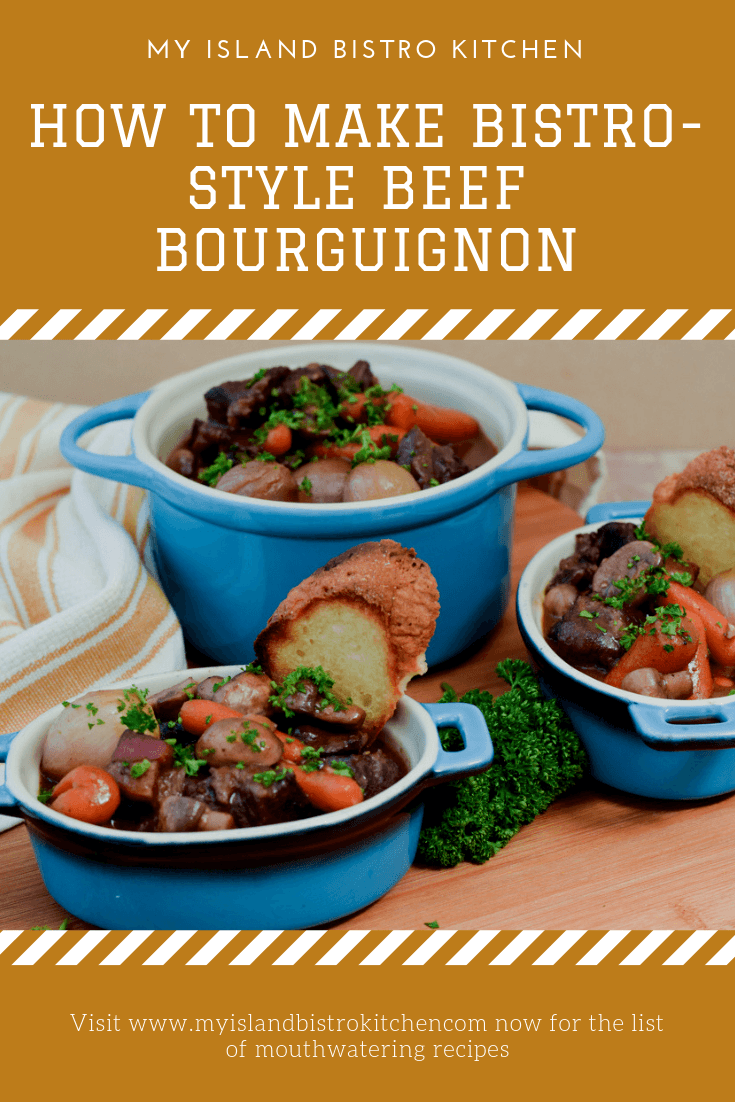
Doesn’t the mere sound of the name Beef Bourguignon conjure up the notion that it is some exotic dish you would expect to find in a French bistro? Guess what? You can easily make this classic French cuisine dish at home! Simple ingredients, economical cuts of beef, and time are all that is required.
Braising
Made with basic ingredients, what makes Beef Bourguignon so wonderful is the cooking method known as braising. Used in many recipes, braising is simply using a long, slow, moist heat method of cooking tougher cuts of meat in a liquid such as red wine and/or beef stock to tenderize the meat.
This method of cooking is great to use for cuts of meat known to be on the tougher side because the combination of moist heat, low cooking temperature, lengthy cooking time, and a flavorful liquid breaks down the connective tissues (collagen) in the meat, melting it into a silky gelatin. This results in divinely tender and succulent meat that will easily break apart with a fork.
Cuts of meat suitable for braising are cuts of muscular meats like chuck or beef cheeks, for example. These cuts from the highly exercised parts of the animal are ones known to have lots of collagen that, like magic, when cooked long and slow, turn tough cuts of meat into soft gelatin that will break apart with the touch of a fork. If you don’t need a knife to cut the meat, you have yourself a dandy Beef Bourguignon! Using more premium cuts of beef will not become more fork tender than the cheaper cuts in this dish so, save your money, and buy the economical cuts.
Braising can be done on the cooktop over low heat but oven braising will provide more even heating and will reduce the risk of burning the meat. Braising on the stovetop will result in more heat directly hitting the bottom of the pot specifically as opposed to oven braising where the heat is more evenly distributed to all sides of the cooking vessel.
Beef Bourguignon is not difficult to make but there are several steps involved and some time has to be dedicated to it. It’s not a dish you would start for dinner after arriving home from work at 5:00pm.
There are many versions of this dish and various ways in which to prepare it. What follows is the method that works well for me.
Choosing the Meat
Both pork and beef are used in this dish.
Pork
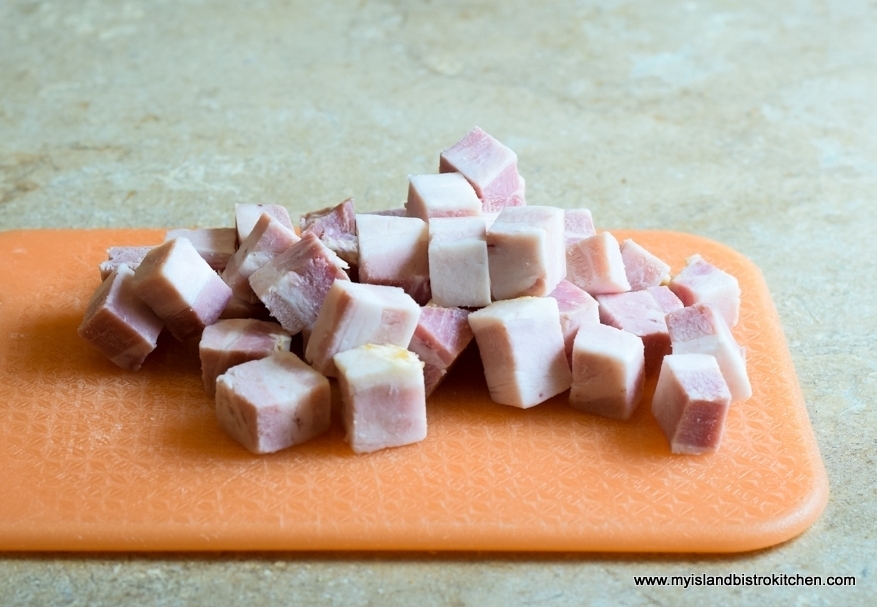
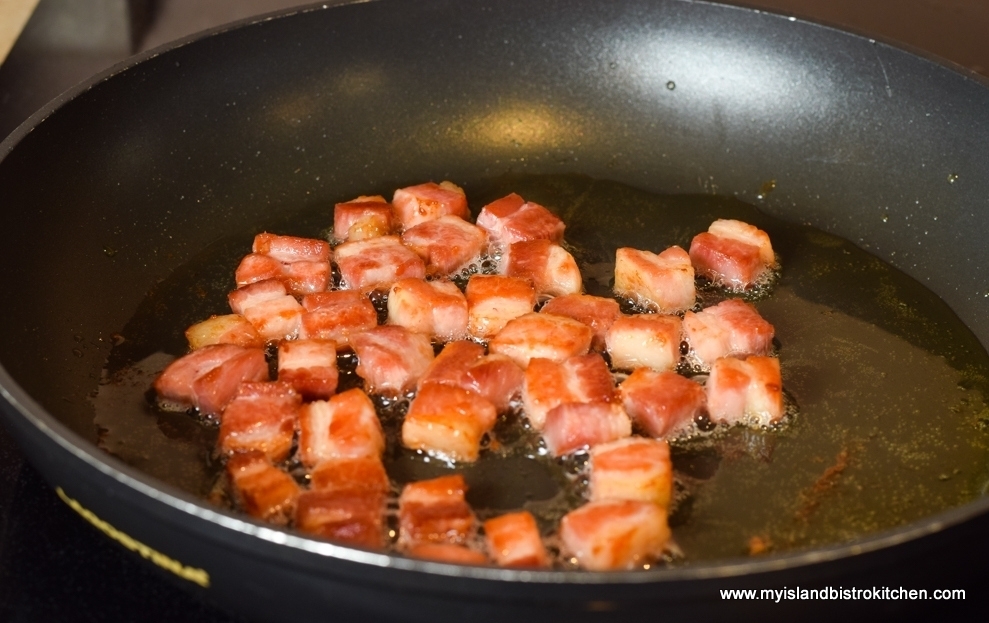
Pork lardons add a lovely texture and layer of flavour richness to Beef Bourguignon.. Lardon is another name for thick, fatty salt pork, much thicker than the thin bacon strips found, pre-packaged, in supermarkets. While the lardons, themselves, lend wonderful texture and flavor to the dish, it is their rendered fat that is prized for the rich flavour it gives to the beef as it is seared before it is braised.
Pork Lardons
I recommend using the lardons over the thin bacon because the thickness of the lardons allows them to keep their shape when fried. You may need to go directly to a butcher shop (as opposed to a standard supermarket) to get the lardons. I went to a local butcher, KJL Meats, here in Charlottetown and, as soon as I said what I was making, the butcher knew exactly what I was looking for and he actually cut the lardons into suitably-sized chunks for me!
The lardons are cooked until the fat in them has been rendered out. That flavorful fat is then used to sear the beef, keeping all the wonderful flavor in the dish.
Pork Lardons
Beef
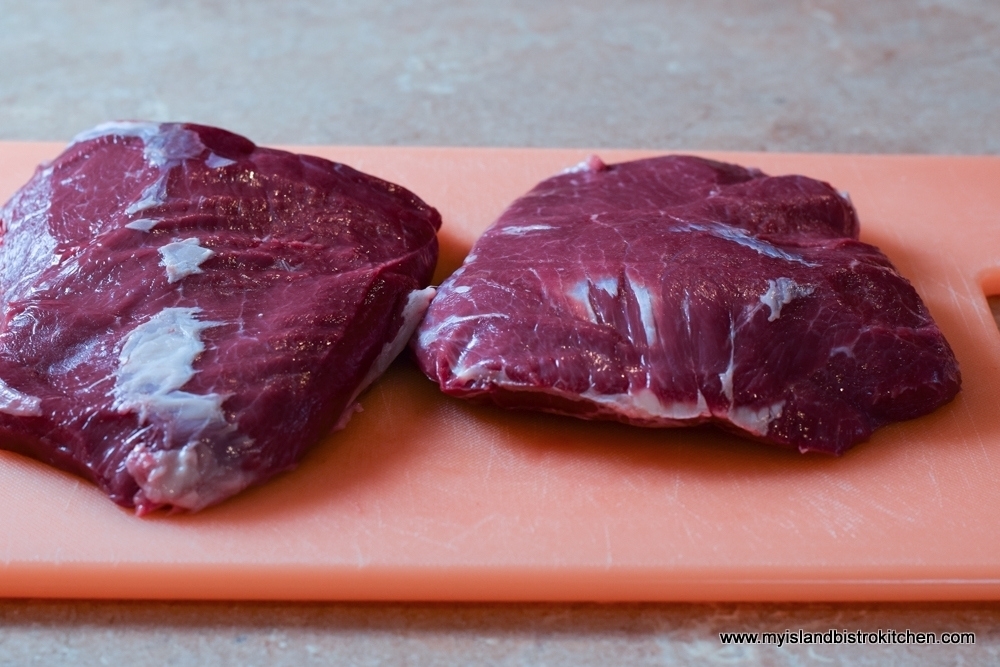
As mentioned, one of the best things about Beef Bourguignon is that economical cuts of beef are used. My preference is to use beef cheeks for this recipe though chuck also works very well. Some marbling in the meat is also beneficial as the slow cooking process will melt the fat and turn it into a melt-in-your-mouth gelatin. The transformation is absolutely amazing!
To get exactly what I want for meat, I go directly to a local butcher – it’s local PEI beef and it’s fresh. The meat in the photographs came from MacQuarrie’s Meats in Milton, on the outskirts of Charlottetown. Depending on where you live and what your local butchers keep on hand, you may need to pre-order specific cuts, such as beef cheeks, from your local butcher.
Beef Cheeks
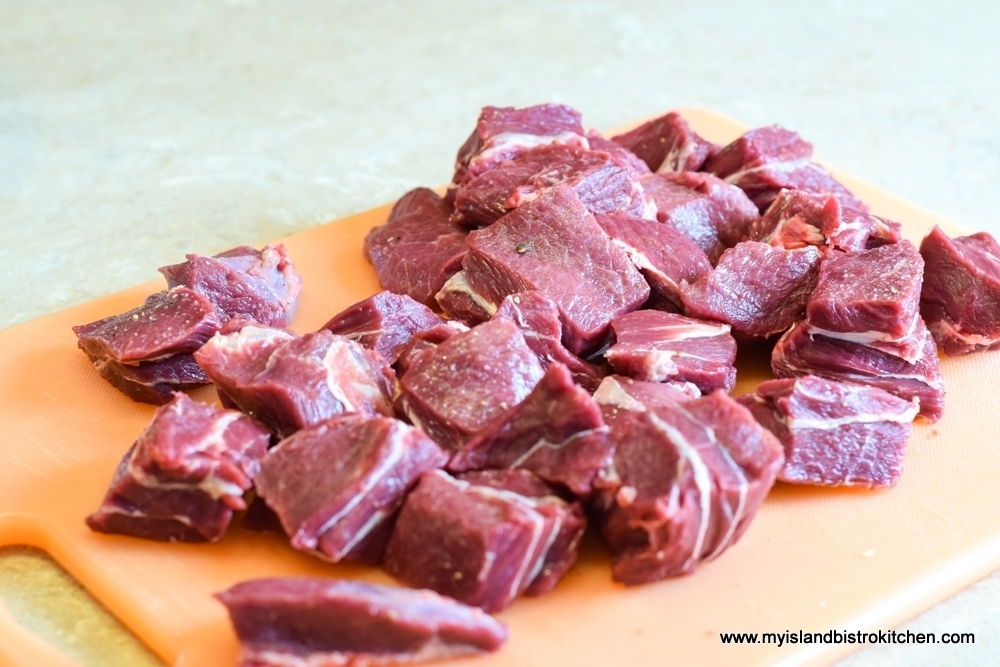
If there happens to be any excess hard fat or tendons still visible on the meat, remove them. Pat the meat dry with paper towel – this will help the cornstarch or flour stick to the meat when it is dredged before being seared. Season the meat with sea salt and freshly ground pepper.
Beef Cheeks cut for Beef Bourguignon
Cut the meat into rather large chunks – approximately 2” pieces. This is meant to be a rustic dish and cutting the meat any smaller may cause the meat to dry out faster and it won’t have the same presentation as if the chunks are larger. Once the meat is dredged in the cornstarch or flour, sear it over medium-high heat in the lardon fat.
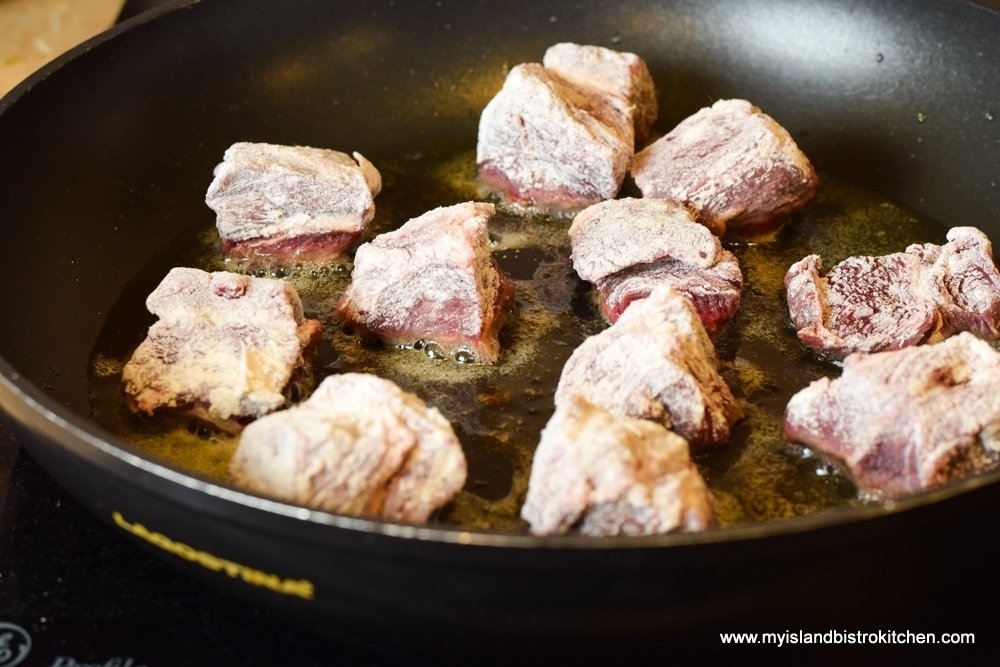
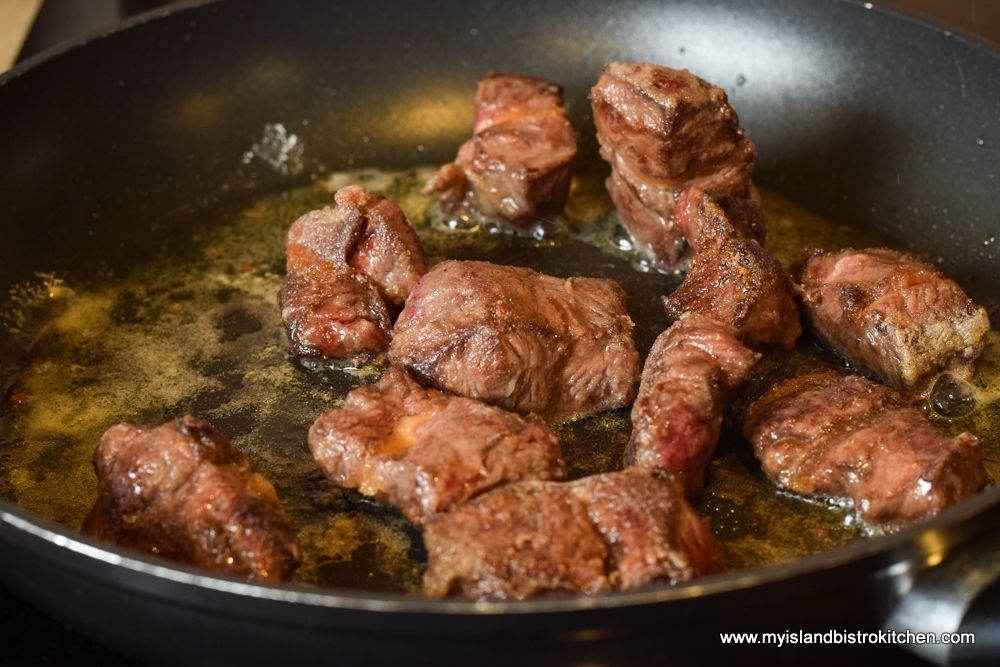
Searing Beef for Beef Bourguignon
Searing the meat before simmering it in the cooking liquid is known as brown braising. This will add depth of flavour as the meat caramelizes while a brown crust forms on the beef. This ‘browning” will not only add flavor but it will help produce a rich brown sauce. Don’t try to speed up the process by over-crowding all the meat pieces into the pan at once. Work in batches and leave some space between the chunks of meat so they brown nicely. The aim of this process is to sear the meat, not steam it or cook it all the way through.
Searing Beef for Beef Bourguignon
Making the Bouquet Garni
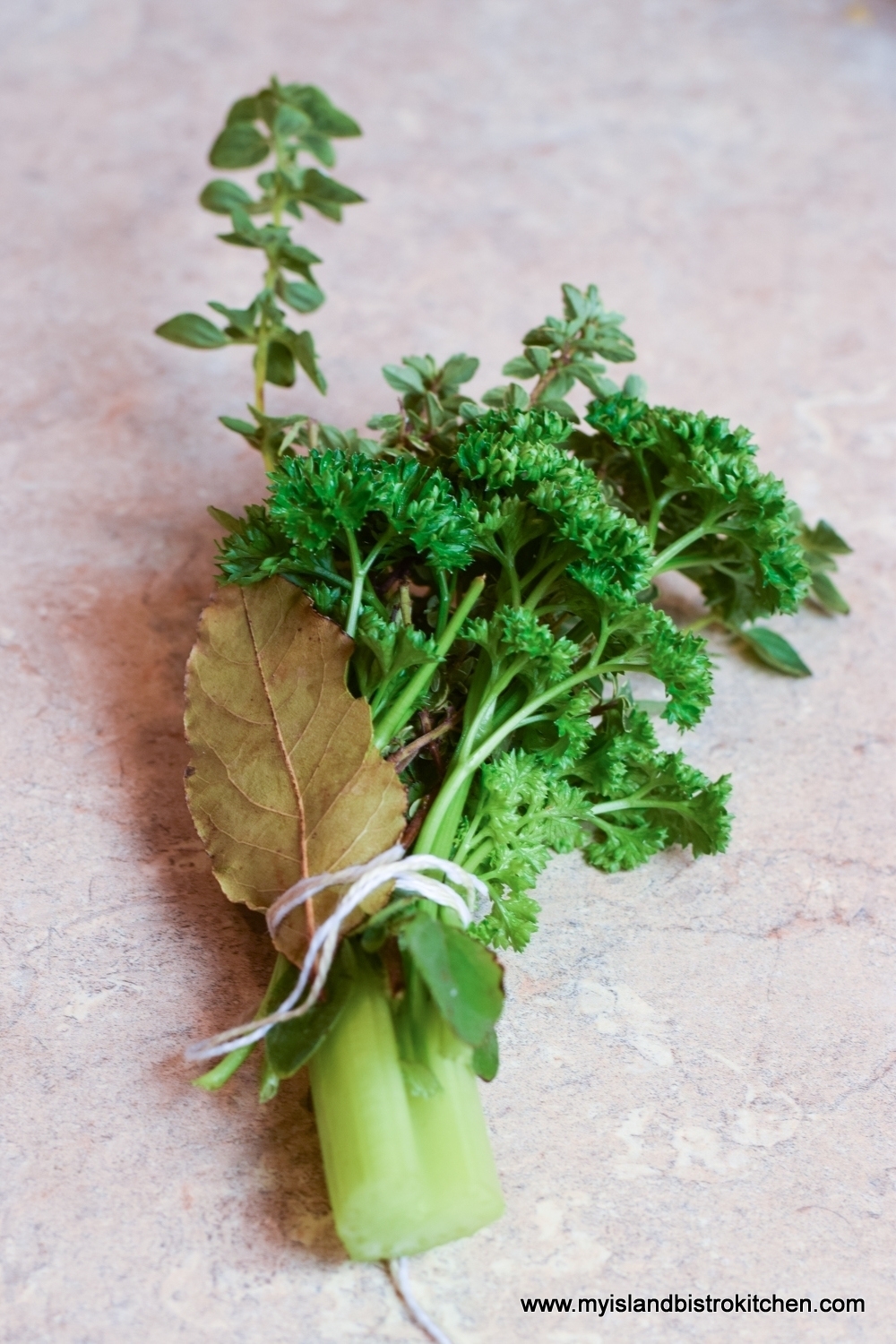
Fresh herbs really do make the difference in this dish. You will need two to three sprigs each of fresh thyme and parsley along with two dried bay leaves. These are easily tied together with kitchen string/twine. Insert 4 whole cloves into the center of a 6” strip of celery and tie the herbs to the celery. This bouquet will get dropped into the braising liquid to flavour it as the meat cooks.
Bouquet Garni
When the Bourguignon is cooked, the bouquet garni is removed and discarded.
Preparing the Braising Liquid
Once the meat has been seared, there will be caramelized brown bits (known as fond) left in the pan. This bears wonderful flavour and will help to color the braising liquid. Deglaze the pan with either red wine, brandy, or beef stock, scraping up the flavorful brown bits. I find the brandy adds a layer of flavour complexity, richness, and depth to this dish.
Some basic aromatics always form a good basis for any braising dish. Cook some coarsely chopped onion in some olive oil and butter. Butter (which gives fabulous flavour) tends to burn easily which causes some flavour deterioration. Olive oil, however, does not burn so quickly so heating it first then adding the butter prevents the butter from burning and yet still gives the dish some buttery flavour. Add some garlic and just a bit of tomato paste and then, of course the red wine which, next to the beef, is the signature ingredient in Beef Bourguignon. It’s really not Beef Bourguignon if there is no red wine in this dish!
The acidic properties in the red wine not only add flavour to the dish but, importantly, soften muscle fibres and generate melt-in-your-mouth quality meat. I recommend using a dry red wine. While technically any dry red wine will work in this dish, I like to use a Pinot Noir that has earthy notes to it – it tends to be a wine that goes well with all sorts of red meat. There is no need to go with the best wine on the market for this dish but I do suggest using one you would be prepared to drink. When I am pairing a wine to drink with Beef Bourguignon, I use the same wine at the table as has been used in the Bourguignon. Don’t use a supermarket “cooking wine” for Beef Bourguignon. No, just don’t do it!
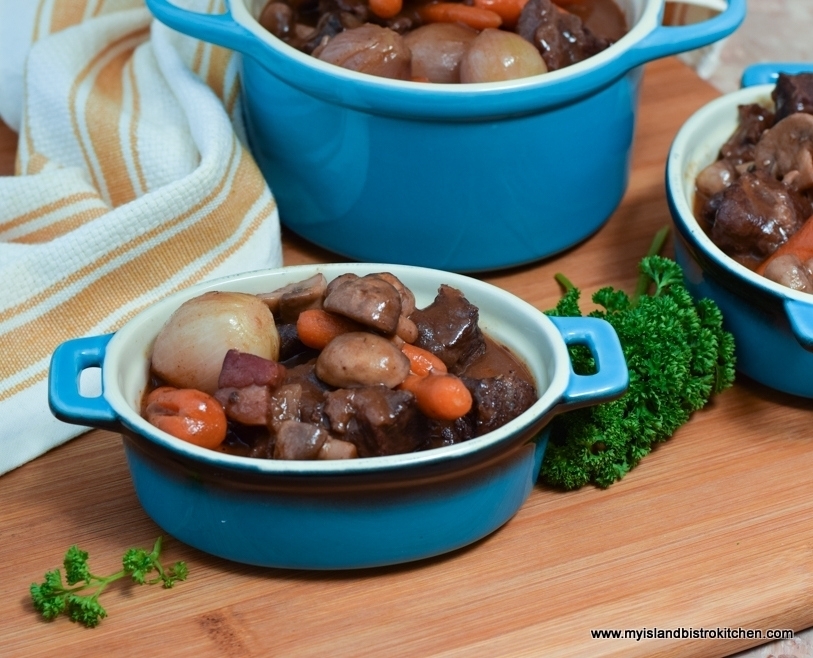
Bistro Style Beef Bourguignon
Slowly boiling the wine for 4-5 minutes will burn off the raw alcohol. This dish is not meant to reek of the wine; rather, the role of the wine is, yes, partly to flavour the sauce in a good way but, more importantly, to tenderize the meat.
Any beef stock can be used in this dish, either homemade (click here for my recipe) or purchased. Adding the beef stock (as opposed to only using wine), adds a layer of flavour. In my opinion, using only wine would make the resulting sauce too strong. If the first taste I get from Beef Bourguignon is a heavy wine taste, that tells me too much wine was used in the braising liquid. The hallmark of a well-prepared dish is the subtle layers of flavours that build the overall flavour profile and one flavour should not dominate the others in a negative way.
With braising, the braising liquid should not entirely cover the meat; rather, it should cover no more than about one-half to two-thirds of the meat. If you “swim” the meat, that’s a stew and, unlike with the braising method, tough cuts of meat will not tenderize using a stewing method. In addition, adding too much liquid will dilute the sauce and flavour. It’s also important that the braising liquid just simmer, not boil. Check the Bourguignon as it braises. If it is actively bubbling/vigorously boiling, reduce the oven temperature.
Keep the pot covered tightly to keep the moist heat in. Otherwise, the braising liquid will evaporate and the meat will be subject to some drying. Dutch ovens are often used for braising because they have the width for the contents to evenly cook and they have tight fitting covers. Other cooking vessels with tight-fitting lids, such as a high-sided casserole dish, will work equally well. The important thing is to use a vessel that allows the sauce to surround, not completely submerge, the meat.
There are many schools of thought on what the “correct” braising temperature should be. I am not sure there is one. My preference is around 275°F. The aim is to keep the braising liquid from actively boiling because the premise behind braising is to let the meat cook very slowly allowing it to tenderize. High temperatures can result in dryer meat. Additionally, since my recipe calls for a starch thickener for the braising liquid, a high cooking temperature will break down the starch causing it to lose its thickening power resulting in a watery thin sauce. As a general rule of thumb, or frame of reference, the sauce should be thick enough to coat the back of a spoon.
Vegetables
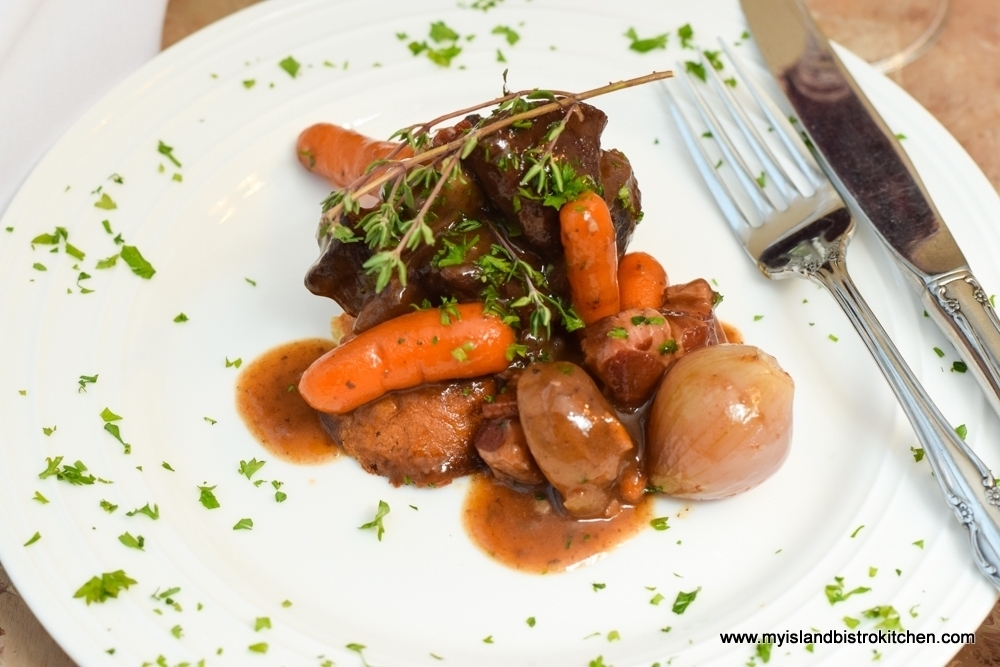
Beef Bourguignon does not contain a lot of vegetables, or varieties of vegetables. Typically, it only has carrots, mushrooms, and either tiny pearl onions or shallots. It’s all about the beef in this dish and the other additions serve only as flavour contributors that, themselves, absorb the wonderful savory flavours in the braising liquid. There are enough vegetables in the Bourguignon, however, that it generally is not necessary to add a side of vegetables (except perhaps mashed potatoes) to serve with the Bourguignon.
Bistro Style Beef Bourguignon
Serving Suggestions
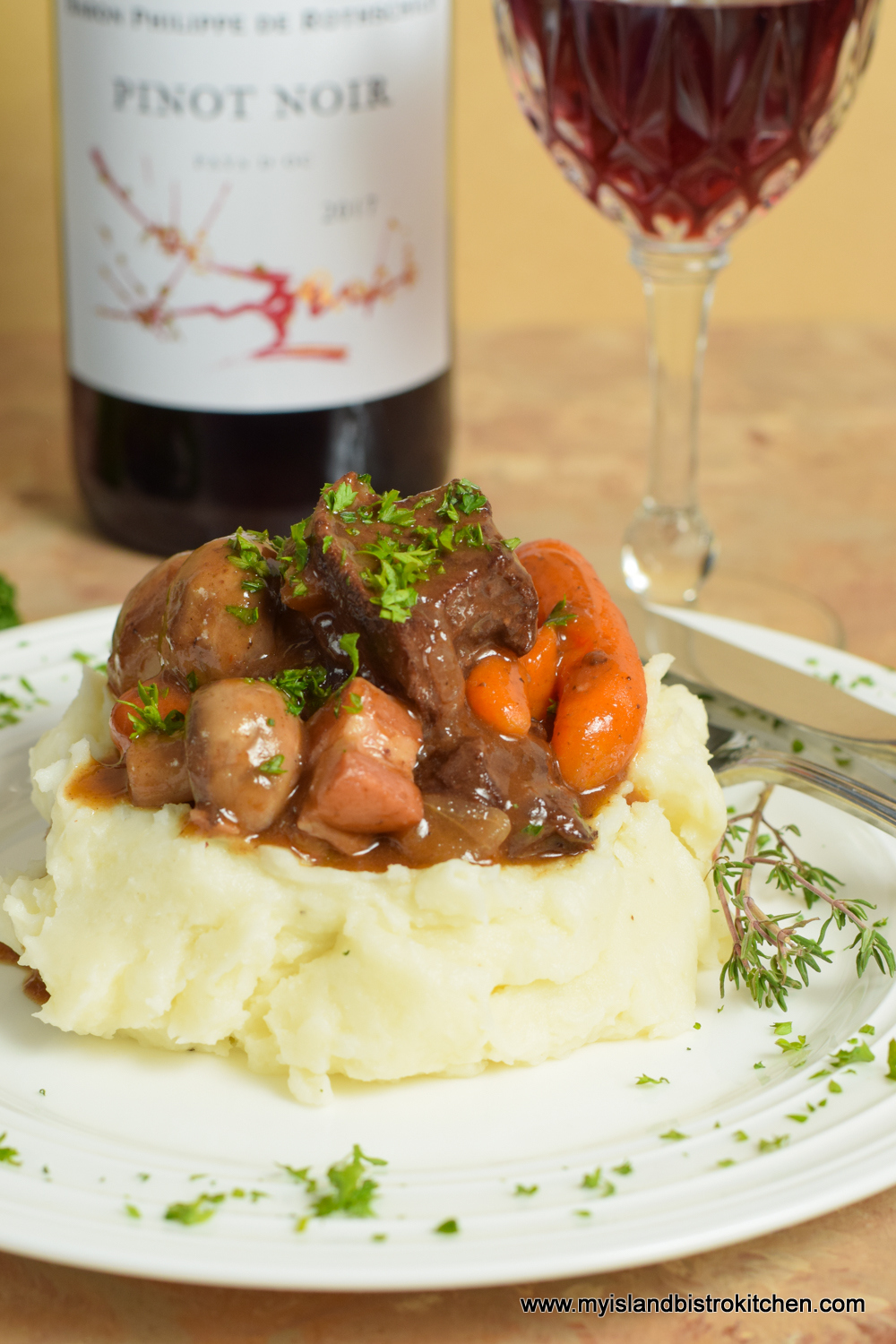
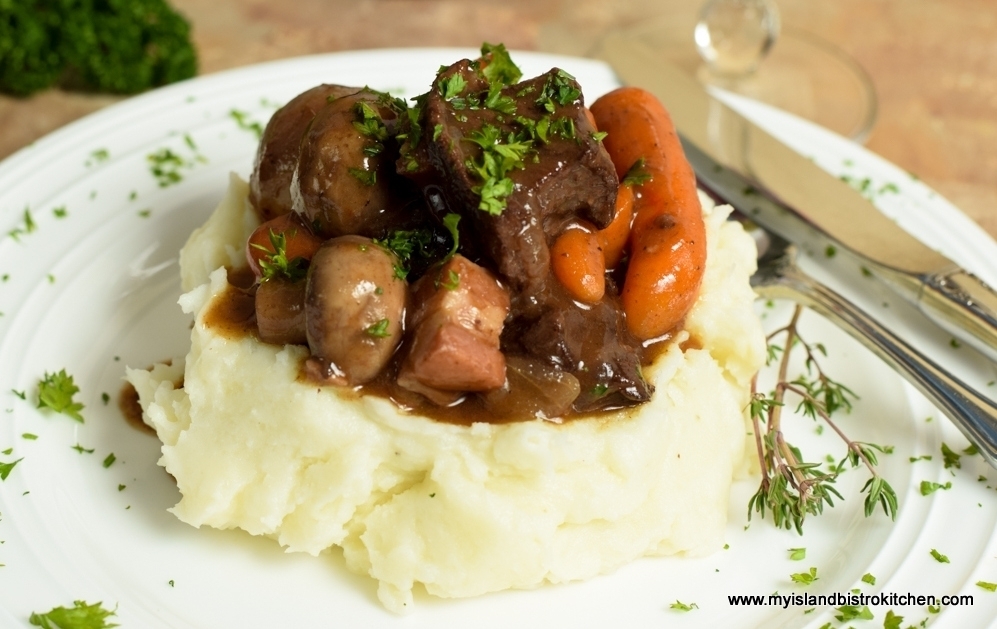
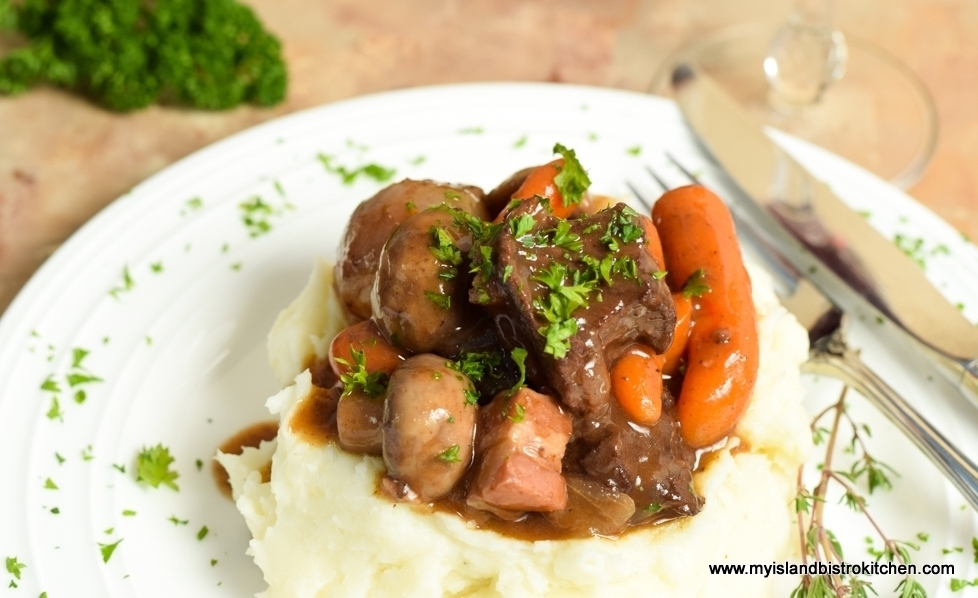
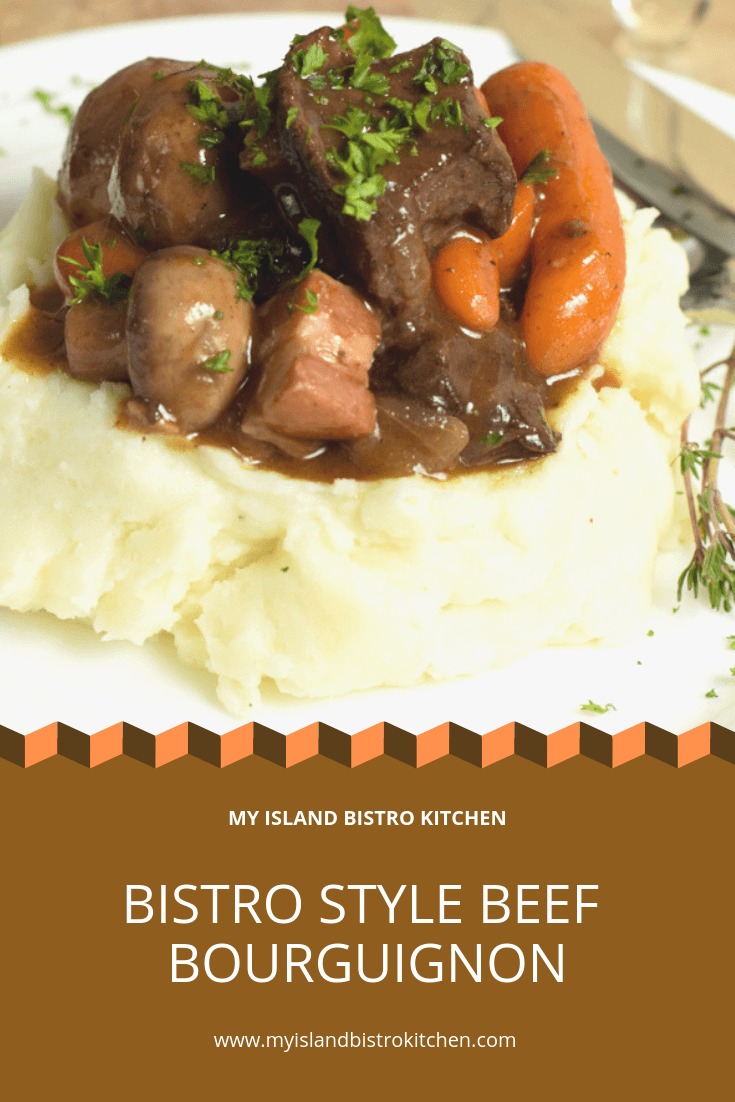
My favorite way to serve Beef Bourguignon is with whipped mashed potatoes seasoned with butter and garlic. The wonderfully rich sauce from the Bourguignon pairs very well with the potatoes.
Bistro Style Beef Bourguignon Served with Whipped Garlic Seasoned Mashed Potatoes
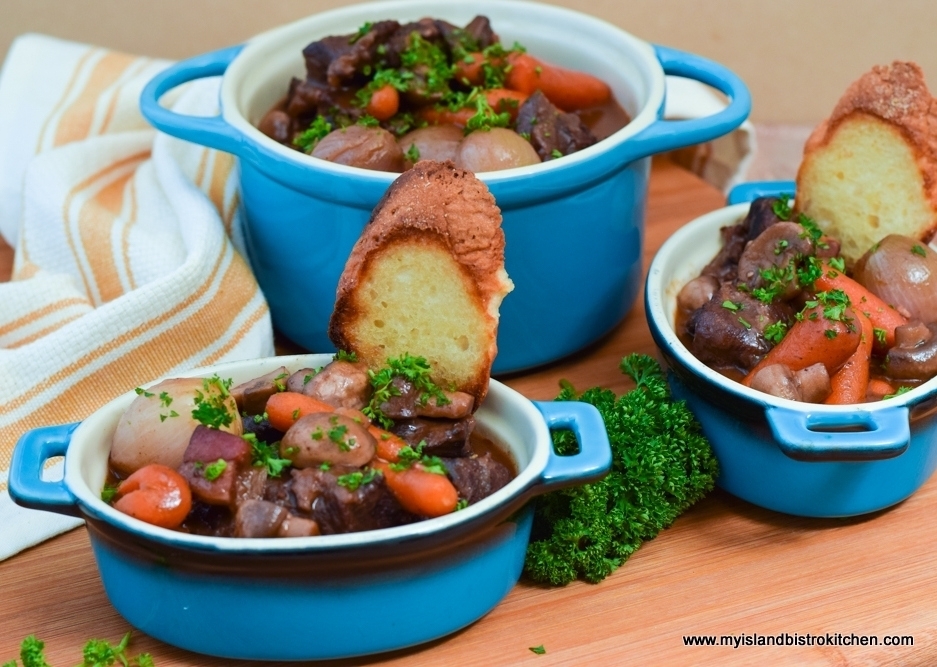
Beef Bourguignon can also be served on, or with, plain toast or garlic bread which can be used to soak up the flavorful sauce. You want to capture every last bite of this delectable sauce!
Bistro Style Beef Bourguignon
This dish freezes well and is part of my batch cooking repertoire. It reheats well in the microwave.
Bistro Style Beef Bourguignon
The recipe for Beef Bourguignon may look a bit complicated but it really is not if the process is organized. Read through the recipe and plan your work and you can produce restaurant-quality food at home. Measure out all the ingredients and do all the chopping and ingredient preparation before beginning the actual cooking.
[Printable recipe follows at end of post]
Beef Bourguignon
Ingredients:
For the bouquet garni:
3 sprigs fresh thyme
3 sprigs fresh parsley
2 large dried bay leaves
4 whole cloves
6” piece of celery rib
2 tsp olive oil
7 oz bacon lardons, cut into chunks approximately ¼“ – 1/3“ thick x 1” long
1½ – 2 lbs beef cheeks or beef chuck
3 tbsp cornstarch or flour
Fine sea salt
Freshly ground pepper
1½ tbsp brandy (or red wine)
1 tbsp olive oil
½ tbsp butter
½ cup onion, coarsely chopped
2 tbsp tomato paste
2 cloves garlic, chopped
1 2/3 cup dry red wine
1½ cups warm beef stock
1 tbsp butter
½ tbsp olive oil
12 oz baby carrots
8 – 10 small shallots or pearl onions
1 tbsp olive oil
1 tbsp butter
8 oz small button mushrooms, halved or quartered (depending on size of mushrooms)
½ cup dry red wine
Method:
Make a bouquet garni consisting of 3 sprigs each of fresh thyme and parsley tied with kitchen string/twine along with 2 large bay leaves. Insert 4 whole cloves into center of a 6” piece of celery rib. Tie the herbs and bay leaves to the celery rib. Set aside.
Heat 2 tsp olive oil in sauté pan over medium heat. Add the bacon lardons. Cook over medium-low heat for approximately 12-15 minutes, until lardons are crisp and brown and the fat has been rendered from the lardons. Remove the lardons with a slotted spoon and transfer to paper towel-lined bowl or plate. Reserve the rendered fat in the pan.
Pat beef dry with paper towel. Season the beef with salt and pepper and cut into chunks approximately 2” in size, removing any excess fat, tendons, and sinew.
Place the cornstarch or flour and the sea salt and pepper into small plastic bag. Shake well to mix. Set aside.
Increase the heat under the sauté pan containing the lardon fat to medium-high. Working in small batches, two to three chunks at a time, dredge the beef chunks in the cornstarch or flour mixture, shaking off any excess. Place the beef chunks in the hot pan, leaving space between each chunk. Sear the meat. Using tongs, turn the meat to brown all sides. Do not overcook – just cook long enough to brown the beef, a minute or two per side. Transfer the seared meat to a 4-quart Dutch oven, casserole dish, or small roaster.
Preheat oven to 275°F.
With the pan (in which the beef was seared) off the heat, add either 1½ tbsp brandy, red wine, or beef stock and stir. Return pan to medium-low heat and deglaze the pan by using a wooden spoon to scrape up any caramelized brown bits remaining in the pan after the meat was seared. Once all the brown bits have been loosened and mixed in with the deglazing liquid, add 1 tablespoon of olive oil then the ½ tablespoon of butter. Add the chopped onions and, over medium heat and stirring constantly, sauté until the onions begin to become translucent. Add the tomato paste and chopped garlic and stir to prevent burning, about 20-30 seconds.
Remove pan from heat and add 1 2/3 cups red wine to the onion-garlic mixture. Increase heat to high, return pan to heat, and bring mixture to a boil then immediately reduce heat to a slow boil. Boil slowly for 4-5 minutes to boil off the raw alcohol in the wine. Add the beef stock. Cook over low heat 2-3 minutes. Stir in half of the bacon lardons, reserving the remainder.
Transfer the onion, wine, beef stock, and lardon mixture to the casserole containing the seared meat. Add the prepared bouquet garni, pressing it gently into the braising liquid. The liquid should cover approximately one-half to two-thirds of the meat. Place lid on casserole dish and transfer it to the preheated oven and cook for about 2½ hours. If the braising liquid is still very thin at the 2½ hour point, add about 1 tablespoon of cornstarch or flour whisked together with 2 – 2½ tablespoons water or beef stock and some of the hot braising liquid to temper the mixture. Stir into braising liquid gently. Regardless whether additional thickening agent is added, return the casserole to oven to cook for 30 more minutes, or until meat is tender to the touch of a fork.
Meanwhile, add 1 tbsp olive oil and 1 tbsp butter to a clean sauté pan placed over medium high heat. Add the carrots and whole shallots or pearl onions. Stir fry for about 5 minutes until the carrots are slightly beginning to soften and both the carrots and onions are lightly tanned with color. Add the stir-fried vegetables to the meat casserole. Return the lid to the casserole and continue slow cooking for approximately 20 minutes. After the 20 minutes, if the braising liquid still does not coat the back of a spoon, add an additional ½ to 1 tablespoon cornstarch or flour mixed with 2 tablespoons beef stock or water and a little hot braising liquid, whisked together.
In clean sauté pan, over medium-high heat, heat 1 tbsp olive oil and 1 tbsp butter. Add the mushrooms and stir fry for 2 minutes. Sprinkle with salt and pepper and add the remaining lardons. Stir fry for 2-3 minutes longer then reduce heat to medium-low and add ½ cup red wine. Cook for 4-5 minutes longer at a very slow boil. Transfer mixture to the casserole and cook for 45 minutes longer, or until carrots are cooked and the beef breaks apart easily with the light pressure from a fork. Remove and discard the bouquet garni. Serve with whipped garlic potatoes, toasted French bread, or a crusty bread.
Yield: Apx. 8 servings
If you have made this recipe and enjoyed it and/or wish to share it with your friends and family, please do so on social media but be sure to share the direct link to this posting from my website.
Connect with My Island Bistro Kitchen on Social Media
Follow “the Bistro” on Pinterest at https://www.pinterest.ca/peibistro/ and pin the Pinterest-ready photo found at the end of this post to your favorite Pinterest boards.
One of the best French classic dishes, Beef Bourguignon is made with beef, pork, carrots, onions, and mushrooms all braised and slow cooked in a rich red wine and beef stock sauce
Course
Main Course
Cuisine
French
Keyword
Beef Bourguignon
Servings8
My Island Bistro KitchenMy Island Bistro Kitchen
Ingredients
3sprigs fresh thyme
3sprigs fresh parsley
2large dried bay leaves
4whole cloves
6” piece of celery rib
2tspolive oil
7ozbacon lardons, cut into chunks approximately ¼“ – 1/3“ thick x 1” long
1½ - 2lbsbeef cheeks or beef chuck
3tbspcornstarch or flour
Fine sea salt
Freshly ground pepper
1½tbspbrandy, or red wine
1tbspolive oil
½tbspbutter
½cuponion, coarsely chopped
2tbsptomato paste
2clovesgarlic, chopped
1 2/3cupdry red wine
1½cupswarm beef stock
1tbspcornstarch or flour
2– 2½ tbsp beef stock, or water
1tbspbutter
½tbspolive oil
12ozbaby carrots
8– 10 small shallots or pearl onions
1tbspolive oil
1tbspbutter
8ozsmall button mushrooms, halved or quartered (depending on size of mushrooms)
½cupdry red wine
Instructions
Make a bouquet garni consisting of 3 sprigs each of fresh thyme and parsley tied with kitchen string/twine along with 2 large bay leaves. Insert 4 whole cloves into center of a 6” piece of celery rib. Tie the herbs and bay leaves to the celery rib. Set aside.
Heat 2 tsp olive oil in sauté pan over medium heat. Add the bacon lardons. Cook over medium-low heat for approximately 12-15 minutes, until lardons are crisp and brown and the fat has been rendered from the lardons. Remove the lardons with a slotted spoon and transfer to paper towel-lined bowl or plate. Reserve the rendered fat in the pan.
Pat beef dry with paper towel. Season the beef with salt and pepper and cut into chunks approximately 2” in size, removing any excess fat, tendons, and sinew.
Place the cornstarch or flour and the sea salt and pepper into small plastic bag. Shake well to mix. Set aside.
Increase the heat under the sauté pan containing the lardon fat to medium-high. Working in small batches, two to three chunks at a time, dredge the beef chunks in the cornstarch or flour mixture, shaking off any excess. Place the beef chunks in the hot pan, leaving space between each chunk. Sear the meat. Using tongs, turn the meat to brown all sides. Do not overcook – just cook long enough to brown the beef, a minute or two per side. Transfer the seared meat to a 4-quart Dutch oven, casserole dish, or small roaster.
Preheat oven to 275°F.
With the pan (in which the beef was seared) off the heat, add either 1½ tbsp brandy, red wine, or beef stock and stir. Return pan to medium-low heat and deglaze the pan by using a wooden spoon to scrape up any caramelized brown bits remaining in the pan after the meat was seared. Once all the brown bits have been loosened and mixed in with the deglazing liquid, add 1 tablespoon of olive oil then the ½ tablespoon of butter. Add the chopped onions and, over medium heat and stirring constantly, sauté until the onions begin to become translucent. Add the tomato paste and chopped garlic and stir to prevent burning, about 20-30 seconds.
Remove pan from heat and add 1 2/3 cups red wine to the onion-garlic mixture. Stir. Increase heat to high, return pan to heat, and bring mixture to a boil then immediately reduce heat to a slow boil. Boil slowly for 4-5 minutes to boil off the raw alcohol in the wine. Add the beef stock. Cook over low heat 2-3 minutes. Stir in half of the bacon lardons, reserving the remainder.
Transfer the onion, wine, beef stock, and lardon mixture to the casserole containing the seared meat. Add the prepared bouquet garni, pressing it gently into the braising liquid. The liquid should cover approximately one-half to two-thirds of the meat. Place lid on casserole dish and transfer it to the preheated oven and cook for about 2½ hours. If the braising liquid is still very thin at the 2½ hour point, add about 1 tablespoon of cornstarch or flour whisked together with 2 – 2½ tablespoons water or beef stock and some of the hot braising liquid to temper the mixture. Stir into braising liquid gently. Regardless whether additional thickening agent is added, return the casserole to oven to cook for 30 more minutes, or until meat is tender to the touch of a fork.
Meanwhile, add 1 tbsp olive oil and 1 tbsp butter to a clean sauté pan placed over medium high heat. Add the carrots and whole shallots or pearl onions. Stir fry for about 5 minutes until the carrots are slightly beginning to soften and both the carrots and onions are lightly tanned with color. Add the stir-fried vegetables to the meat casserole. Return the lid to the casserole and continue slow cooking for approximately 20 minutes. After the 20 minutes, if the braising liquid still does not coat the back of a spoon, add an additional ½ to 1 tablespoon cornstarch or flour mixed with 2 tablespoons beef stock or water and a little hot braising liquid, whisked together.
In clean sauté pan, over medium-high heat, heat 1 tbsp olive oil and 1 tbsp butter. Add the mushrooms and stir fry for 2 minutes. Sprinkle with salt and pepper and add the remaining lardons. Stir fry for 2-3 minutes longer then reduce heat to medium-low and add ½ cup red wine. Cook for 4-5 minutes longer at a very slow boil. Transfer mixture to the casserole and cook for 45 minutes longer, or until carrots are cooked and the beef breaks apart easily with the light pressure from a fork. Remove and discard the bouquet garni. Serve with whipped garlic potatoes, toasted French bread, or a crusty bread.
I love a bowl of chili, especially on a cold fall or winter day. I also like the chili to have lots of texture and flavour and to be well-filled, hearty, and not be too watery. This recipe for Chicken and Pumpkin Chili has a lovely flavour profile owing to the selection of ingredients and a curated blend of spices to complement the core ingredients. Continue reading Chicken and Pumpkin Chili→
If you are a regular follower of my food blog, you will know that I do all I can to maximize the value of food products and reduce food waste. In my view, one of the best buys to extend meals is a turkey. Not only does it generate a wonderful roast turkey dinner but there is tremendous goodness left in the carcass and, often, there is more meat than can be used up as cold turkey and it can be transformed into other dishes. Or, sometimes, one just gets tired of the turkey before it is all used up so a great way to maximize it is to turn it into a delectable Turkey Vegetable Soup.
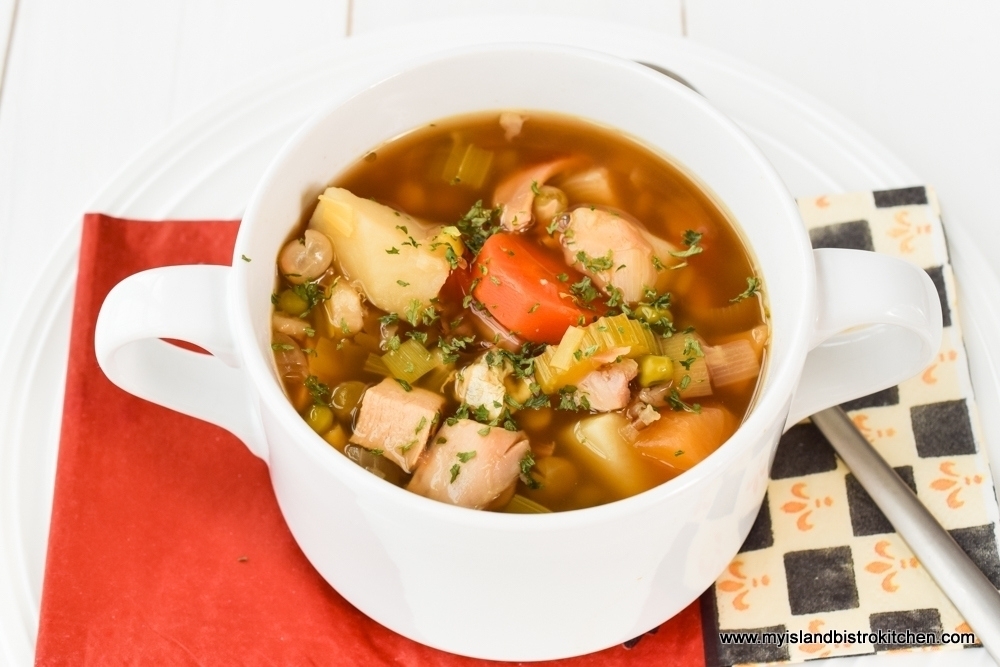
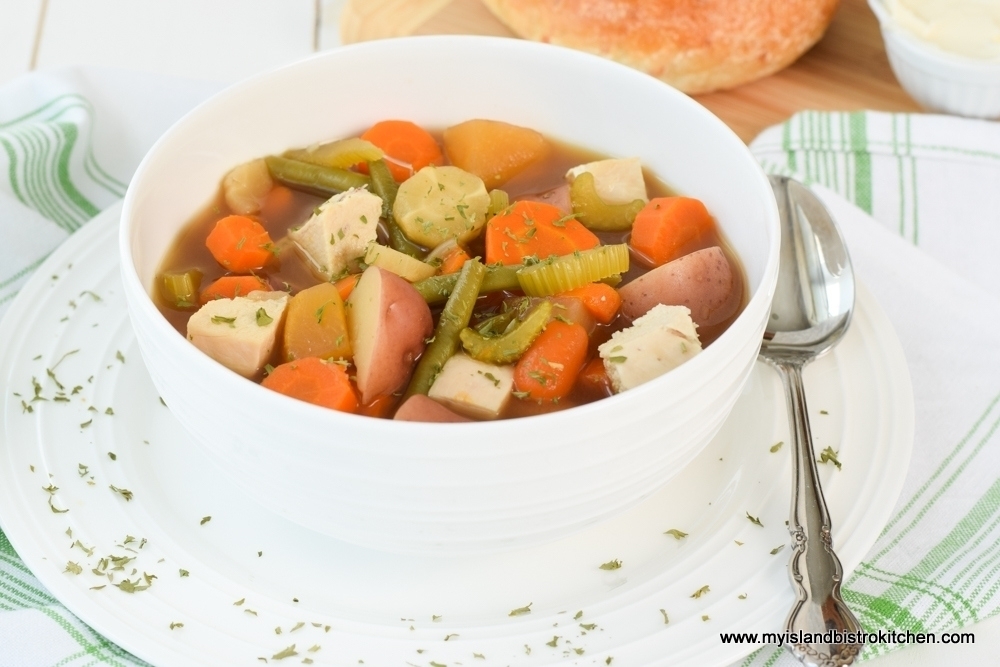
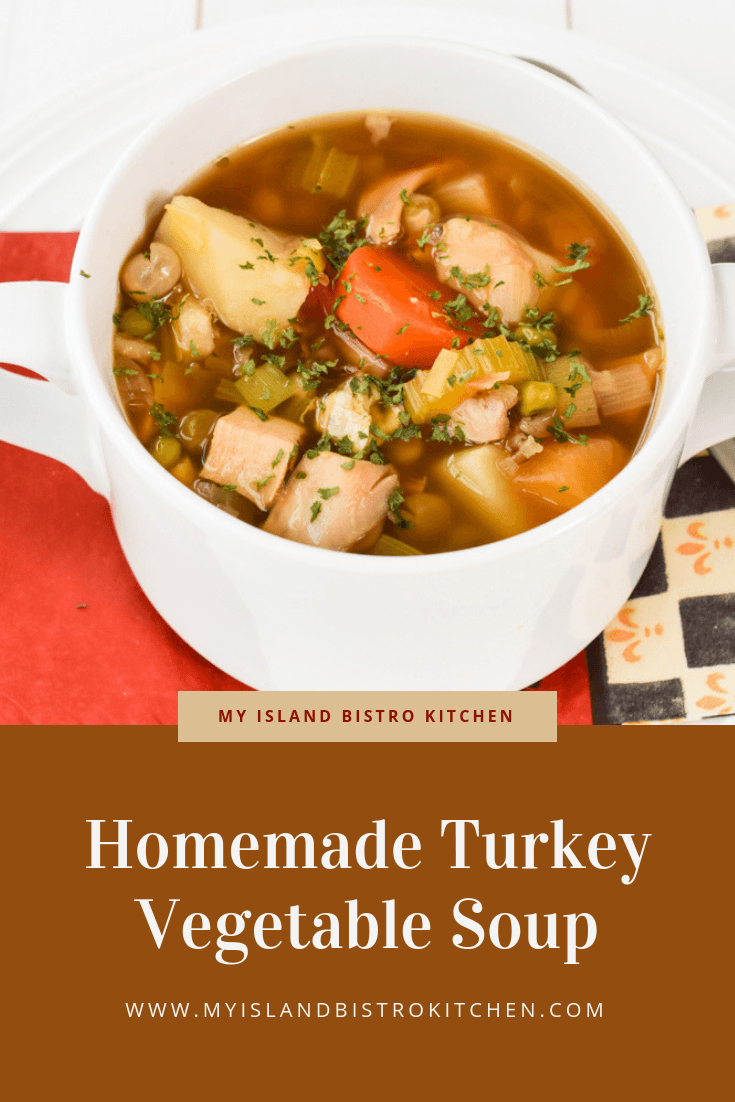
Homemade Turkey Vegetable Soup
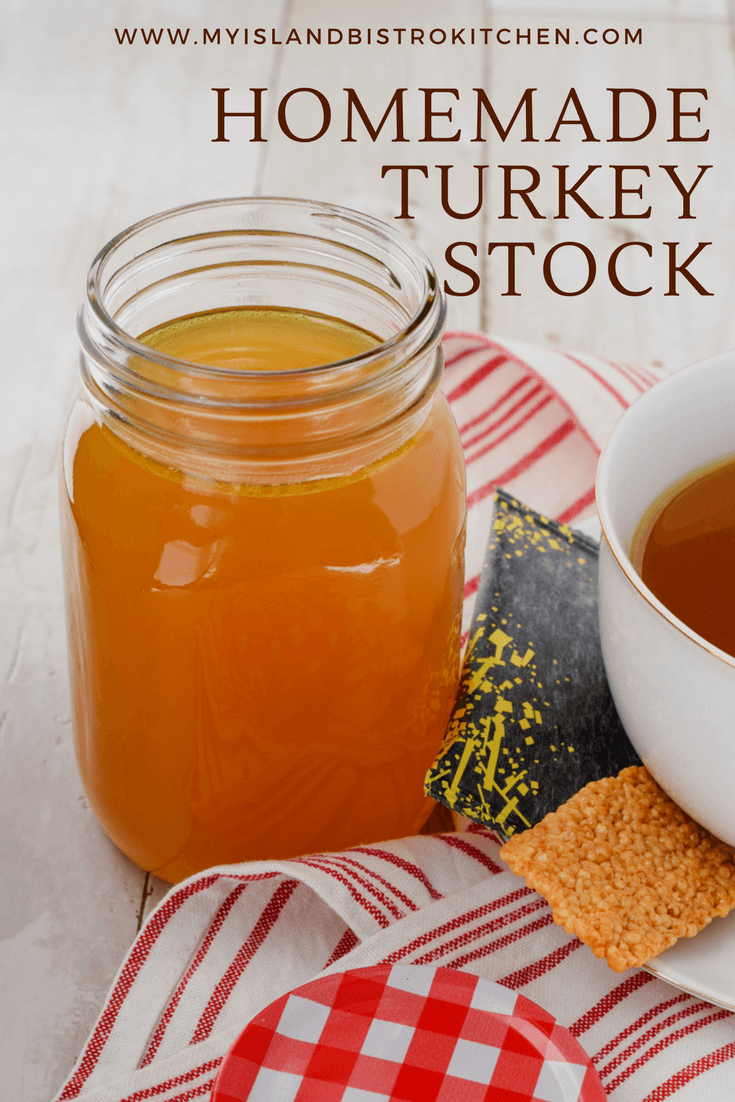
The first thing I do after a roast turkey dinner is strip off all the remaining usable meat from the turkey carcass. I will either immediately make homemade turkey stock with the carcass or freeze it in an airtight freezer bag and make the stock later. You can find my recipe for making turkey stock by clicking here. If the plan is not to make the Turkey Soup right away, I suggest setting aside 3-4 cups of the turkey meat and freezing it in an airtight freezer bag to have ready to drop in to the soup when it is later made.
Homemade Turkey Stock
Homemade Turkey Vegetable Soup is both delicious and nutritious and my version of this wholesome soup freezes well. The recipe makes a big batch (about 18-20 servings) though it may be halved. However, if freezer space is available for the soup, it is mighty handy to have on hand for later use.
Now I do, of course, recommend that homemade turkey stock be used as the foundation for this soup because it is wholesome and free of preservatives. However, commercially-made stock/broth may be used in its place.
Homemade Turkey Vegetable Soup
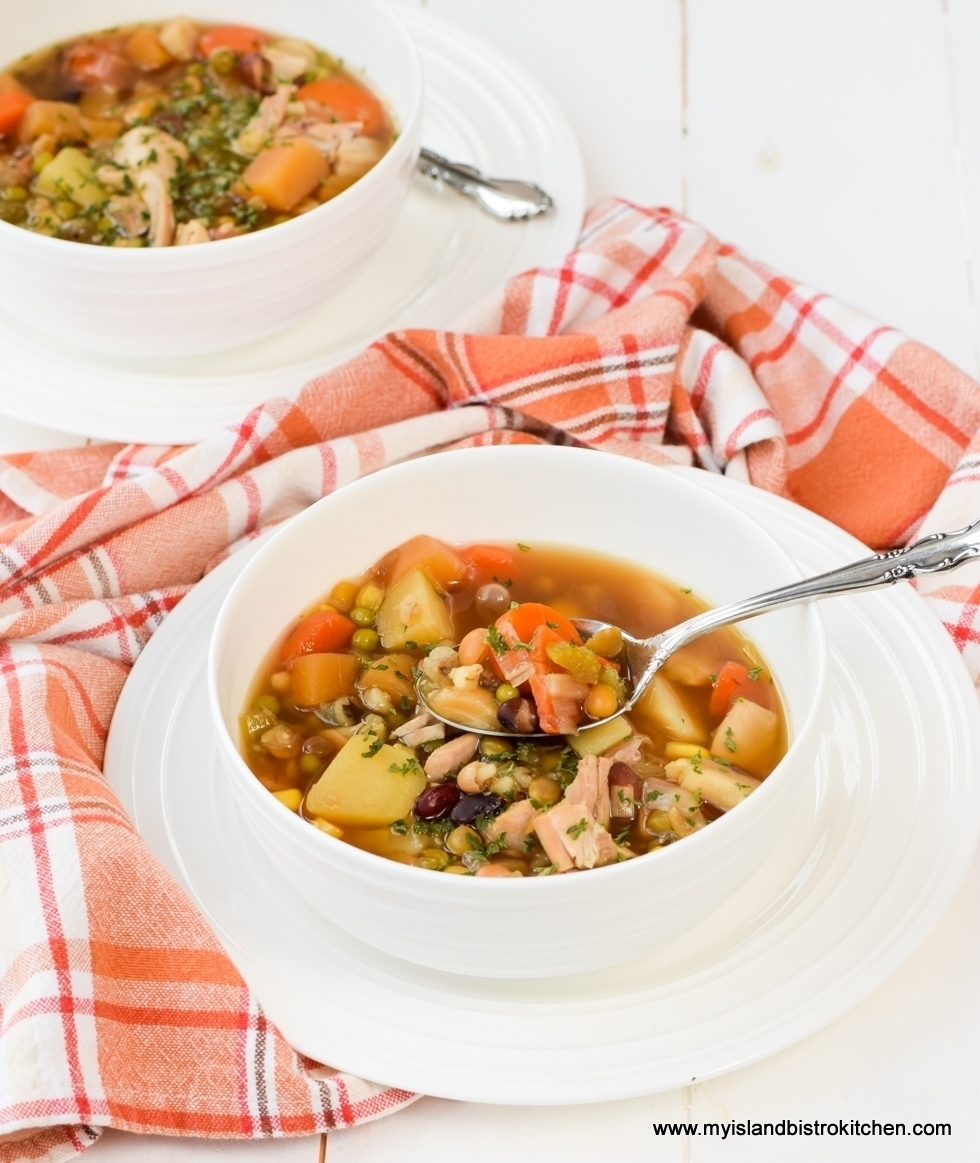
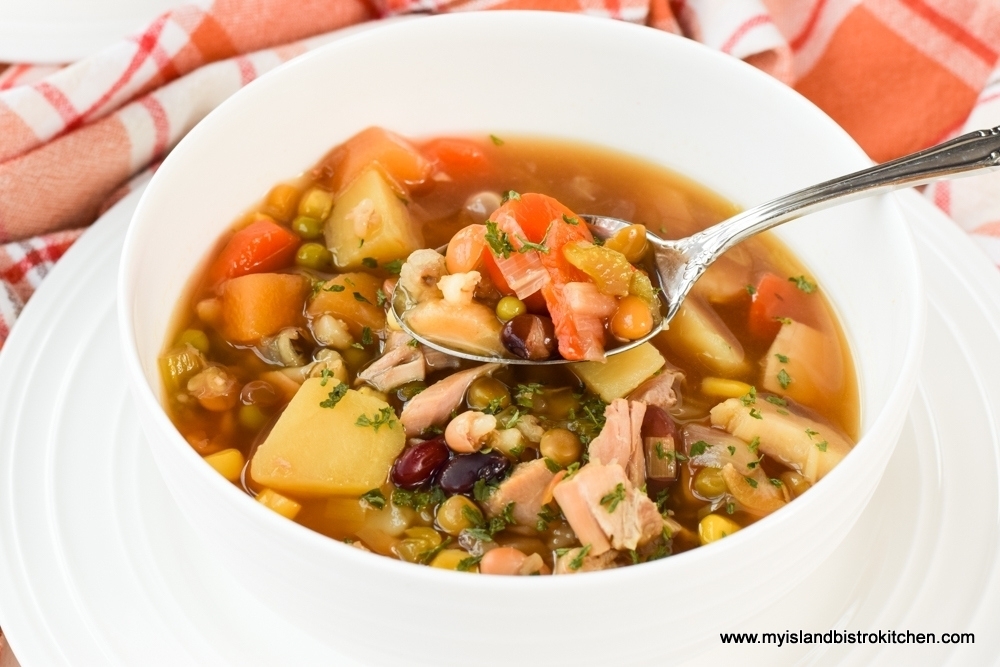
I recommend a careful reading of my recipe for this soup before beginning to make it as there are some steps involved and probably a shopping trip, too. To begin, I typically use a dry soup mix comprised of beans, lentils, split peas, pearl barley, and white rice. I buy this bulk at my local bulk food store and this mix does require a bit of pre-soaking, cooking, and standing time before it is incorporated into the soup pot. Otherwise the contents of the mix will not cook in the amount of time it takes to cook the remaining ingredients of the soup. So, time will need to be allotted for that activity. While using this mix adds fibre and bulk to the soup, the soup may be made without it and several photos in this posting show soup made without the dry soup mix. If making the soup minus the dry soup mix, simply increase slightly the quantity/amount of fresh and/or frozen vegetables called for in the recipe so that the soup is filled with goodness and is not too runny.
For this Turkey Vegetable Soup, I am not starting out with the traditional pure mirepoix because that requires that the aromatic holy trinity of carrots, celery, and onion be chopped really fine. In this soup, I want those ingredients to be left larger, in bite-size chunks. However, I do sauté them, along with the parsnip and leek for 2-3 minutes to start the release of their flavours along with the garlic.
Homemade Turkey Vegetable Soup
Because I use my own homemade stock which already has some seasonings added, I don’t add huge amounts of seasonings to the soup and this is one soup that I do not like overly spiced or seasoned. One flavour booster I have found that works really well in this Turkey Vegetable Soup is dry onion soup mix so I add a couple of tablespoons along with small amounts of thyme, summer savory, turmeric, paprika, ground coriander, cloves, and nutmeg and, of course, the standard bay leaves. As always, I recommend, when making a recipe for the first time, to make it with the ingredients and amounts called for by the recipe creator. If, after you have tried it as it has been developed, you find it needs more or less of a seasoning to suit your personal taste, the adjustments can be noted and made in the next batch.
Homemade Turkey Vegetable Soup
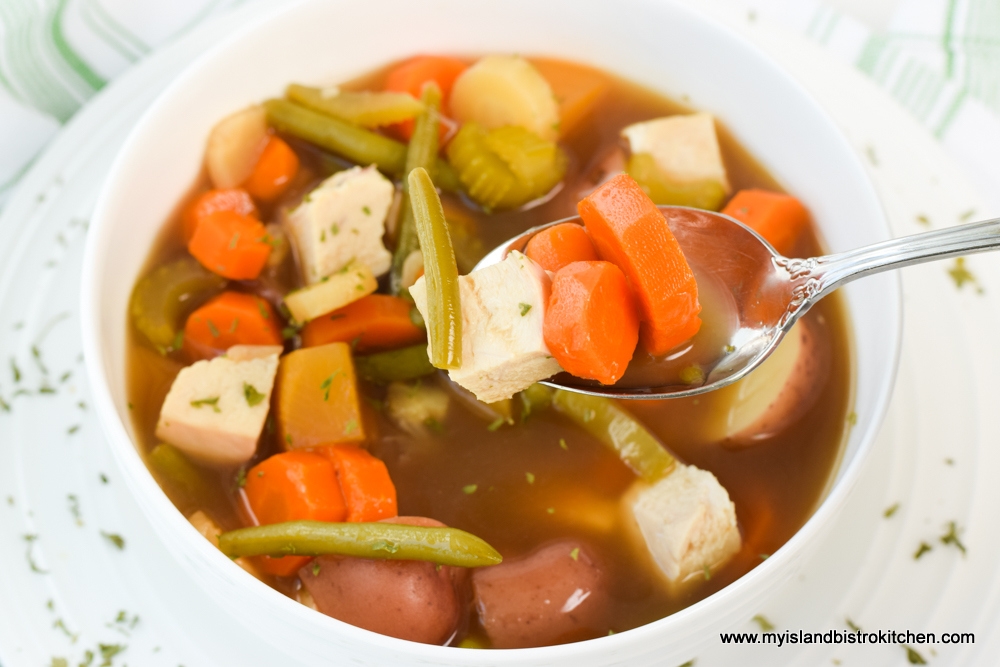
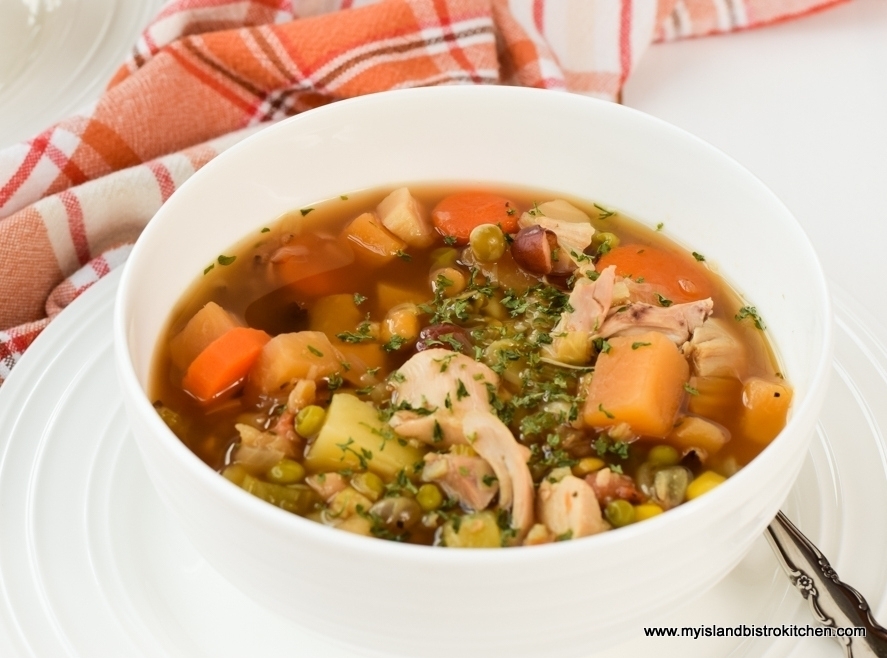
I like rutabaga so add a fair bit of it to the soup. It adds both substance and some sweetness to the soup. Sometimes, I will make this soup with peeled cubed potatoes (seen in photo above) and, other times, I will make it a little more rustic, using the mini red potatoes with their skins on (as shown in photo below). Either works.
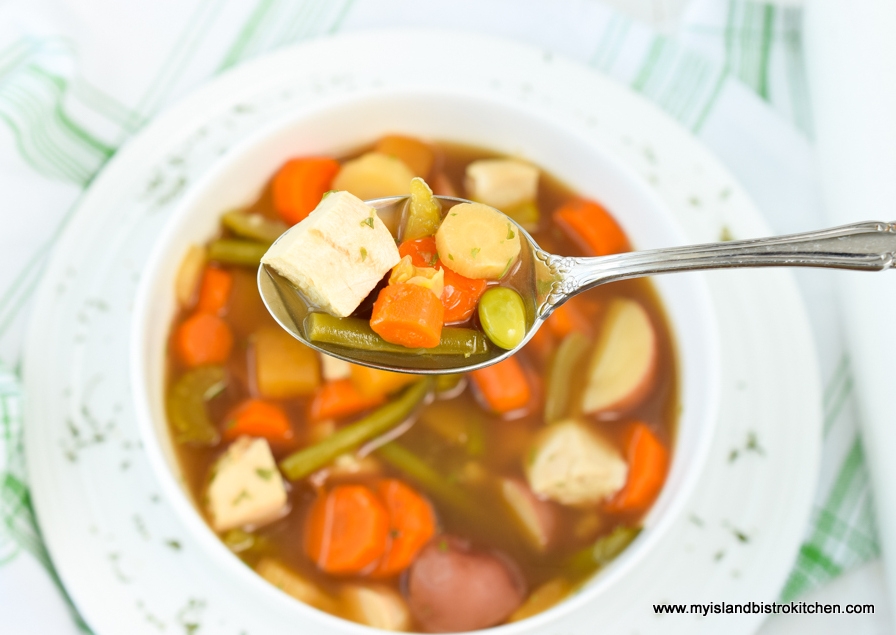
Turkey Vegetable Soup
Nearer the end of the cooking process, add 1 1/2 cups of frozen vegetables. This can be either corn, peas, or mixed vegetables – any on their own or in any combination to make up 1 1/2 cups. I like the soup well filled! One nice thing about this kind of soup is that if you don’t like, for example, peas, then simply replace them with another vegetable you prefer.
The cooked turkey may either be cubed (as shown in photo above) or coarsely shredded (as seen in photo below) for this soup. Making turkey soup is a great way to use up light and/or dark meat left on the turkey. It only needs about 5 minutes in the soup for it to heat. Don’t re-cook the meat as it will become tough and it will lose its flavour.
In large saucepan, soak the dry soup mix in 3 cups of cold water for 2 hours. Bring to a boil, covered, over medium-high heat. Reduce heat to low and boil gently for 2 minutes. Remove from heat and let stand 1 hour. Drain.
In large stockpot, over medium heat, melt the butter then add the olive oil. Add the onions, carrots, parsnip, celery, and leek. Sauté for 2-3 minutes, stirring briskly. Add the garlic and, stirring constantly, cook for 1 minute longer.
Add the turkey stock, cover, and bring just to the boiling point but do not boil. Add the dry onion soup mix and spices along with the bay leaves. Add the rutabaga and drained soup mix of beans, lentils, peas, etc. Cook gently, partially covered, over medium-low heat for about 30 minutes. Season with salt and pepper to taste.
Add the potatoes and cook, partially covered, for about 10-12 minutes before adding the frozen vegetables. Cook for an additional 15-20 minutes, or until vegetables are cooked. Add the cooked turkey and simmer for 5 minutes or so, just until the turkey is heated. Season with salt and pepper to taste.
Remove bay leaves and ladle soup into bowls. Soup freezes well.
Yield: Approximately 18-20 servings (1¼ cup serving size)
You may also like this recipe for My Island Bistro Kitchen’s Homemade Turkey Chowder.
Homemade turkey stock, leftover turkey, and loads of vegetables combine with light seasoning to make a delicious and nutritious turkey vegetable soup.
Course
Soup
Cuisine
American
Keyword
Turkey Soup
Servings18
My Island Bistro KitchenMy Island Bistro Kitchen
Ingredients
1cupdry soup mix of beans(lentils, split peas, pearl barley, and white rice)
3cupscold water
3– 4 tbsp butter
1tbspolive oil
1cuponion,coarsely chopped
2cupscarrots(about 3 large), cut into bite-sized chunks
1½cupsparsnip(about 2 large), cut into bite-sized pieces
1cupcelery(1 large celery rib), sliced
1leek,white and green parts only, sliced
5-6clovesof garlic,minced
12cupsturkey stock
2tbspdry onion soup mix
1tspdried summer savory
¾tspdried thyme
¼tspturmeric
¼tsppaprika
1/8tspground coriander
1/8tspcloves
1/8tspnutmeg
2bay leaves
1¾cupsrutabaga,cut into bite-sized chunks
1lbmini red potatoesunpeeled, halved or quartered depending on their size or, alternatively, 2 cups peeled potatoes, cubed
1½cupsfrozen vegetables(peas, corn, or mixed vegetables)
3 - 4cupscooked turkey meat,cubed or coarsely shredded
Salt and pepper,to taste
Instructions
In large saucepan, soak the dry soup mix in 3 cups of cold water for 2 hours. Bring to a boil, covered, over medium-high heat. Reduce heat to low and boil gently for 2 minutes. Remove from heat and let stand 1 hour. Drain.
In large stockpot, over medium heat, melt the butter then add the olive oil. Add the onions, carrots, parsnip, celery, and leek. Sauté for 2-3 minutes, stirring briskly. Add the garlic and, stirring constantly, cook for 1 minute longer.
Add the turkey stock, cover, and bring just to the boiling point but do not boil. Add the dry onion soup mix and spices along with the bay leaves. Add the rutabaga and drained soup mix of beans, lentils, peas, etc. Cook gently, partially covered, over medium-low heat for about 30 minutes. Season with salt and pepper to taste.
Add the potatoes and cook, partially covered, for about 10-12 minutes before adding the frozen vegetables. Cook for an additional 15-20 minutes, or until vegetables are cooked. Add the cooked turkey and simmer for 5 minutes or so, just until the turkey is heated.
Remove bay leaves and ladle soup into bowls. Soup freezes well.
Recipe Notes
Yield: Approximately 18-20 servings (1¼ cup serving size)
[Copyright My Island Bistro Kitchen]
If you have made this recipe and enjoyed it and/or wish to share it with your friends and family, please do so on social media but be sure to share the direct link to this posting from my website.
Connect with My Island Bistro Kitchen on Social Media
Follow “the Bistro” on Pinterest at https://www.pinterest.ca/peibistro/ and pin the Pinterest-ready photos found at the end of this post to your favorite Pinterest boards.
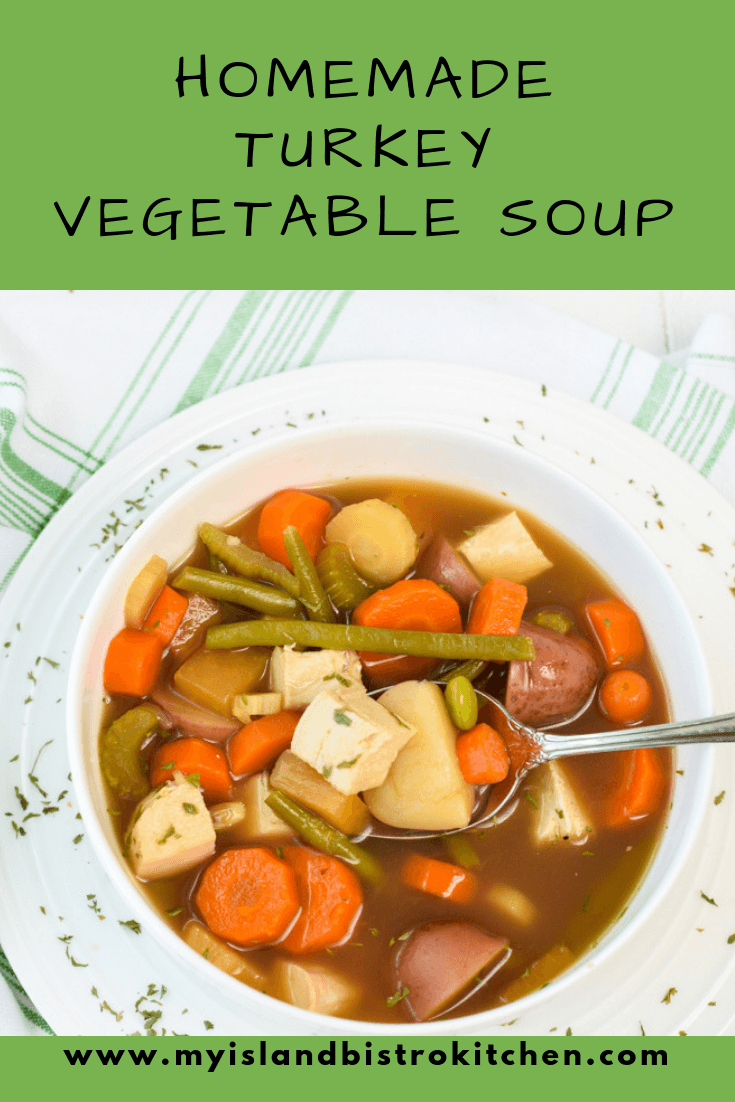
Pin Me To Pinterest!
Homemade Turkey Vegetable Soup
You may also enjoy these other soup and chowder recipes from My Island Bistro Kitchen: